


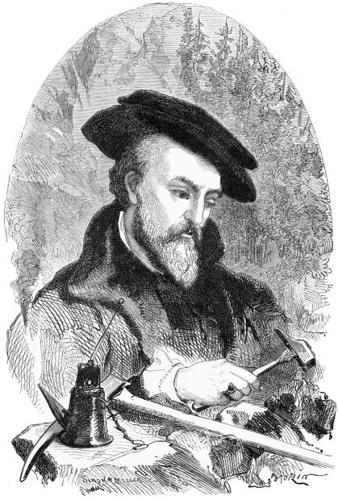
Modern mineral collecting has its roots in the 16th century. Georgius Agricola (1494-1555), a German scientist and father of mineralogy and mineral collecting, published “De Re Metallica,” a treatise on mining, and “De Natura Fossilium,” considered the earliest mineralogy textbook. At the time, minerals were called fossils and mineralogy was in its infancy.
By the end of the 18th century, prominent mineral collections were found in Europe and the United States, mainly among the moneyed class.
Thomas Barton (1730-1780) and his sons William Barton (1754-1817) and Benjamin Smith Barton (1766-1815) collected North American minerals, including specimens of tin.
Barton is credited with having taught Meriwether Lewis (of the Lewis and Clark expedition) proper nomenclature and identification of mineral specimens.
People are also reading…
Founded in 1792, the Chemical Society of Philadelphia was one of the earliest groups devoted to the study of mineralogy in the United States.
During the 19th century, mineral collecting became more widespread in the United States, including in the Arizona Territory, with spectacular copper minerals acquired in Bisbee by Dr. James Douglas and Ben Williams, both Phelps, Dodge & Co. affiliates.
William Phipps Blake (1826-1910), territorial mineralogist for Arizona and compiler of the first independent list of minerals found in the Arizona Territory, in 1909, and Arthur L. Flagg (1883-1961), a mining engineer and Arizona Department of Mineral Resources museum curator, ensured Arizona would lay a strong foundation for mineral collecting in the 20th century that would culminate in a greater interest, appreciation and participation among the masses.
After World War II, there was a surge in mineral collecting and mineral shows as returning servicemen sought out a hobby. In December 1946, a group of rockhounds in Tucson formed what became the Tucson Gem & Mineral Society.
Organized field trips and lectures followed, featuring speakers such as Dr. John Anthony, a University of Arizona mineralogy professor who would go on to co-author “Mineralogy of Arizona,” and Dr. Harvey H. Nininger, renowned meteorite collector.
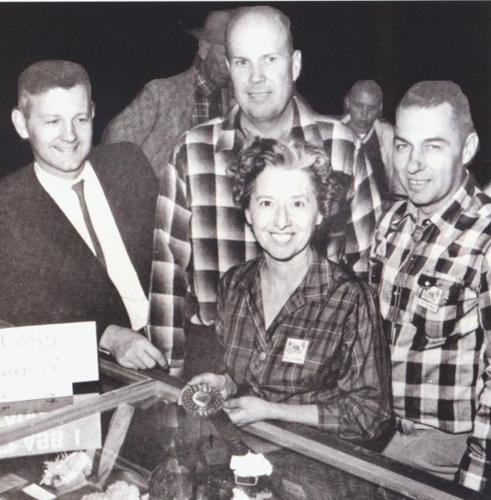
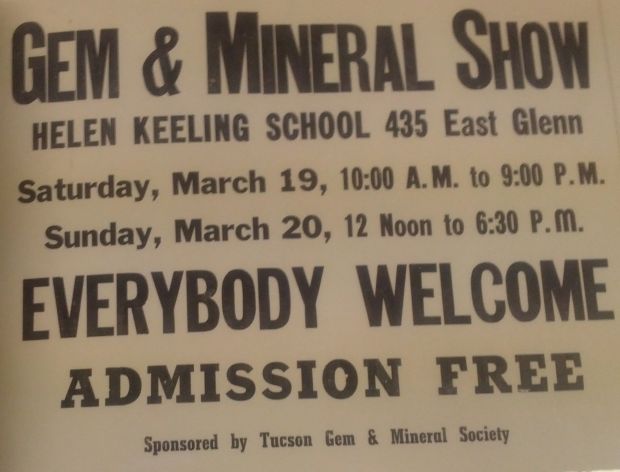
Early founders of the Tucson Gem & Mineral Show included Dan Caudle and Clayton Gibson, who along with their wives and a group of devoted volunteers, were responsible for planning and putting on the first Tucson Gem & Mineral Show March 19-20, 1955, at Helen Keeling Elementary School.
The first show boasted free admission and included 1,500 visitors and at least nine dealers. Richard Bideaux and Gene Schlepp, later prominent Tucson mineral dealers, would win several ribbons for their mineral displays.
The next year, the show was moved to a Quonset hut at the Pima County Fair and Rodeo Grounds on South Sixth Avenue, where it stayed until 1972.
Factors that helped the show grow included the leadership of the Tucson Gem & Mineral Society, Arizona’s vast mineral wealth and abundant mining localities coupled with the accessibility of exquisite mineral specimens from all over the Southwest, proximity to Mexico — a proven tourist destination — and our mild winter climate.
By 1960, the show had more than 25 dealers and 3,500 visitors who paid a 25-cent admission fee.
Smithsonian Institution gem and mineral curator Paul Desautels accepted show chairman Clayton Gibson’s invitation to bring displays and participate in the 1961 Tucson show, resulting in a landmark change in how future shows were organized.
William Ascarza is an archivist, historian, author and member of the Tucson Gem & Mineral Society. His latest book, “The Chiricahua Mountains: History and Nature,” will be available Tuesday at Barnes and Noble online. Email him at mining@azstarnet.com
Sources: Ferry, Elizabeth Emma. 2013. “Minerals, Collecting, and Value Across the U.S.-Mexico Border.” Indiana University Press; Jones, Robert W. 2004. “50-Year History of the Tucson Show.” Tucson Gem and Mineral Society. The Mineralogical Record Inc.; Rutschky Jr., Charles W. “Thomas Barton’s Collection of Minerals.” Pennsylvania History, Vol. 8, No. 2 (April, 1941); Tucson Gem & Mineral Society Archive; Wilson, W.E. “The History of Mineral Collecting, 1530-1799: With Notes on Twelve Hundred Early Mineral Collectors: Mineralogical Record” 25(6). 1994.


 Nancy Guthrie's Tucson neighbors: Life with streamers 'unbearable'


