

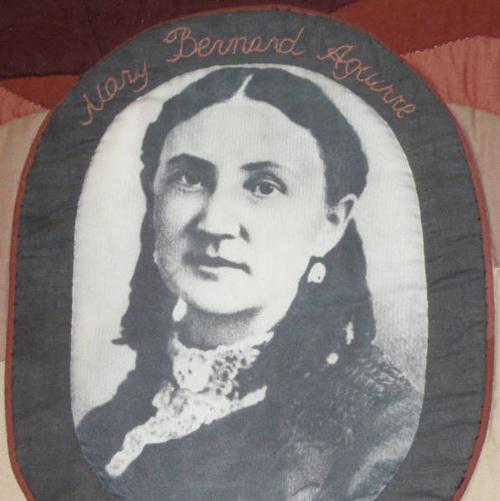
Curly-haired Mary Bier Bernard probably had no idea what was in store for her when she married 29-year-old Mexican-born Epifanio Aguirre on Aug. 21, 1862, but the world she had known for the past 18 years was about to change dramatically.
Born June 23, 1844 in St. Louis, Mary grew up in Westport, Missouri, one of the largest trading centers on the Missouri River. Epifanio drove mule and oxen trains along the Santa Fe Trail, delivering supplies to Army posts throughout the Southwest. He and his men brought huge wagonloads of materials up from Chihuahua, Mexico, to Westport Landing.
In March 1863, as Epifanio readied his men to return to Mexico for another shipment of goods, he was keenly aware of the conflict that divided the U.S. Skirmishes between Northern and Southern troops were rampant along the Missouri-Kansas border, making movement through the region extremely dangerous. He dare not take Mary with him, particularly since she was expecting their first child.
People are also reading…
When he returned to Westport that August with a load of wool from Altar, Sonora, he met his new son, Pedro, who was born June 26. By September, he was ready to get his wagons back on the road. This time, Mary would not be left behind.
That September, the couple and 3-month-old Pedro left Westport for Las Cruces, New Mexico. Epifanio and his men were hauling 10,000 pounds of freight in 10 wagons with 10 mules each.
Mary thoroughly enjoyed the 1,300-mile adventure and found her accommodations in the large rustic ambulance “marvels of comfort.” She relished the pockets in the doors where she could store combs, brushes and a looking glass.
“I was like a child,” she said, “with no more knowledge of the responsibilities of life or the care of a baby and only glad to leave that cruel war and its horrors behind.”
The wagons arrived in Las Cruces three months later. By March, Epifanio was again on the road, leaving Mary and Pedro at the hacienda of his parents, Don Pedro and Doña Maria de Refugio Aguirre.
Mary made three more trips along the Santa Fe Trail and bore two more children. Epifanio Jr. was born in Las Cruces on May 12, 1865; Stephen arrived Feb. 4, 1867, while the family was back in Westport.
In 1869, two of Epifanio’s supply trains were destroyed, one in an Indian raid and the other by fire. He moved his family from Las Cruses to Altar, Sonora, where he and his brothers owned several businesses.
One of the family enterprises was operating a stagecoach that made regular trips from Altar to Tucson. On Jan. 16, 1870, Epifanio took the reins of the stage and headed for Tucson. Near Sasabe Flats, Apaches descended on the stage, killing Epifanio.
Mary and her sons returned to Westport but in 1875, with Arizona desperately needing schoolteachers, she returned here to teach in the tiny community of Tres Álamos, just north of present-day Benson. Taking 8-year-old Stephen with her, she left her two older boys in Tucson in the care of Epifanio’s brother, Pedro.
The little adobe schoolhouse at Tres Álamos had no desks, chairs or blackboards and Mary found few school supplies for her 23 students. She rounded up boxes for tables, although the children had to sit on the floor for their lessons.
In April 1876, an Apache warrior walked into Mary’s classroom. As the man sat down and began looking through one of the textbooks, Mary calmed the children and continued the class. He finally stood and walked out.
Within the week, a nearby Indian attack claimed the lives of an entire family. Many in the area believed the schoolhouse Indian had been closely watching the community.
With her students fearful of leaving home, Mary and Stephen returned to Tucson where she found a job teaching at the Tucson Public School for Girls. The 20 girls in her classroom, according to Mary, “were the most unruly set of girls the Lord ever let live. They had an idea they conferred a favor upon the school and teacher by attending.”
When the girls climbed out the school’s windows and romped through the streets, Mary rounded them up and confined her disobedient charges to the schoolhouse.
The next day, unhappy with their new schoolmarm, several students failed to appear. By the end of the week, only five girls remained in the class.
Mary told Territorial Gov. Anson P.K. Safford she had “broken up your girls’ school trying to keep order.” Safford laughingly told his new teacher she should continue her discipline with his blessing.
The next week, all the girls were back in their seats and behaved for the rest of the term.
Mary left the Tucson school in 1878. That same year, 13-year-old Epifanio Jr. was killed by lightning.
She headed 60 miles south of Tucson to the ranching community of Arivaca to become the community’s first educator. Over the next 10 years, her work at the Arivaca school attracted the attention of officials at the University of Arizona. In 1896, she was asked to take the position as head of the University’s Spanish Language Department.
The Tucson Daily Citizen reported, “Mrs. Aguirre is a lady of exceptional talent, and educated both in Spanish and English to a degree which is a perfect guarantee of the excellent service she will render.” The faculty and students knew the petite teacher as “the cheerful little professor with ringlets.”
Her son Pedro eventually settled on a ranch in Southern Arizona while Stephen found his home in San Francisco. On May 9, 1906, Mary boarded a Southern Pacific train for the coast. Train travel now made the journey much easier than those days when she knocked about in the bed of a rough, crude wagon along the Santa Fe Trail.
Near San Juan, California, the train abruptly jumped the tracks, tumbling passengers into a pile of broken bones. On May 24, 61-year-old Mary died from complications of the train wreck.
“No woman in the Southwest was better known than Mrs. Aguirre,” read her obituary. “She was a recognized authority on the history of New Mexico, Arizona, and Sonora.”
Mary Aguirre is considered the first woman professor at the University of Arizona.
Jan Cleere is the author of four historical nonfiction books about the early people of the Southwest. Email her at Jan@JanCleere.com
Sources:
Mary Bernard Aguirre, “Spanish Trader’s Bride,” The Westport Historical Quarterly, Vol. IV, No. 3 (December 1968)
Aguirre papers, 1859-1976 (bulk 1907-1975), MS 0007, Arizona Historical Society.
Annette Gray, “Journey of the Heart: The True Story of Mamie Aguirre (1844-1906), A Southern Belle in the ‘Wild West,’” Graytwest Books, 2004
Nedra P. Suderland, “Mary Belle Bernard Aguirre: First Teacher at Tres Alamos,” Cochise County Historical Journal. Vol. 28, No. 1 (Spring/Summer 1998),
“The Journal of Mamie Bernard Aguirre,” Jackson County Historical Society, Spring 1966
Roscoe Willson, “Freighters Lived Dangerously,” The Arizona Republic’s Arizona Magazine, August 18, 1968


 Nancy Guthrie's Tucson neighbors: Life with streamers 'unbearable'


