

When the 5,800 runners compete in the Buffalo Marathon on Sunday, they will start downtown, take in parts of Delaware Avenue and wind up back at the post-race party at the Buffalo Niagara Convention Center.
During that 26-mile run, they will see what some might consider the best this community has to offer: Marcy Casino on Hoyt Lake, Babeville, the Saturn Club and parts of the Lower West Side’s Hispanic Heritage District.
What they won’t see, as one colleague suggested, is what another part of the city has to offer, and what that part of the city could be with more support.
They would only see that if, instead of the traditional route, the marathon took them through the heart of the African American community, the same community devastated by a racist gunman who murdered 10 Blacks in the Tops Market on Jefferson Avenue based on his own ignorance of Black life.
People are also reading…
It is not hard to imagine that the same media and social media stereotypes that fueled the gunman also infect, to a lesser degree, the developers, bankers, doctors, lawyers and others who will never kill anyone but who nevertheless can impact how Black Buffalo does or does not grow and prosper.
It is not hard to imagine that projecting the same sense of “other” onto people deemed not worthy of living can, to a lesser degree, also deem them not worthy of a business loan, a mortgage, a job or of having their restaurants, stores and shops patronized – until you get to know them.
But it is also not hard to imagine that hosting large, popular events in the Black community – instead of walling it off from Buffalo’s civic life – could chip away at those very stereotypes.
Could such events really be held in the Cold Spring community around Tops and other such neighborhoods? There already is a template.
At its inception in 2014, Slow Roll Buffalo was very intentional about routing its Monday evening bike rides through such areas. The very first ride incorporated the Central Terminal and Martin Luther King Jr. Park neighborhoods.
With residents waving from their porches and stops at businesses and community landmarks on each ride, participants not familiar with the community get to see a different side of Black life than the one often portrayed in the media.
In addition, after deliberate efforts to diversify Slow Roll’s ridership – partnering with the East Side Bike Club, for instance – participants get to interact one-on-one with people they otherwise would never meet.
“When you’re with a group of people, there are always opportunities for conversation and education,” said Slow Roll President Janelle Brooks, who lives in Cold Spring and whose mother and uncle were in the Tops shortly before the massacre.
That interaction cannot help but break down stereotypes. As an example, Brooks cited trash piled up on sidewalks. It can easily lead to the impression that “those people” are slovenly – until a fellow rider explains the city’s bulk trash collection schedule.
The rides offer an opportunity to “get to know people at their core, rather than having preconceived judgments based on what they look like,” Brooks said.
That was the whole idea, co-founder Seamus Gallivan said.
“Often lost in the spectacle of Slow Roll is the message of Slow Roll,” he said. “You just end up riding beside someone you don’t know and would never have met otherwise.”
But – and this is critical – Slow Roll doesn’t just foist itself on a neighborhood. Gallivan said organizers meet with block clubs and “ride with neighborhoods, not just through them,” avoiding streets if block club leaders request it, though that has never happened.
In the process, Slow Roll has “changed from just riding to trying to see how can we help,” said George Johnson, president of Buffalo United Front, which formed the East Side Bike Club. As an example, he said, they have a 311 ride in which they contact the city’s call center to report issues they come across that need addressing.
In short, as its website says, Slow Roll is an effort “to connect people across borders” – borders of race, ethnicity, class and geography. It was making those efforts long before a demented gunman tried to drive people apart by painting those borders in blood.
The question now is: Which other large community events will step up to also help erase those borders – and negative perceptions – by locating in what has otherwise been a civic no-man’s-land?
“I think that’s a great idea,” Executive Director Greg Weber said when asked about taking the Buffalo Marathon through Black neighborhoods.
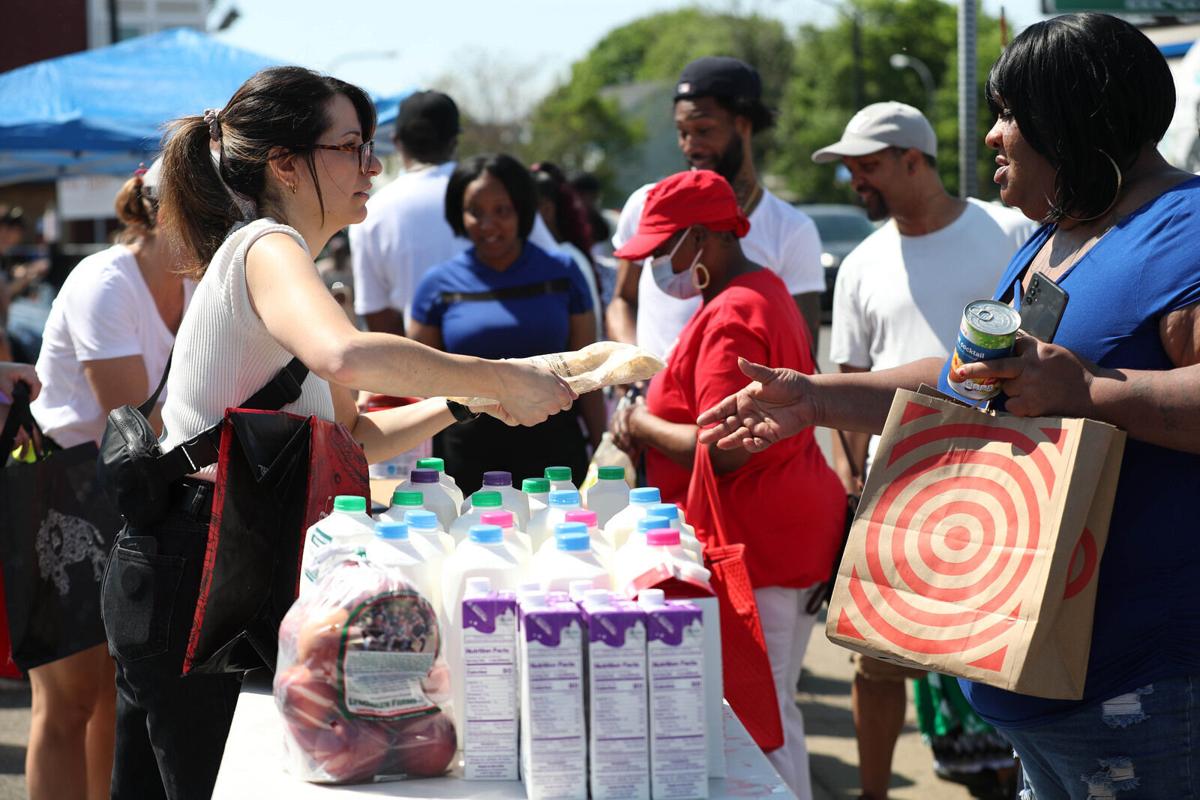
But he also quickly cited the costs of changing a race course that has to be certified as a Boston Marathon qualifier. He also called the local race “very community-centric,” citing the food drive it will stage on Saturday to help people affected by the Tops closure.
Those efforts – along with countless others to honor the dead as well as assist the neighborhood – are to be commended. Indeed, I would be among the critics if the larger community wasn’t rallying around Cold Spring.
But a community traumatized by racist violence and devastated by the closure of one key business would not be so economically vulnerable in the first place if we saw it the way we see other neighborhoods.
With its annual Queen City Jazz Festival on a closed-off section of Broadway, the Colored Musicians Club has proved you can hold musical events – other summer jazz festivals? – in or near Black neighborhoods. The Juneteenth Committee has proved you can hold large festivals – food tastings? – in the heart of the Black community.
If logistics and timing are obstacles when it comes to moving events this summer, those excuses won’t fly in years to come. “Thoughts and prayers” are great, as are donations. But once those dry up, once the national media turn to the Texas school massacre or the next big story, what will be left in terms of incorporating Buffalo’s Black neighborhoods into the larger community to permanently change attitudes here?
For all of the expressions of empathy, it will be worth noting which organizations join Slow Roll – and which don’t – in answering that question.
In this Series
Complete coverage: 10 killed, 3 wounded in mass shooting at Buffalo supermarket
-
Updated
Hochul pledges pursuit of justice after shooting, calls on sites to crack down on white supremacist content
-
Updated
Sean Kirst: In Buffalo, hearing the song of a grieving child who 'could not weep anymore'
-
Updated
Recently retired police officer, mother of former fire commissioner both killed in Tops shooting
- 249 updates


