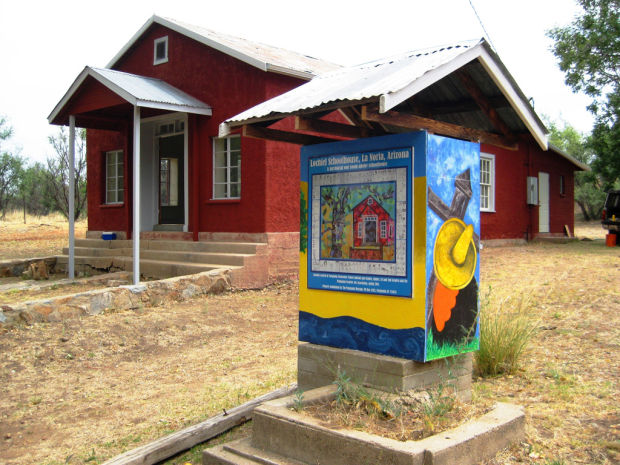
New life is being pumped into the red one-room Lochiel Schoolhouse that sits southeast of Patagonia in the fertile San Rafael Valley.
For three years, Germán Quiroga has organized workdays to renovate the schoolhouse near towering cottonwood trees in the tranquil, remote community near the U.S.-Mexico border.
Quiroga, 62, president of the Patagonia Museum, the area’s historical society, leases the schoolhouse from Patagonia Public Schools. Children attended school in the community since 1892, when Lochiel was known as La Noria.
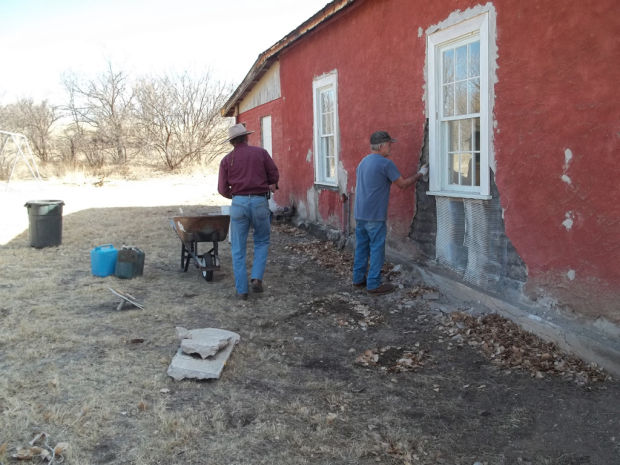
The project to renovate the schoolhouse has attracted volunteers who believe in preserving history. They toil once a month on the schoolhouse, which was built before 1905 and closed in 1972 when enrollment dwindled to a few students.
It lay in disrepair — much of it caused by vandals and the elements — for decades. Now the restoration work touches the heart of Germán’s mother, Elena Quiroga, 80, who was a student at the schoolhouse from 1939 to 1948.
People are also reading…
It was her dream — which was supported by her late husband, Rámon Quiroga, a native of Patagonia and former town councilman — that the schoolhouse be preserved, maintained and respected as a historical site, attracting tourists and students to learn about the area.
“I am so happy about all the work that has been done and will be done to get the schoolhouse looking the way it should,” said Elena Quiroga, who can clearly recall class lessons, writing on the chalkboard and students sitting in rows of wooden desks.
She also remembers pupils’ chores, including cleaning the chalkboards, sweeping the floors, bringing in chopped wood for the stove and lugging in water from a well. When they needed to be excused, they used an outhouse on the property.
Elena Quiroga’s great-grandparents, Antonio and Carolina de la Ossa, were pioneers who settled in Lochiel in 1886 and raised cattle. Homes of the ancestors still stand.
So does a chapel and the family cemetery where Elena’s father, grandparents, great-grandparents and many other relatives are buried.
Relatives still work the land that is grazed by Here-ford and Black Angus cattle amid rolling hills spotted with ranch homes and windmills.
The historical significance in preserving the schoolhouse has spread.
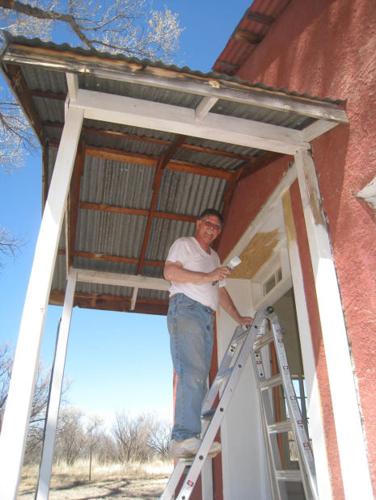
More than 100 have volunteered to renovate the building, putting in about 1,000 work hours collectively. They have hauled trash, cut and mowed grass, stuccoed and patched walls, and painted the exterior of the schoolhouse.
Others have done roof repairs and installed new double-hung windows, doors and a flagpole. Playground equipment has been restored, and a kiosk was built outdoors that holds a mosaic sign and artwork created by students at Patagonia Elementary and Patagonia Union High schools.
“I have an appreciation of old, historic buildings,” said Ralph Schmitt, 57, a retired carpenter from Elgin, Ill., who moved to Patagonia in 2003.
Schmitt, who has been a major force in completing the carpentry work in the old building, said he feels a “real sense of American nostalgia for one-room schoolhouses. It was a simpler time, an easier time back then.”
“My mother went to a one-room schoolhouse in Elgin. It was K-8. The building was torn down to make room for a subdivision.
“That inspired me to get involved in this project,” Schmitt said. “Certain forms of architecture are classic — be it a simple adobe building or a craftsman’s bungalow. For me, they are works of art, and if I can do something to help restore them to the original form, I will.”
The restoration work has been supported by grants, monetary donations and donated supplies, said Germán Quiroga, a retired mail carrier.
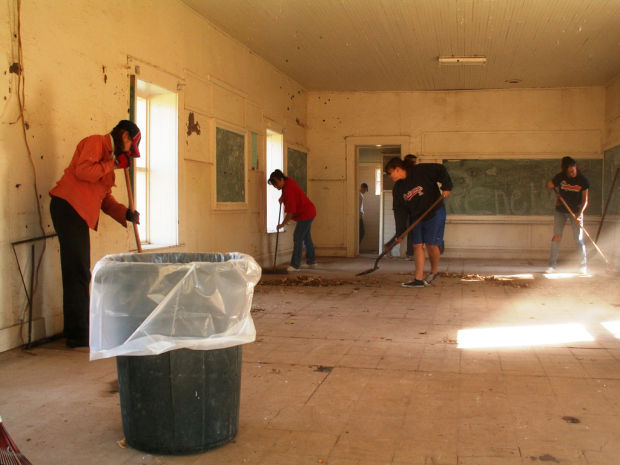
The exterior of the building has been restored, and volunteers have started working on the interior. The linoleum tile and plywood were removed, exposing a hardwood floor that needs to be replaced.
Repairs need to be made to the ceiling and walls, including patching bullet holes, and much-needed coats of paint. Renovation of an indoor bathroom is underway, along with a storage area for supplies and a section where students stored their belongings.
Original wooden desks used by students will eventually be put on display.
A teacher’s house that was built in 1962 on the property will become a large ramada with picnic tables. The ramada will include a section where historical information will be displayed, Germán Quiroga said.
“We have made progress, but we still have a long way to go,” he said. “My philosophy is to take little steps, get things done and move along.
“When everything is completed, we will have a big party and celebrate,” he said.