Second of two parts
When researcher David Stone met Richard Pablo in the fall of 2011, he knew right away he had found his assistant.
Pablo, a student at Tohono O’odham Community College’s West Campus near Sells searching for extracurricular involvement, had been sent to meet with Stone about a new project in its early stages that involved recycling glass into a new cement mix.
“He seemed like a much more colorful character than most people,” recalls Stone, a researcher working under an environmental grant at the college.
“He was animated — most O’odham people are quiet and reserved, but Richard was laughing a lot and he wanted to get involved.”
The two became a team, and in the process began to confront the problem of alcoholism on the O’odham reservation.
People are also reading…
After Pablo became Stone’s assistant, TOCC administrators gave Pablo money for a glass-collecting trip to Tucson. Instead, he used the cash for gas and took Stone into the desert, following a paved road only so far before turning off.
“We just went right into the desert, and there’s party sites all over,” Pablo says. “Some places we’d go and I’d show him and there’d be stacks and stacks of glass where everybody would just throw their bottles.”
Pablo knows the sites well. At 46, alcoholism was always part of his life. Pablo started drinking regularly at age 16, and his current span of sobriety — about five years — is his longest.
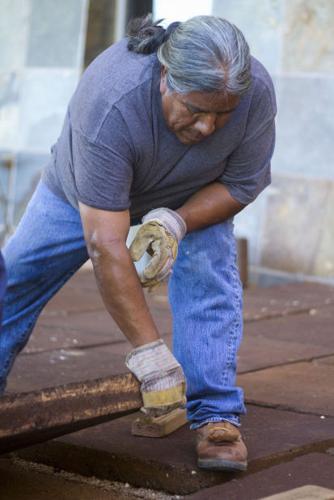
He admits that school wasn’t his top priority growing up on the Nation. His hands are calloused and thick from years working construction, laying sheetrock, roofing and building tile. Twenty years ago, he ran drugs across the reservation, which led to three years in prison.
Pablo’s experience is not unlike those of many others on the Tohono O’odham Nation. Legally, the reservation remains dry. But with a square mileage nearly equal to the state of Connecticut, a dry reservation is hard to enforce. And with so many of its members interrelated, Pablo says it’s difficult to “drop a dime” on someone.
The Nation follows the trend of alcohol abuse on reservations across the state. The Arizona Department of Health Services in its 2011 report — the most recent data available — showed alcohol-induced deaths among Native Americans in Arizona were the second-leading cause of death, reaching nearly 200, including about 20 on the Tohono O’odham Nation.
Pablo’s drinking came gradually. He watched his parents drink regularly and followed their example. He joined his friends and spent hours in the desert, polishing off Qs and tossing them in the dirt.
Historical trauma
What’s at the center of Pablo’s alcoholism and the high rates of alcohol abuse among Native American communities?
Tommy Begay, a research associate at the UA’s Department of Psychiatry, suggests a theory called historical trauma.
The theory espouses that because Native Americans were evicted from their lands, it led to a cultural disconnect that manifested dysfunctional behavior
that possibly led to violence, drug use and alcoholism. As generations of people battle vices like these, many of their children pick up the habits, simply following what they think is normal.
Reconnecting Native Americans to their culture, Begay says, has been his solution to the condition.
For Pablo, the solution was collecting the bottles.
Stone didn’t expect to address an issue like alcoholism when he started coming to Sells, but it soon became evident that the glass was more than just litter. At national tribal conferences as far as Washington, D.C., Stone and Pablo presented their project to hundreds of Native Americans. Their photos of bottles blanketing the landscape struck chords with audiences, many who hung their heads in shame.
“Immediately, we had to deal with all of that,” Stone says. “It wasn’t just bottles behind a store or behind a bar. Our recycling very quickly became more than just the recycling of a material, but the recycling of feelings.”
A lasting effort
Sells, the capital of the Tohono O’odham Nation, is 60 miles west of Tucson. It serves as the hub for the tribe’s governing body, many tribal businesses and all of the Nation’s trash.
The Waste Management facility in Sells handles 18 to 20 tons each day, brought in from across the reservation. Without a landfill in town, the waste is trucked to Los Reales Landfill in Tucson, where the company pays $32 per ton to dump at least a single truckload every day. After factoring in the transportation expense, the monthly costs amount up to $16,000, said Gary Olson, the facility’s manager.
“When you have such a long distance to go to a landfill for disposal, trying to divert anything you can from that truck is important,” Olson says. “So when (Stone) came forward with an idea of glass recycling on the Nation so it would never have to leave, I saw that as a win-win situation.”
Three years into the program, Olson doesn’t see any reason to stop. Now his own workers gather what’s left of glass in the desert. The facility is outfitted with a glass crusher, a shiny, John Deere-green miracle worker whose arrival meant no more shattering bottles by hand with a tamper.
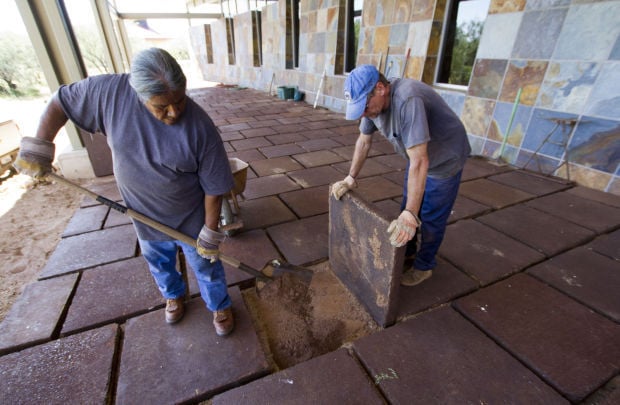
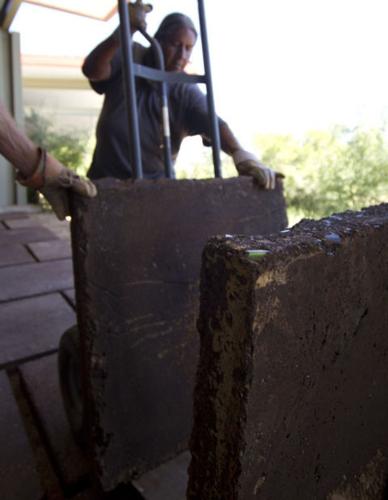
The special cement that uses recycled glass has been put to use in several areas, namely on a new patio addition at the Tohono O’odham Nation Cultural Center and Museum. Stone estimates the project used 90,000 pounds of his material. That’s 60,000 pounds of glass that didn’t end up on another truck to Tucson.
When Pablo graduates from TOCC in May with an associate degree in liberal arts, he won’t be the first of his family to do so, but he’ll be one of few. He’s got tentative plans to transfer to the UA, but he’s not sure what he’ll study.
After Pablo’s struggles, school became his way out, and he knows it’s his answer to avoiding a slip back into old habits, or another dead-end construction job.
“Growing up, grade school felt so constricted,” he says. “Community college really opened up my mind — it became my dope. The instructors became, I guess, my dealers.”
Pablo’s time collecting bottles has taken him farther than he expected. In the last three years, he’s been to Washington, D.C., five times to speak at conferences and once in Reno and Phoenix. He thinks it’s funny that his public speaking instructor failed him for not being able to stay on topic during presentations.
Cleaning the desert has led to a cleaner conscience. It’s helped him maintain his sobriety, but he knows it’s just the beginning.
“The glass is just the icing on the cake,” Pablo says.
Kyle Mittan writes for Arizona Sonora News, a news service from the University of Arizona School of Journalism. Reach him at kyle.mittan@gmail.com



 Tucson's newest Shake Shack gets neighbors