

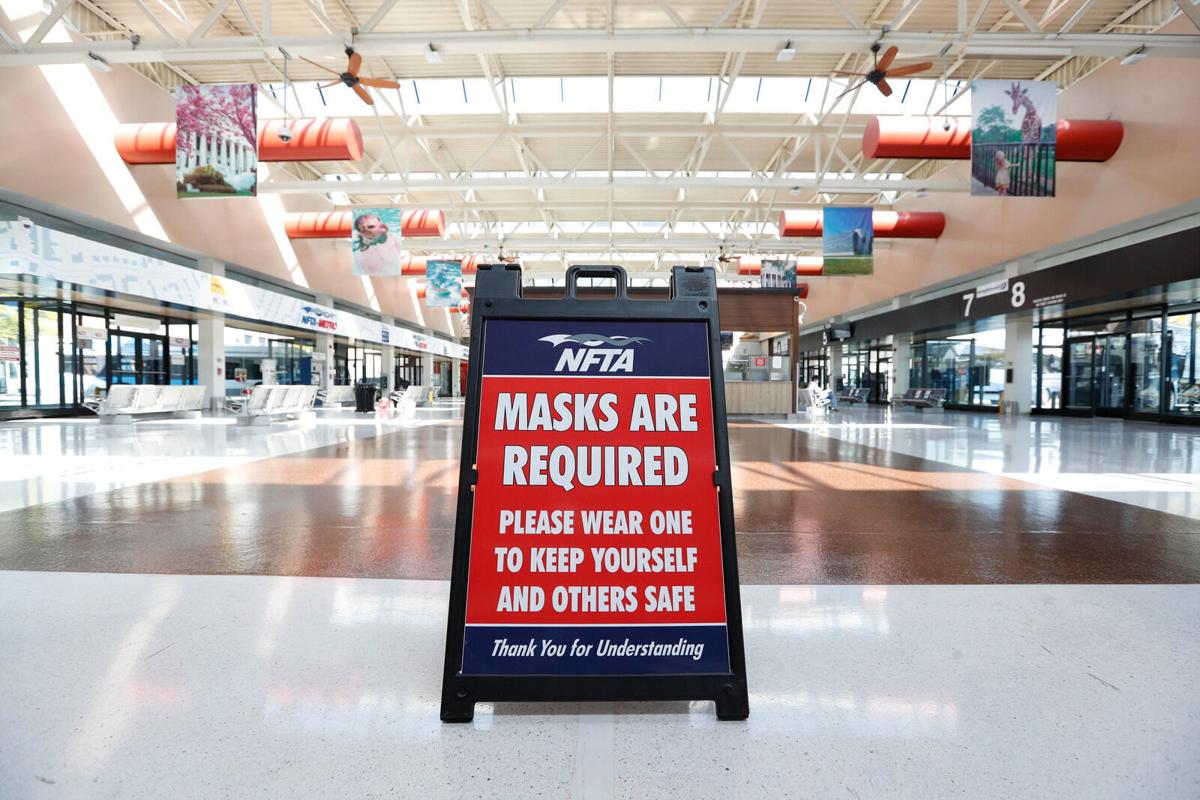
Masks will no longer be required on public transit, Gov. Kathy Hochul announced Wednesday.
Planes, trains, buses and transportation stations were among the last places in the state where masks were still required as part of the effort to limit the spread of Covid-19.
"We have to restore some normalcy," Hochul said.
The new rule goes into effect immediately, she said. The change means that one of the only remaining vestiges of pandemic restrictions will be health care facilities, where masks continue to be required.
The new guidance comes more than two and a half years since the appearance of Covid-19 in New York and a wide range of public health restrictions which included staying six feet away from people, remote work, online schooling and at one point, nearly universal mask wearing in public places.
People are also reading…
But in recent months, compliance with New York's mask rules on major transit was spotty, as anyone who has traveled could tell you. Air travelers also contended with the dueling guidelines between the federal government and the state – for many months you were supposed to continue to wear a mask while inside a New York airport, but you no longer were required to once you were aboard a plane.
Now, mask wearing just about anywhere in the state will be optional.
"Here we are. Big day," she said as she started a news conference from a clinic in New York City at which she unveiled a new sign that would be posted in New York City subways that read: "Masks are encouraged but optional. Let's respect each other's choices."
Hochul's announcement came as she also discussed the state's plan for the latest boosters, which became available Wednesday.
Boosters that specifically target the Omicron variant are now available at pharmacies and clinics across the state.
Anyone 12 and over is eligible for the Pfizer booster. You must be at least 18 for the Moderna booster.
"It makes me very hopeful that it will be extraordinarily helpful. I'm looking forward to getting my shot," she said.
During the news conference, Hochul sat down in a chair as a masked nurse administered the shot.
"Let me know when you do it," the governor said winking, a moment after she got the shot.
"It's that easy," she said continuing the news conference as she urged all eligible New Yorkers to get the booster.
State Health Commissioner Mary Bassett explained that anyone who has already had their initial Covid-19 vaccines, including boosters, is eligible to get their shot as long as it's been at least two months since the last booster.
That includes people who got a second booster.
"If it's been more than two months and you're 12 or over, you should get it," Bassett said.
She said the new booster specifically targets the BA.4 and BA.5 Omicron subvariants which are the dominant strains circulating now.
They don't yet know if the new booster will fully protect against infection. During Delta and Omicron waves over the past year, many people got sick or tested positive with Covid-19 despite being fully vaccinated, which public health officials called "break-through infections." However, they were much less likely to end up in the hospital or die from the virus.
"We're very hopeful it will protect better against infection," Bassett said.
She said that protection against severe illness is still "a very good reason to get your booster."
It's also much easier to get a vaccine now. Last year, New Yorkers scrambled to try to get appointments. First, they were limited to certain populations and age groups but then as the state and county health departments held mass vaccinations clinics, people struggled to book appointments through cumbersome websites.
Now, most major drug stores offer appointments through their websites, offering an array of times and places to get the boosters.
Hochul remarked on the progress the state has made over the "28, 29 months" since the Covid-19 pandemic began in March 2020.
"It's been going on a very long time," she said.
She pointed to the Omicron wave in late December and January.
"We had literally 90,000 cases back on Jan. 7," she said. Eight months to the day later, the number is down to 3,400 cases a day, she said.
Hospitalizations have dropped too, she said. Eight months ago, there were about 10,000 people with Covid in hospitals across the state. Now, the number is down to about 2,200.
"We are seeing a major decline in hospitalizations," she sad.


