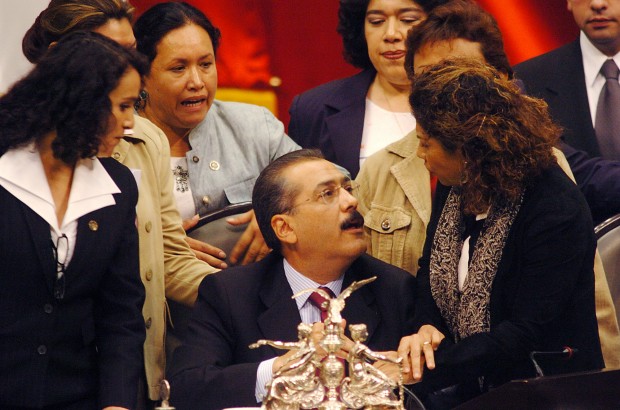
Manlio Fabio Beltrones, who was a cross-border political star when governor of Sonora in the 1990s, has given up his long-held dream of Mexico's presidency.
In an online video, Beltrones, now a senator, said last week that in the name of party unity, he would cease his pursuit of the Institutional Revolutionary Party's nomination for president.
"This is one of the moments in life and politics in which one has to decide between striving to be an important figure and being a useful man," he said. "I've decided not to participate in the nominating process for the presidency, opting instead to be a useful man for my country and my party."
Beltrones' party, known as the PRI, dominated Mexico for 70 years before ceding the presidency in 2000. He came of age in the conservative wing of the party, now known as the "Dinosaurs," but didn't take high office until Mexico was moving away from one-party rule.
People are also reading…
"His star rose at an inopportune time," said Ed Williams, an emeritus professor of political science at the University of Arizona.
During the 1990s, Beltrones and former Arizona Gov. Fife Symington formed a partnership that boosted the cross-border relationship as the North American Free Trade Agreement was coming into effect.
Beltrones' political rise stalled in 1997, the last year of his governorship, when The New York Times published an exposé accusing him and another governor of collaborating with drug traffickers. When Beltrones' term ended that year, he had to rebuild his career.
One of his moves was to hire Keith Rosenblum, a former Arizona Daily Star reporter, to write an analysis and critique of the Times story, one of several Times stories on Mexico that won a Pulitzer Prize in 1997. The book, titled "No Accuser, No Crime, but You're Guilty," came out in 2001.
In 2003, Beltrones won election to the lower house of Mexico's congress. And in 2006, he became a senator through a process that essentially allows the parties to name a number of senators in proportion to the party's share of the vote.
In that role, he emerged as the leader of the Senate and developed a reputation as a pragmatist, said Roderic Camp, a political-science professor and expert on Mexico's politics at Claremont-McKenna College in California. But in the meantime, a new young governor had emerged as the PRI's next star.
Beltrones' decision cleared the way for that man, State of Mexico Gov. Enrique Peña Nieto, to announce his solo pursuit of the PRI party's nomination over the weekend.
Beltrones was long an underdog to Peña Nieto, Camp said. What changed this month is that Mexico's left-wing parties settled on a single candidate, he said, and that forced the PRI to make its decision early.
Still, that doesn't mean the 59-year-old Beltrones is disappearing from the scene, Camp said.
"If Peña Nieto goes on to win in July, Beltrones could reasonably expect a high position in the new government."
Contact reporter Tim Steller at 807-8427 or at tsteller@azstarnet.com