A Cuban asylum seeker detained at Eloy Detention Center has been hospitalized without explanation, days after the man said he was placed in solitary confinement as "punishment" and indicated that he intended to harm himself.
Neither the Arizona Daily Star nor family members have been able to reach Alexander Hernández, 45, since he sent a series of worrying messages to his family and the Star on April 27, two days after he was placed in solitary confinement.
Two Eloy detainees told the Star that an official at Eloy said Hernández attempted suicide prior to his hospitalization. Another detainee's wife told Hernández's family the same thing.
U.S. Immigration and Customs Enforcement officials only revealed that Hernández had been hospitalized after his attorney showed up at Eloy on April 29 for a "wellness check" and was unable to see him, said immigration attorney Pattilyn Bermudez Solano.
People are also reading…
"This is serious," she said on Monday. "We don't even know if he’s alive."
ICE has not responded to the Star's April 29 request for information on Hernández's health status and the reason for his hospitalization.
In an interview for another story, in late April, Hernández told the Star he was reaching a point of desperation after Eloy officials, on April 20, took away the wheelchair he'd been relying on since December.
On April 25, Hernández went to Eloy's medical unit, with the help of a friend, and refused to leave until he got emergency treatment for his excruciating back pain, he said. But instead of getting help, he was sent to solitary confinement, Hernández wrote to the Star, using a prison-messaging app.
"They are punishing me here for asking for medical help," he wrote April 25, from a solitary-confinement cell. "Please, I can't bear these abuses anymore."

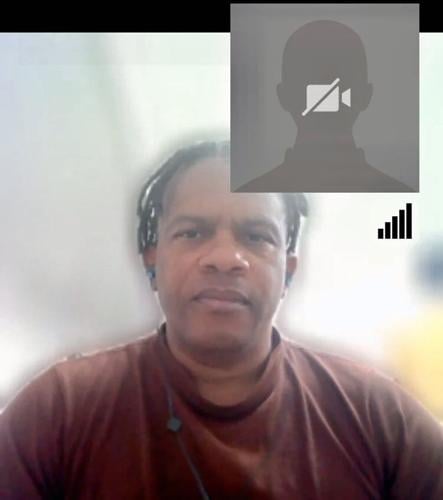
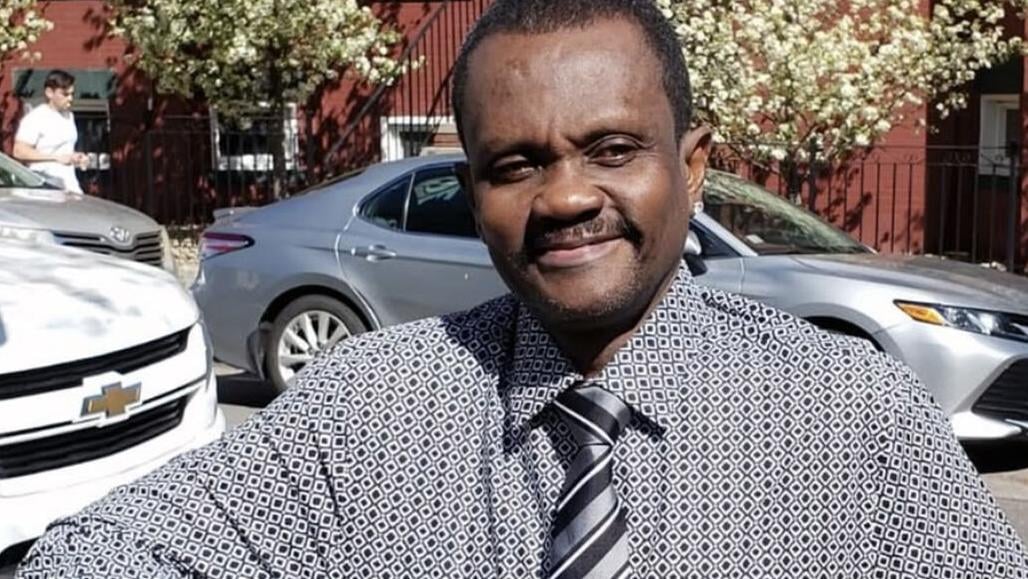
Cuban asylum seeker Alexander Hernandez, pictured here at Eloy Detention Center, on an April video call with the Arizona Daily Star, said he's been suffering from excruciating back pain for eight months. On April 25, he went to Eloy's infirmary and said he wouldn't leave until he got medical help. Instead, he was put into solitary confinement, he told the Star in written messages. Hernandez attempted suicide in his solitary cell two days later.
Hernández told the Star in an April 27 message that he had informed ICE officials that he would harm himself if he didn't receive medical help. He hasn't responded to the Star's messages since then.
Hernández's family in Phoenix have been desperate for information about his health status, since receiving concerning messages from him April 27. But ICE has not responded to the family's queries, said Hernández's son Dasnel, who is 24.
After reading Hernández's messages, "we started calling everywhere to find out what was going on. He wasn't calling back or responding to messages," he said. "We don't know what condition he's in, what hospital he's in, nothing. They haven't told us anything."
Hernández had told his family, and the Star, that a guard had been harassing him. Hernández believed Eloy officials were retaliating against him for filing a complaint about the guard, and that racial discrimination may have also played a role in his inadequate medical care.
"Every time he calls me, he tells me he’s in a lot of pain and that he can’t walk," said Dasnel, one of Hernández's five children. "There are days when he doesn’t call at all because he simply can’t manage to get to the phone."
The last time he visited his father, "he looked very thin," Dasnel said. "He's not doing well."

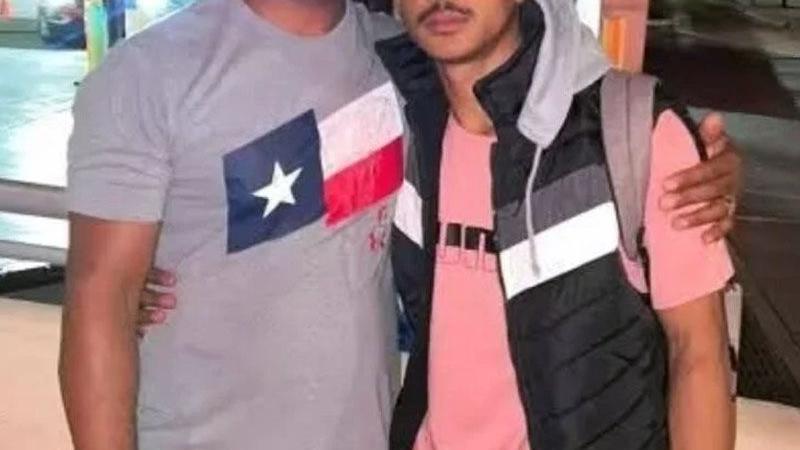
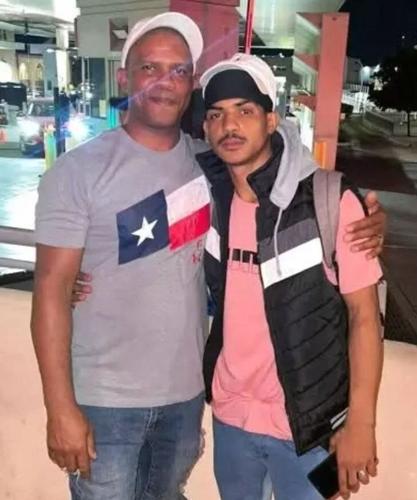
Eloy detainee Alexander Hernandez, 45, left, is pictured with his son, Dasnel, soon after the son arrived in the United States from Cuba. Dasnel, who is 24, said he was unable to get any updates from ICE about his father's health status after Hernandez was hospitalized in late April.
'Serious mental illness' classification
On April 28, a Department of Homeland Security attorney filed a motion informing the immigration court that Hernández had "serious mental illness," and could get special accommodations as a member of this vulnerable class. Attorney Bermudez Solano shared the motion with the Star.
If Hernández did attempt to hurt himself April 27, it would explain DHS suddenly filing the motion, Bermudez Solano said.
The motion "makes me think there’s something really serious going on," she said.
Bermudez Solano said she intends to ask DHS's legal department what prompted the motion about Hernández's mental health.
"I'm his attorney. You have information about my client that I'm not even able to get from him because I cannot see him and I cannot talk to him," she said.
Hernández's family and his significant other said he's never struggled with his mental health before.
"I don't know what they're trying to do to him in there, but Alexander has never had mental health issues. Never," his partner wrote in a text message.
Hernández's partner — also a Cuban immigrant who said she's known Hernández since childhood — asked the Star not to publish her name, even though she entered the U.S. legally, using the CBP One application, and has an ongoing immigration process. But she fears being detained because the Trump administration is even targeting immigrants who followed all the rules, she said.
Pain at level '10'
Although Eloy is owned and operated by private, for-profit prison company CoreCivic, medical and mental health care at Eloy is handled by ICE's medical arm, ICE Health Services Corps, or IHSC. With a budget of $421 million in 2024, IHSC provides medical care at 18 ICE facilities, according to ICE's fiscal year 2024 annual report.
Hernández has suffered from severe lower back pain since his arrival at Eloy in August 2025, he said. At first, he was granted the lower bunk bed in his cell but after nine days, Eloy staff made him start using the top bunk, worsening his pain, he said.
"The response was that such (lower) beds were reserved for people who truly needed them," Hernández told the Star.
Hernández said he was turned away from the medical unit repeatedly, until one day in December he collapsed in pain, he told the Star in a video call from Eloy, on April 22.
When an officer asked him what's wrong, "I told him, 'I can't walk, the pain is so intense. I’m not the type of person to cry, but I can barely endure the pain,'" Hernández recalled telling the man. "He called the medical unit for me, and that’s when they gave me the wheelchair."
From December to April, Hernández relied on the wheelchair but Eloy took it away on April 20, he said. Without a wheelchair, Hernández said he'd been unable to go to the cafeteria for the meals provided by Eloy — instead relying on costly food items he can purchase at the commissary — nor could he get to the medical unit to get his medication, unless a friend helped him.
Hernández said his liver is inflamed, due to taking so much ibuprofen over the past eight months at Eloy.
In March, after seven months at Eloy, Hernández said he was taken to get an MRI scan of his back and he was told he has several slightly bulging discs and possibly arthritis, but there was no clear diagnosis or solution. His condition, and mental state, have continued to deteriorate since then, he said.
When Hernández went to the medical area April 25, he told staff he "urgently" needed help for pain that was at level "10," he wrote to the Star that day.
"They wouldn't let me see the doctor, nor return to me the wheelchair that I need to move," he wrote. "They violate health regulations, just like they violate the rights of every person that finds themself here."
Deaths in ICE custody have soared throughout President Donald Trump's second term, as ICE has detained more immigrants and already poor detention conditions have deteriorated, advocates say.
At least 49 people have died in ICE custody since Trump took office, including 18 deaths so far in 2026. That's a rate of about one detainee death every six days this year.
Haitian asylum seeker Emmanuel Damas, who was detained at Arizona's Florence Correctional Center, died in March, weeks after he began complaining of a tooth infection that doctors said likely led to septic shock, the Star reported.
Damas' family in Boston struggled to get any information from ICE, and from the HonorHealth hospitals where Damas was being treated, until he was near death, the family told the Star.
An Arizona Hospital and Healthcare Association spokesperson told the Star it's "standard practice" that hospitals don't share information with families about patients who are in federal custody. That includes ICE detention, which is civil detention and not part of the criminal-justice system.
'For his convenience'
Eloy detainee Oscar Zeledon has become close friends with Hernández and helps him get around Eloy whenever he can, he told the Star, speaking in Spanish. Zeledon said he took Hernández to the medical unit April 25 and heard Hernández pleading to see the doctor on an emergency basis.
Guards made Zeledon leave Hernández at the medical area, he said. Days later, after Hernández had been sent to solitary confinement, an ICE officer told Zeledon that Hernández had tried to kill himself, Zeledon said.
Zeledon said the officer also told him that ICE had planned to keep Hernández in solitary confinement "permanently," so that they could bring him his food and medicine there. The officer said it was "for his convenience," Zeledon said.
"They're denying him everything, and they're all covering for each other with lies," said Zeledon, who has long been frustrated with the lack of care his friend has received at Eloy.
"He was in a lot of pain. And several times we went to the doctor to try to get the wheelchair and they refused," he said, speaking in Spanish. "We even filed a grievance so the doctor could provide him with the wheelchair, but they never picked it up. It (the grievance) was just sitting there in the box."
After two days in solitary, Hernández seemed to have lost hope, in messages sent to a Star reporter through the prison-messaging application.

On April 25, Alexander Hernandez went to Eloy's medical unit, with the help of a friend, and refused to leave until he got emergency treatment for his pain, he said. But instead of getting help, he was sent to solitary confinement, Hernandez said. "They are punishing me here for asking for medical help," he wrote to the Star on April 25, from a solitary-confinement cell. "Please, I can't bear these abuses anymore."
"I have very little strength left," he wrote to the Star on April 27, two days after he said he was placed in solitary confinement. "I have been without medication since the 20th. I didn't receive any food from the cafeteria. I only managed to eat a few things from the commissary, and even that was a struggle."
"I haven't had the strength to speak with my family today. I am in a very bad state," he said in another message. "They were supposed to transfer me back (out of solitary) today, but that was part of the lie to keep me here in this hole, a place where I'm restricted from everything, even the possibility of filing the legal paperwork I need to get out of here, Habeas Corpus."
No parole for vulnerable detainees
In Trump's second term, ICE has largely declined to use its discretion to release detainees with serious illness or other vulnerabilities on humanitarian parole.
In the first 11 months of 2025, ICE "discretionary releases," such as release on humanitarian parole, fell by 87%, said a January report from the American Immigration Council, a research and advocacy group that promotes immigrant rights.
In February the Star reported on ICE's nine-month detention of an elderly Cuban woman with worsening dementia, who relied on a wheelchair. The Star's reporting prompted U.S. Rep. Adelita Grijalva, a Tucson Democrat, to advocate for the release of the woman, Julia Benitez, on humanitarian parole.
On Feb. 26 Benitez, 79, was released to her family in Florida, 11 days after the Star published its story on her detention.
ICE is detaining more people with serious health conditions that the agency and its contractors are ill-equipped to handle, said Liz Casey, a social worker with Arizona legal-advocacy group the Florence Immigrant and Refugee Rights Project.
"We've heard of people threatened with disciplinary segregation (ICE's term for solitary confinement) for insisting they need better medical treatment or need medication," she said, in an interview unrelated to Hernández's case. "This is definitely something we see often, and I would say we’re seeing it more often over the past six months."
Bermudez Solano said Hernández's concerns about medical negligence at Eloy echo the complaints of "inhumane" treatment from other detainees she's represented.
Even with urgent cases, and those requiring a specialist, Bermudez Solano said that often her clients "haven't gotten the medical attention. Or they do, but not in the timely manner they're supposed to."
Contact reporter Emily Bregel at ebregel@tucson.com. On X, formerly Twitter: @EmilyBregel

Emily Bregel
Border reporter





 Short-term ICE detention facilities under scrutiny