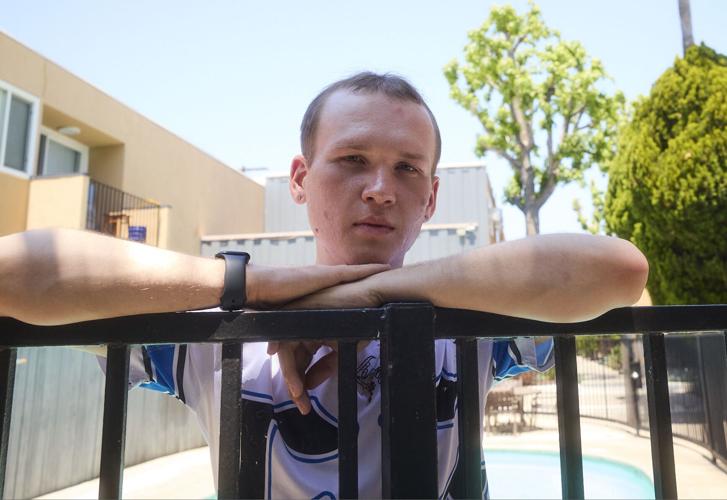
Russian asylum seeker Maksim Borisov, 22, said he was thrown into solitary confinement for refusing to “voluntarily” agree to return to Russia, where he’d fled persecution as a gay man.
Iranian dissident Narges Dehghani, 32, said, after she admitted to suicidal thoughts, she was isolated in a room the size of a parking space for three days, worsening her trauma from being kidnapped and sexually assaulted in her home country.
Samir Aghar of Afghanistan said he lost nearly 20 pounds, and has started having to rely on sleeping pills, after a two-month stay in solitary while he was still 18 years old.
The three immigrants — none of whom have criminal records — said their time in isolation at Eloy Detention Center in Arizona this year and last still lingers in their minds, causing nightmares, depression and hopelessness.
People are also reading…
“This is torturing. They’re torturing me,” Borisov remembers thinking as he stared at the wall of his cell, trying to ignore the smell of feces and the sound of a man screaming.
“I never did anything to this country,” Borisov said. “I never broke any law, and I’m being punished because I don’t want to die in my country.”

Russian asylum seeker Maksim Borisov, 22, said he could get killed if he returned to his home country because he is openly gay. That didn't stop ICE officers from pressuring him to self-deport and sending him to solitary confinement when he refused.
More than two-thirds of people in immigration detention facilities in the U.S. have never been convicted of a crime. Legally, they’re not allowed to be subjected to conditions that are as harsh as prison or amount to punishment because immigration detention is a civil, not criminal, process, said Kyle Virgien, a senior staff attorney with the American Civil Liberties Union’s National Prison Project.
And yet, thousands of immigrants each year in the U.S. are sent to solitary confinement, a punishment so severe that the United Nations considers a 15-day stint in solitary tantamount to torture.
Advocates fear the problem is worsening under President Donald Trump, as the Department of Homeland Security has gutted its internal oversight agencies and the detained immigrant population has exploded. Unnecessary uses of solitary confinement could easily fly under the radar, putting vulnerable detained people in real danger, physically and psychologically.
At least two detainees have already died in solitary confinement this year, one in Texas and one in Georgia. Another detainee, who was being interviewed for this story, attempted suicide in Arizona in late April, days after he said he was sent to solitary as “punishment” for demanding medical care.
Liz Casey, social worker for Arizona’s Florence Immigrant and Refugee Rights Project, said the Trump administration has emboldened ICE officers to be cruel.
“I think it’s just this sense of unlimited and unchecked power that guards and ICE officers have right now,” Casey said.
A Lee Enterprises and Arizona Daily Star investigation found that, in Trump's second term, ICE is misusing and overusing solitary confinement in ways that violate immigrants' rights and ICE’s own policies. In dozens of interviews over the last seven months, detainees said solitary confinement is a tool ICE officers use to coerce them into abandoning their immigration claims and self-deporting — a practice experts say is unconstitutional.
ICE and CoreCivic, a for-profit prison company that runs Eloy, denied using “solitary confinement” at all, instead using the term “segregation” to describe the isolation of detainees in cells. An ICE spokesperson also denied any coercive or unconstitutional uses of “segregation.”
“Allegations that detainees are subjected to segregation to pressure them to accept voluntary departure are completely FALSE,” ICE spokeswoman Yasmeen Pitts O’Keefe said in an email. “Every individual is afforded a due process according to our U.S. immigration laws.”
But 10 Eloy detainees interviewed by the newspaper team described being sent to solitary confinement for unnecessary reasons and excessive lengths of time, which advocates argue violates their rights. The detainees said they can be sent to isolation for minor disciplinary infractions, refusal to self-deport, complaining about conditions, language misunderstandings and expressing suicidal thoughts.
“These abuses of solitary in the ICE detention system are really intended to deter people and to scare people into giving up their claims to status in the U.S.,” Virgien said.

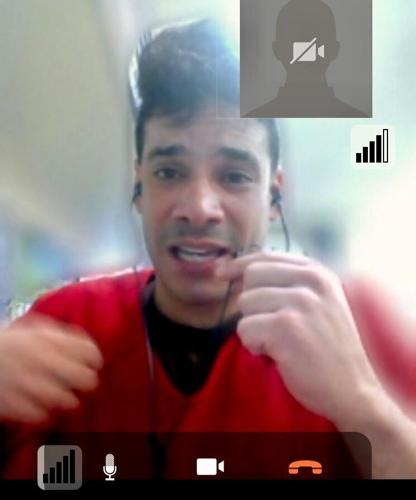
Afghan asylum seeker Samir Aghar, 19, on a video call from Eloy Detention Center, where he's been held for more than a year. ICE arrested Aghar on his 18th birthday, two years after he arrived at the U.S.-Mexico border as an unaccompanied minor.
Aghar said his time in solitary deeply affected him; months later, he still feels like his brain “doesn’t work” the same.
“My friend is talking with me, he’s trying to say things to me, but my brain is somewhere else,” he said, noting he sometimes feels like he’s “in a movie.”
Aghar was a student at Tucson’s Catalina High School when ICE detained him on his 18th birthday last year. He had crossed the southern border and surrendered to border agents when he was 16, along with his 14-year-old brother.
His fear of staying any longer at Eloy or getting sent to solitary again caused him to give up his asylum claim, against the advice of his attorney.
“Before I felt like I had rights, like I’m a human,” Aghar told the Star on a video call from Eloy. “Now, I understand I am alone. I have myself and my God. No one else.
“We have no rights here.”
‘Cruel’ and ‘dangerous’
The United Nations defines solitary confinement as the isolation of detained people for more than 22 hours a day “without meaningful human contact.” U.N. guidelines prohibit its use for more than 15 days. Such prolonged uses “amount to torture” or “cruel, inhuman or degrading treatment or punishment,” the guidelines state.
ICE has long maintained it does not use solitary confinement, though the isolation detainees experience meets the widely accepted definition of solitary.
CoreCivic’s Ryan Gustin said solitary confinement “does not exist” at Eloy Detention Center. Gustin said the use of "segregation" is distinct from solitary because detainees “retain full access to courts, visitation, mail, showers, meals, all medical facilities and recreation.”
That claim contradicts accounts from detainees who told the Star that in solitary, they’re routinely restricted from purchasing food at the commissary, using communication devices and taking showers, which are only allowed three times per week in segregation.
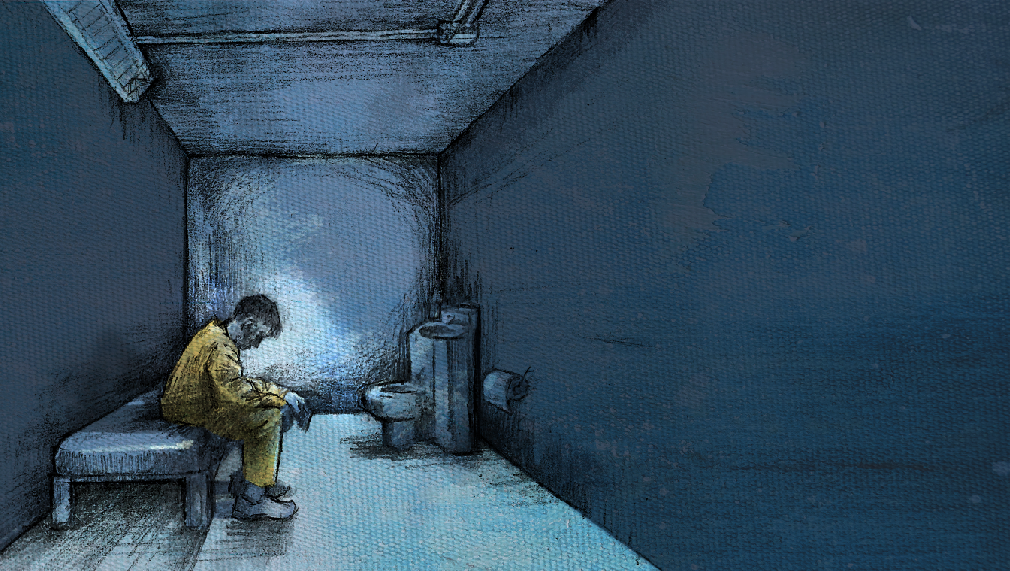
Iranian dissident Dehghani said she was locked in her isolation cell at Eloy for 24 hours a day for suicide watch. The room had nothing but a toilet and a plastic box to sleep in. No mattress, pillow or blanket.
The only human contact she experienced was a brief daily check-in to ask if she was still suicidal, along with the constant gaze of someone observing her through a small window. She said the interactions were not meaningful. If anything, they were degrading. Staff even watched her as she used the toilet.
“They just put me there like a starving animal that has a disease, just apart from others,” she said. “They think it’s just a treatment to prevent me from harming myself, but it harmed me more by doing that.”
In her delirium, Dehghani said she saw her mother in the room with her.
“The only word I was repeating was ‘mom, mom, mom,’ begging her to help me,” Dehghani said.
On the third day, she lied and said she was no longer suicidal, just to get out of confinement. She still has nightmares from it.
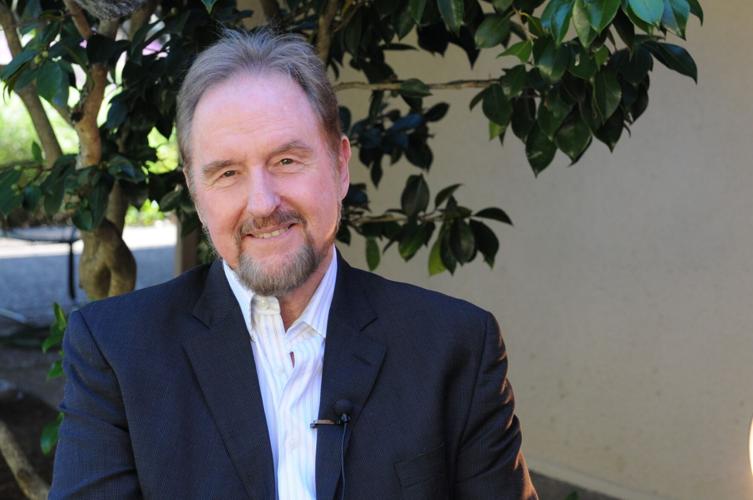
Craig Haney, a UC Santa Cruz psychology professor and solitary confinement expert, described social isolation as a “psychological toxin.” He said solitary confinement can cause depression, anxiety, hopelessness, the atrophy of social skills, and in more severe cases, hallucinations, cognitive impairment and PTSD.
“It’s cruel because it hurts people,” Haney said of solitary confinement. “It’s harmful, and it’s dangerous because it can harm people in ways that are long-lasting. In some instances, it can damage people indefinitely. And in extreme cases, it can lead to suicide.”

Cuban asylum seeker Alexander Hernandez, pictured here at Eloy Detention Center, on an April video call with the Arizona Daily Star, said he's been suffering from excruciating back pain for eight months. On April 25, he went to Eloy's infirmary and said he wouldn't leave until he got medical help. Instead, he was put into solitary confinement, he told the Star in written messages. Hernandez attempted suicide in his solitary cell two days later.
Cuban asylum seeker Alexander Hernandez, 45, seemed to lose all hope after two days in solitary confinement at Eloy. He attempted to hang himself in his isolation cell on April 27, he later explained to the Star using a prison messaging app.
“I have very little strength left,” he messaged earlier that day, a few hours before trying to take his life. “They were supposed to transfer me back (out of solitary) today, but that was part of the lie to keep me here in this hole, a place where I'm restricted from everything.”
Hernandez had been suffering from debilitating back pain for eight months, he said. A week after Eloy officials took away the wheelchair he’d been relying on since December, he went to the medical unit and refused to leave until he got emergency care.
Instead of getting help, he was placed in solitary confinement, he said.
Hernandez was hospitalized for days due to his suicide attempt. He got back in touch with the Star after he recovered, writing in mid-May that officers put him back in solitary again.
"What they're doing to me is a psychological game to affect my emotions and psychologically damage my mind. They're driving me crazy,” Hernandez said. “I don't know what to do anymore."
ICE has not responded to the Star’s inquiry about Hernandez’s claims.
‘Overused’ tool
ICE has sent at least 19,000 detainees to solitary confinement since April 2024, when ICE started reporting monthly segregation data. About 1,000 of those were isolated at Eloy Detention Center, which was the facility with the fourth-highest solitary placements.
A new ICE reporting policy implemented in December 2024 required disclosure of previously hidden short stays in segregation, causing a major spike in the reported number of people sent to solitary right around the time when Trump took office.
The reporting change makes it so the use of solitary confinement under Trump and former President Joe Biden cannot be directly compared.
But the length of solitary stays has been increasing for the “special and vulnerable population,” the only group for which length-of-stay data is available. That subset includes people with serious illnesses, suicidality or “protective custody” status, which is when a detainee is isolated because they request protection from the general population.
The average time spent in solitary for the vulnerable was well above the U.N.’s 15-day limit, which is in place because severe symptoms become less reversible at that point.

ICE tracks how many immigrants it sends to solitary confinement each month, but the data is messy and incomplete, a Lee Enterprises analysis found.
In 2025, under Trump, the average consecutive days vulnerable detainees spent in solitary confinement was 42. The average was also 42 days under Biden in 2024.
That figure has more than doubled since earlier in the Biden administration. From 2022 to 2023, vulnerable detainees spent on average 18 consecutive days in solitary confinement.
At Eloy in 2025, two detainees said they spent four and five months, respectively, in solitary confinement, with continuous stays of up to two months.
Michelle Brané, former Immigration Detention Ombudsman for the Department of Homeland Security, said she worries the use of solitary confinement could be expanding under Trump due to a massive surge in immigration detention.
In January 2025, 40,000 people were detained in U.S. immigration detention facilities, according to ICE data. By January 2026, ICE’s detained population had soared to a record high of nearly 71,000.
The figure has dropped to 60,000, as of April, but is still higher than any detention figure on record, prior to Trump’s second term.
Brané said solitary confinement was “already being overused as a disciplinary measure” under the Biden administration.
“Under this administration, where they're detaining more people with less concern for their well-being … it is likely being overused even more,” she said. “It was a problem then. And it’s a problem now.”
“We saw in Minneapolis what ICE was willing to do and what this administration was willing to do in plain daylight to U.S. citizens while being filmed, right? I think we can all only imagine what is happening behind closed doors to immigrants who are being detained.”
Pressured to self-deport
Borisov awoke in early May to an officer saying he was leaving Eloy Detention Center. Officers packed up his belongings and said he would be on a flight from Phoenix to New York, then to Hong Kong and then to Moscow.
Borisov would “get persecuted, and he could get killed just for being gay” in Russia, said Elle Delgado, a paralegal in the law office representing Borisov. Borisov’s asylum claim was denied in large part because he was nervous in court, Delgado said, which made the judge question his credibility. They are appealing.

Maksim Borisov
“I really, really cannot go back to Russia,” Borisov said. “It’s impossible.”
Despite the risks he could face, Borisov said an officer tried to pressure him into signing a document agreeing to be deported to Moscow.
“‘You need to sign it,’” Borisov remembers an officer saying to him.
“No. I’m not going to sign it,” Borisov said. “I’m not going to get deported. I need to see a judge. I have a lawyer.”
“‘If you refuse right now, you know what we’re going to do next time?’” Borisov claimed the officer said. “We’re going to force you to hop on the plane, or you’re going to go to jail … where people like you are gonna get raped.”
Still, Borisov refused to sign.
In response, Borisov said he was given a disciplinary violation for refusing a direct order from an officer and sent to solitary confinement. Borisov was released from solitary after 27 hours, but he said the isolation was still hard on him because he’s a very social person.
Margo Schlanger, a University of Michigan law professor and expert on civil rights, said it’s possible Borisov’s rights were violated, assuming the situation happened as Borisov described. She acknowledged there can be misunderstandings, such as detainees believing ICE is pressuring them to sign voluntary departure forms when it’s actually their notice to appear in court.
Borisov speaks and reads English well. He said the documents stated he would be giving up his right to argue his case before an immigration judge and allowing ICE to deport him.
“He has a right to contest his deportation,” Schlanger said. “If they’re trying to coerce him to give up that due process right, then that violates due process.”
CoreCivic denied unjust treatment of detainees, citing its human rights policy.
“The claims in your inquiry that our staff acted in a threatening or retaliatory manner are false,” Gustin said. “Our staff do not provoke detainees, nor do they encourage self-deportation. CoreCivic has no role in that process.”
Syrian national Kamel Maklad, who was detained at Eloy for more than two years, disputed that response. He said guards are “always trying to pick fights with the detainees just to give them more time” in solitary confinement.
“They do it so that the detainee, out of desperation, will hurry up and request voluntary deportation,” Maklad said.
Maklad claims one guard admitted it, telling him, “‘It’s part of my job. I have to make your life miserable so that you request your own deportation.’”
‘Unconstitutional punishment’
People in immigration detention have due process rights under the 5th Amendment, even if they are not U.S. citizens.

Margo Schlanger, a University of Michigan law professor and expert on civil rights, said detainees have a right to contest deportation. “If they’re trying to coerce (a detainee) to give up that due process right, then that violates due process.”
Schlanger said the use of solitary confinement in immigration detention can violate those Constitutional rights if it’s:
- Substantively harmful. Someone’s rights could be violated if the solitary confinement is “very, very harmful — harmful enough where it’s hurting someone’s health” or “causing really significant mental illness to be exacerbated,” Schlanger said.
- Poorly justified. If ICE sends someone to solitary confinement for an illegitimate reason — such as someone’s race or religion, which are protected in other areas of the Constitution — that violates their rights.
Virgien, the ACLU attorney, said ICE often does not have legally legitimate reasons for sending detainees to solitary confinement.
Legally, detainees can be sent to solitary only for a “legitimate governmental objective,” such as the safety and security of the facility, an ACLU lawsuit argues. Punishing or intimidating detainees to try to get them to “voluntarily” self-deport is not a legitimate reason, Virgien said.
“The Supreme Court has been very clear that nothing in immigration detention can be punishment,” Virgien said. That’s because detainees are held civilly and aren’t serving time for a crime.
The use of solitary confinement also becomes a form of “unconstitutional punishment” when it’s an “excessive” consequence for accomplishing ICE’s safety goals, Virgien said.
The ACLU is suing ICE and the Department of Homeland Security in part over “unnecessary” and “excessive” uses of solitary confinement at the California City Detention Facility, a former shuttered prison in the Mojave Desert that was repurposed into an ICE facility in 2025.
One California City detainee was sent to solitary confinement for simply asking to finish his shower, according to the lawsuit. Another man was sent to solitary for refusing to give up his tennis shoes, a medical accommodation given at a previous ICE facility to help alleviate a chronic foot condition. Several men were isolated for refusing an officer’s order to put their shirts back on while exercising.
These arguably unconstitutional solitary stays for minor rule infractions are happening at Eloy, too.
Minor infractions
Casey said she frequently hears complaints from Eloy detainees about guards punishing them with solitary for “offenses” such as not cleaning up their cell, hanging clothes on the bunk bed or covering up the too-cold air vents.
“It’s treating people like children, almost,” she said. “A lot of these disciplinary (issues) that people are getting write-ups for are just absolutely the most minor issues. They’re arbitrary, they’re subjective, based on if the guard is in a bad mood that day or wants to harass somebody.”
Multiple detainees complained about the poor air-conditioning system at Eloy, which often leaves their cells around 50 to 60 degrees Fahrenheit.
Lincoln Nunes, a migrant from Brazil, said when he was in solitary confinement at Eloy, an officer came to his cell with a portable thermometer. It read 56 degrees.
As Nunes lay in bed, he said the ceiling vent blew cold air directly onto his chest. So he partially covered the vent with paper to redirect the air away from him.
“And that was enough to trigger an investigation,” Nunes said. That meant an additional 72 hours in solitary confinement.
During that time, Nunes said he yelled at an officer to get his attention, which added another 72 hours to his time.
Nunes spent a total of seven days in isolation in the fall. He was initially sent there because officers falsely accused him of trying to hack law library computers, he said. Nothing ever came of that investigation.
Aghar, the 19-year-old, said he, too, spent a week in solitary confinement last year waiting for officers to investigate him for offenses that were later dismissed.
Aghar, and several other detainees, said guards who dislike you will create “fake write-ups to put you in the hole,” which is how detainees frequently refer to solitary.
“Seven days for one investigation? That’s a punishment,” he said. “This place, it’s like hell. There’s no humanity in here.”
Aghar’s growing frustration and hopelessness have led him to act out, leading to more time in isolation, he said.
Earlier this year, he went to the medical area to get his routine allergy treatment and asked to have an injury to his hand looked at, too. When the nurse refused without explanation, grabbing the medicine from his hand and shutting the door in his face, Aghar said he lost his temper.
He kicked the door.
Almost immediately, at least five officers surrounded him. That was another three days in solitary.
‘Safety and security’
ICE contends the use of “segregation” is necessary to control “violent and dangerous” detainees.
“When needed, segregation is a measure taken to promote safety and security of a facility, and can help protect other detainees as well as facility staff,” Pitts O’Keefe wrote in an email.
Gustin added that detainees are held in “the least restrictive environment necessary” to ensure safety.
But only 5% of vulnerable detainees were sent to segregation due to a “facility security threat” from January 2022 to March 2026. ICE only reports segregation reasons for the vulnerable population.
The rest of the vulnerable detainees were segregated for other reasons: 45% for discipline or a pending disciplinary investigation, 30% for medical or mental health reasons, and 20% for protective custody.
According to ICE's own assessment, 75% of detainees at Eloy are classified as having "no threat level." Nearly 80% of Eloy detainees are classified as "noncriminal" in ICE’s latest detention dataset. Nationwide, 71% of detainees are noncriminal.
Most of the detainees interviewed for this story — Borisov, Aghar, Dehghani, Nunes, Maklad — have no criminal record. Another detainee sent to solitary, Jordano Casanova, has only one citation for driving without a valid license.
Hernandez, the detainee who attempted suicide, has a conviction stemming from a 2023 domestic violence incident with his ex-wife. But he served his six-month sentence for that crime. And the reason he was sent to solitary was not his criminal record, but his complaints about medical care.
Some of the “security threats” that landed people in solitary at Eloy were simply language misunderstandings.
“Every day someone goes to solitary confinement because of their misunderstandings and their inability to speak English,” Eloy detainee Rafeq Mohamm Hasan said. “They are oppressing people.”

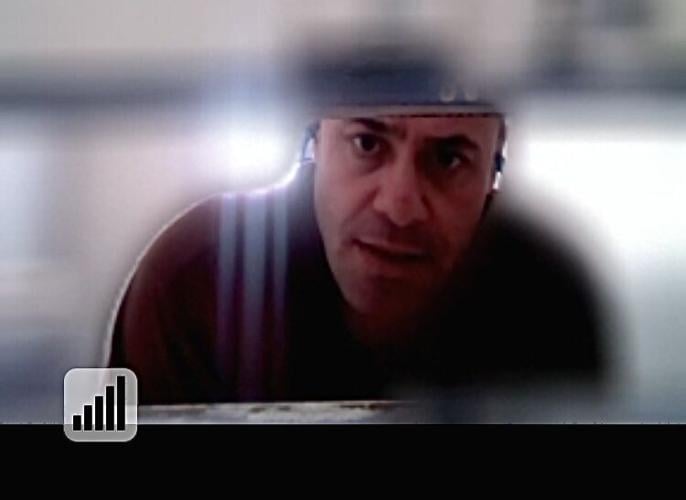
Syrian asylum seeker Kamel Maklad, who has no criminal record, spent a cumulative five months in solitary confinement at Eloy Detention Center. After winning "withholding of removal" to his home country, where an immigration judge agreed he'd face threats to his life, ICE spent more than a year trying, and failing, to find a third country to deport him to. After two years and four months at Eloy, Maklad was released in December 2025 after a successful habeas corpus petition challenging the legality of his continued detention.
Maklad, speaking in Spanish, said one of his lengthy solitary stints came after he asked a guard to stop moving his medications around, emphasizing that with, “I tell you,” said in English.
Because of Maklad’s accent, the official thought he said, “I kill you,” and ordered him to solitary confinement for two months because of that “threat,” Maklad said.
Maklad wrote a letter explaining himself and got witnesses to attest that he hadn’t threatened the guard.
“It was purely a verbal misunderstanding,” Maklad said. “Without making physical contact, and without uttering any insults, they still handed me a two-month sentence,” later reduced to one month.
Cecilia Valenzuela, a volunteer who visits Eloy detainees, wrote a letter of support for Maklad. She said guards joked about the mix-up that landed Maklad in solitary, referring to him as, “I tell you.”
“That’s the cruelty,” she said. “They exacerbate the situation by laughing at them, because they feel powerful.”
Months in isolation
Asylum seeker Casanova, of Cuba, 33, said that for months, he fought against the pressure to sign a voluntary departure form.
Speaking to the Star in December 2025, Casanova at times cried so intensely his words were unintelligible. He was worried for his wife and three kids in Goodyear, Arizona.
After fighting with another detainee, Casanova said was punished with 30 days in “the hole.” But he was placed in a cell next to the same detainee, who taunted him. He begged to be moved, but officers refused.
“The officers here don’t do anything; they don’t help you,” Casanova said. “All they do is come by and ask if you want to be deported.”

After spending a cumulative four months in solitary confinement during his eight months at Eloy, Cuban asylum seeker Jordano Casanova accepted a voluntary departure to Mexico in February. "I don't want to suffer here anymore," he wrote to the Star from Eloy Detention Center. Casanova has no criminal record except for a traffic citation for driving without a valid license. He left behind a wife and three young children in Goodyear, Arizona.
Already stressed, Casanova said he “snapped” after the officer wouldn’t let him use a tablet device for a planned video call with his kids on his birthday last August. He said the officer “knew that the only thing I ever asked for was the chance to speak with my children.”
“I felt overwhelmed, and I threw a (plastic) cup at him,” he said, breaking into tears. “I threw a cup right at him. For this, they gave me 60 days more of punishment. … The officials here don’t care about the life of anyone.”
Nunes, who became friends with Casanova, said Casanova’s solitary stays would “snowball” on top of each other, a frequent occurrence for detainees. They get so frustrated in isolation, they act out, triggering 72-hour investigations where they are stuck in solitary, Nunes said. Sometimes the disciplinary infractions trigger another 15 or 30 days in isolation.
For Casanova, that stacked up to at least four months spent in solitary confinement.
Eventually, Casanova gave up his asylum claim. In one of his last messages to the Star, sent through a prison-messaging app, Casanova wrote that he’d requested a voluntary departure to Mexico.
“I don’t want to suffer here anymore,” he wrote in February.
Casanova was deported soon afterwards. The Star has not been able to locate him.
No oversight
As immigration detention expands, oversight of detention facilities has all but been eliminated.
CoreCivic claimed its detention centers are subject to extensive oversight, including unannounced visits by elected officials. The response ignores DHS’s year-long effort to restrict legislators’ unannounced visits to ICE facilities, prompting a group of Democratic legislators to sue the agency last July.
It also ignores the “reduction in force” that the Department of Homeland Security announced March 21, 2025, for three federal agencies that served as watchdogs over immigration services and detention facilities. Staff at the offices has been cut by 80% to 96%, according to a report from the Kino Border Initiative and the Washington Office on Latin America.
In May, DHS shuttered one of the offices completely, the Office of the Immigration Detention Ombudsman (OIDO).
“It's clear there's no accountability at all throughout the entire agency,” said Brané, who used to run OIDO.
The cuts came as ICE received a massive infusion of funding through the One Big Beautiful Bill, which directed $75 billion to ICE, including $45 billion for expanding detention capacity.
One of the gutted offices, the Civil Rights and Civil Liberties Office (CRCL), investigated about 3,000 complaints related to immigrants’ rights each year, including investigations into medical care and family separations. OIDO investigated about 11,000 detainee complaints about facility conditions each year.
Brané said her former office was important because they visited detainees in person and investigated their claims in real time. In emergencies, “we could get there right away,” she said.
But DHS considered the three watchdog offices "roadblocks to enforcement."
“These offices have obstructed immigration enforcement by adding bureaucratic hurdles and undermining DHS’s mission,” former DHS spokeswoman Tricia McLaughlin said in media statements at the time.
Gustin said Eloy “maintains a robust grievance process,” but detainees complain that nothing is done with their grievances.
Casanova said for detainees like himself who are sent to solitary, “There’s no one you can turn to for help.”
“You get thrown in ‘the hole’ for 20 days, and there’s no one you can ask, ‘Please, investigate this!'” Casanova said. “Why am I being held here for 20 days when I haven’t done anything wrong?”
Violating policy
Schlanger, who ran CRCL during former President Barack Obama’s administration, said she helped develop an ICE policy implemented in 2013 to reduce solitary confinement in immigration detention.
The directive requires ICE to use solitary as “a very last resort for as little time as possible,” Schlanger said. The policy was still in place as of December 2024, according to a new complementary policy.
Brané said that during her time as Immigration Detention Ombudsman from April 2024 to January 2025, ICE frequently violated that policy.
Detainees would complain to her office about being sent to segregation for not following orders, disturbing the peace or other minor disciplinary infractions, Brané said. That could be as simple as someone refusing to take their medication or having an angry outburst about the food served that day.
Time spent in isolation was often “excessive,” Brané added. People would get sent for days or weeks when they could have been held for just a few hours to calm down.
She said part of the problem is that contradiction is baked into ICE’s policy: solitary confinement is supposed to be used as a last resort, but it can also be used for discipline. Discipline is the most common reason vulnerable detainees get sent to solitary.
“For the most part, ICE would show some reason … that a person had been put into segregation, and it complied with their policies on the use of segregation,” Brané said. “That's why one of the things we were really looking at was, is there a way to improve the policies? Because they didn't seem necessarily appropriate to us.”
The ombudsman office was developing recommendations for ICE to move away from using segregation as a form of discipline, Brané said. Now, that work has stopped.
Federal bills stalled
Legislative efforts to rein in the use of solitary confinement in immigration detention have been going on for decades, with little to no progress.

Craig Haney, a UC Santa Cruz psychology professor and solitary confinement expert, described social isolation as a “psychological toxin.” “It’s cruel because it hurts people,” Haney said of solitary confinement. “It’s harmful, and it’s dangerous because it can harm people in ways that are long-lasting. In some instances, it can damage people indefinitely. And in extreme cases, it can lead to suicide.”
Haney said some states — including Colorado, New Jersey, New York and Connecticut — have passed their own version of the U.N. guidelines, enshrining those limits on solitary confinement into state law. He said the U.S. is “slowly” moving in that direction, with similar laws introduced in at least 17 other states, according to the organization Solitary Watch.
But none of those laws apply to federal immigration detention facilities.
“These places are operating largely — not necessarily completely, but largely — out of the oversight of the law,” Haney said.
Federal bills to limit the use of solitary confinement in immigration detention have been unsuccessful so far.
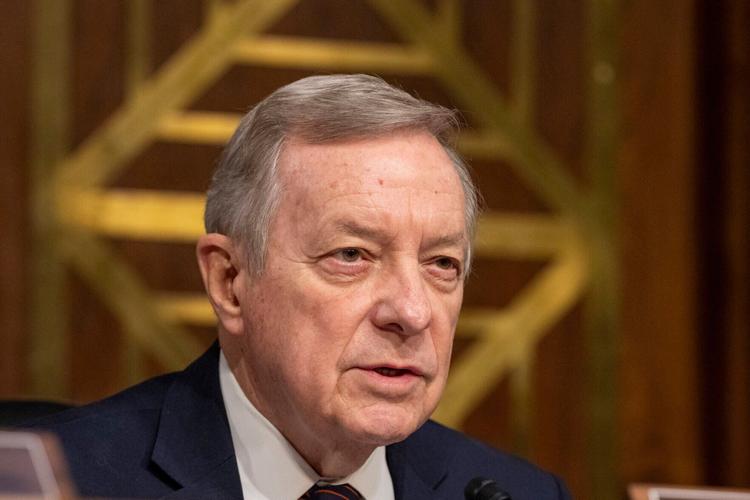
U.S. Sen. Richard Durbin, D-Illinois, introduced bills in 2019 and 2024 that aimed to have detainees sent to solitary confinement only for short calming periods of a few hours, rather than the extended stays of days or weeks.
The 2024 bill would have limited the length of solitary stays in immigration detention to a maximum of 8 hours each day and 16 hours every 7 days, unless there was a “substantial and immediate threat” that could not be addressed another way. Then, solitary confinement could be used for up to 7 days in a 14-day period.

U.S. Sen. Richard Durbin, D-Illinois, introduced bills in 2019 and 2024 that aimed to have detainees sent to solitary confinement only for short calming periods of a few hours, rather than the extended stays of days or weeks. Both bills on the issue died in committee. "The overuse of solitary confinement remains a stain on our nation,” Durbin said in 2024.
It would be illegal to place people who were pregnant; had serious mental illnesses, like Dehghani; were younger than 25, like Aghar and Borisov; or had disabilities in solitary confinement at all, unless they posed a “substantial and immediate threat,” the bill states.
Durbin said during a 2024 hearing that he had been working on this issue since 2012, when he convened the first-ever Congressional hearing on solitary confinement. But both of his bills on the issue died in committee.
“More than a decade later, the overuse of solitary confinement remains a stain on our nation,” Durbin said in 2024.
A third federal bill that would similarly restrict the use of solitary confinement in all federal facilities, including immigration detention, was introduced in 2025 by U.S. Rep. Sydney Kamlager-Dove, D-California. That bill remains in committee.

‘Fighting for my life’
Aghar, the teenager detained in Arizona last year, said he still can’t fully believe he’s been imprisoned for more than a year.
He’s asked to be deported to Afghanistan, even though he would be at risk there because his father worked with and supported the U.S.-backed government in Afghanistan, before its 2021 collapse, making him a Taliban target.
Aghar is still detained because DHS can’t obtain travel documents for him to return to Afghanistan, his former attorney said.
“I’m supposed to be finishing school right now. I’m supposed to be thinking about my future,” he said. “Just deport me. I don’t want to be here.”
Aghar’s time in civil detention has no end date, which he said makes it less bearable than a defined prison sentence would be, for someone who’d actually committed a crime.
The days pass slowly, the teenager said.
“Some nights I pray and I cry. I want to die here,” he said. “I just want to sleep and not wake up.”
Borisov felt similarly during his more than a year at Eloy. He struggled with depression daily, but kept that information secret because he didn’t want to get sent back to solitary.
“Every day I'm waking up, and I'm thinking about when it’s going to end. And oh my god, I wish it was going to end today,” he said in early March. “I just want to get out of here.”
Borisov was released a few weeks later to California after winning his habeas corpus petition, which argued that his lengthy detention was illegal.
He continues to fight his appeal and is seeking work authorization so he can afford a place to live. He’s currently homeless, relying on friends to avoid living on the streets.
Borisov said he feels like he served a sentence for something he didn’t do. People treat him like a criminal even though he never broke the law. He didn’t even cross the border illegally. He said he wants people to know what happened to him.
“This is a horrible journey I went through,” he said in April. “I need to keep fighting for my life and my story.”
Contact reporter Emily Hamer at emily.hamer@lee.net or 262-844-4151.
Contact reporter Emily Bregel at ebregel@tucson.com. On X, formerly Twitter: @EmilyBregel

Emily Hamer
Public Service Journalism reporter

Emily Bregel
Border reporter



 Two pregnant detainees hospitalized in Arizona; one claims border agent struck her