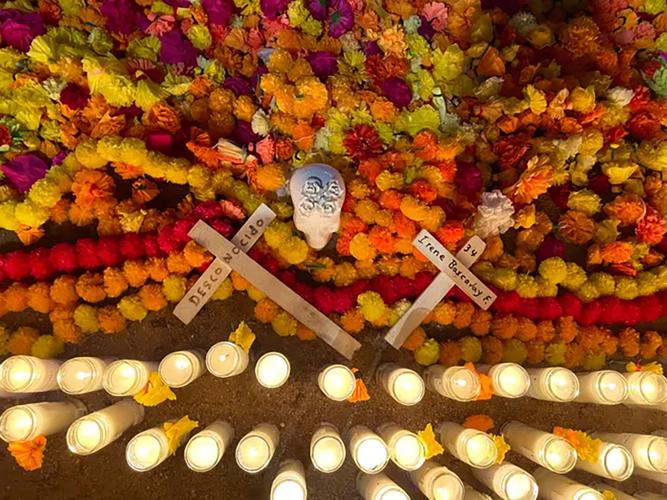
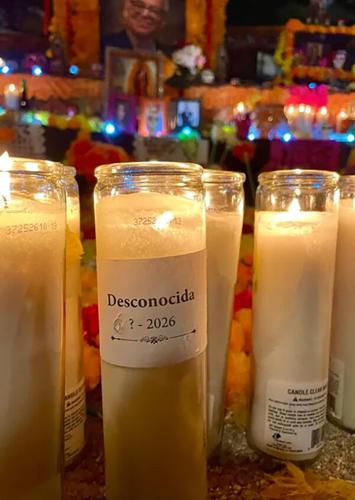
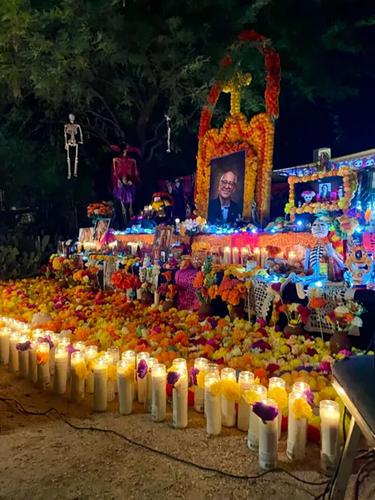
The warm candlelight from a 60-foot-wide by 10-foot-high altar at "El Tiradito," a popular shrine in downtown Tucson, could be seen from the street corner of West Cushing Street and South Main Avenue on the night of Nov. 3.
In that glow, by the colorful display of paper flowers, food and drink offerings, and framed photographs, about a hundred people gathered a day after the Day of the Dead celebrations.
They placed 121 candles to commemorate people who have died in the Arizona desert after crossing the U.S.-Mexico border illegally to seek refuge, economic opportunity, or to reunite with loved ones. Dozens more candles were placed for those who died in immigration detention.

This year alone, the remains of 100 people have been recovered from the Arizona borderlands, one of the deadliest crossing areas for families and single adults who seek to enter the United States without authorization.
People are also reading…
More than 4,000 remains have been recovered since 2003, according to data from the Pima County Medical Examiner's Office.
"That's the year I started taking antidepressents," said Maru Carrasco, who has been over two decades with Derechos Humanos, or the Human Rights Coalition, the grassroots nonprofit organizing the evening vigil.
At the time, Carrasco was helping families in Mexico find their missing loved ones in Arizona, either lost in the desert or in detention, when she received basic training from the Medical Examiner's Office. They wanted volunteers assisting those families to understand the basics of postmortem examination, she said, so there were better chances at identifying the deceased. That year, she walked into two refrigerated semitrucks, serving as morgues at the time.
From 1998 to 2003, the number of migrant deaths in the Arizona desert grew tenfold. It hasn't gone back down significantly.
"The one thing that is consistent is that the death crisis remains," said Brad Jones, a political science professor at the University of California, Davis Global Migration Center and board member with Humane Borders, the organization partnering with the Medical Examiner's Office to map migrant deaths in Arizona.

The Pima County Medical Examiner's Office serves five other counties across Arizona, including Santa Cruz and Cochise. When Border Patrol agents, hikers, tribal members and humanitarian workers find a body or its remains, they report it to other law enforcement, which then calls the Examiner's Office.
This year, the number of found remains dropped by half in comparison with 2023. The lower death toll correlates to the drop in apprehensions by U.S. Border Patrol, but that decrease is part of year-to-year fluctuations that don't create a trend over time, Jones said.
Greg Hess, Pima County medical examiner, had a similar perspective: The numbers wax and wane.
"For us really there is nothing different," he told The Arizona Republic. "It won't be impactfully different unless we return to our pre-2000 numbers. Which I don't ever foresee happening in the near future."
In Arizona, more than 4,500 people, 379 minors and children included, have died in the desert after crossing the border illegally. Hess' office began tracking this data separately, as a population subset, in 1981. Migrant deaths ramped up at the start of this century.
An incomplete picture of border deaths
There's no telling how many migrants have died across the U.S. borderlands. California, Arizona, New Mexico and Texas all run different death investigation systems; there is no unified federal system per se for migrant deaths, said Hess, Pima County's medical examiner.
Hess' office, and Texas' Webb County Medical Examiner’s Office, are the best source of public data.
U.S. Customs and Border Protection tracks migrant deaths and the border through the Missing Migrant Program but has not made data on it public since 2023. The agency is required to report annually to Congress the number and location of unidentified remains along the southwest border. The agency did not provide The Republic with figures on this years' deaths.
Annual reports for fiscal year 2025 lacked important information, "creating gaps in congressional oversight" agency's missing migrant program, said a report from the U.S. Government Accountability Office.
The work to examine, identify and report data on migrant deaths is no different to other work done by the Examiner's Office, Hess said. It's just part of the work they do, with no dedicated personnel or funding.
Just like other subsets of deaths — i.e. overdose, heat-related deaths, veteran suicide or domestic violence — available data helps inform initiatives or policy, he added. Like placing more cooling stations in an area, or investing in prevention programs.
"If you don't have an objective number, then people are just making stuff up."
Exposure to extreme temperatures is the most common cause of death, but there are thousands of skeletal remains for which autopsy or identification are hard or impossible to determine. Nearly 350 migrants have also died in the borderlands from blunt force injuries, gunshot wounds or other injuries from homicide, according to data from the Pima County Medical Examiner's Office.
Some human remains are recovered on private lands, others in federal wildlife refuges, national monuments or Forest Service lands. About 40% of all human remains have been recovered on lands from the Tohono O'odham tribal nation.
Fewer water stations will increase deaths, nonprofit says
Humane Borders, the nonprofit partnering with the Medical Examiner's Office to map migrant deaths' data, has kept emergency drinking water stations out in the desert for over 20 years to prevent deaths from dehydration and exposure.
Through a volunteer-driven network, they installed and refill dozens of 55-gallon blue plastic barrels across private and public lands in southern Arizona. This year, the number of water stations will decrease.
The organization relied on annual permits from federal agencies to operate the stations. Between September and October, the National Park Service, Bureau of Land Management, and U.S. Fish and Wildlife Service refused 12 permit renewals.
Among these losses are stations in Cabeza Prieta and Buenos Aires National Wildlife Refuge, Ironwood National Monument, and Organ Pipe Cactus National Monument.

More than 4,000 remains have been recovered across Arizona's borderlands since 2003, according to data from the Pima County Medical Examiner's Office.
The organization fears more migrants will die as a result of this decision. They will continue to operate stations on private land.
Since Humane Borders began its work, it also hasn't received permission from the Tohono O'odham Nation to operate and maintain water stations on its land. The sovereign tribe, whose ancestral territory stretched into the Sea of Cortez before it was split by the Gadsden Purchase, has 62 miles of international border with Mexico.
Who is to blame?
Humanitarian groups and migrant advocates say deaths near the southern border result from policies that purposefully push migrant crossings to remote, dangerous territory — a policy called "prevention through deterrence" implemented since 1994.
CBP points to criminal organizations.
"Smugglers routinely place people in perilous situations, provide them with misleading information, abandon them in remote areas, and treat them as commodities for profit with no regard for human life," a spokesperson for the agency wrote to The Republic.
The Border Patrol was aware of the deadly results of the strategy to deter migrant crossings by beefing up border enforcement close to cities. As a result, it launched a safety initiative to address rising deaths in southern Arizona, according to a 1998 report from the Congressional Research Service.
“Illegal entry is a petty misdemeanor,” Sabri Dikman, the acting chief in Border Patrol's Tucson sector, told USA TODAY in 2021. “And that’s certainly nothing that would be deserving of a death penalty.”
Some migrant advocates see systemic root causes as the culprit: violence, instability and poverty so great at their country of origin or region that they compel families to take life-threatening risks.
The difference on how migrant deaths are framed can have big impacts on policy, suggested Jones, the UC Davis professor. One of his areas of research focuses on "blame attribution" when it comes to migrant deaths at the border.
In his survey studies, Jones randomized people into groups and provided different context and information — like the reason behind migration — and asked who was most likely to blame for the situation.
"The analogy is similar to homelessness: Who is responsible? Is it the individual itself, or is it the societal conditions that lead some people to become homeless?" Jones said.
"Depending on what side of the coin you fall on, it will affect the menu of policies that you might be willing to support."