After the latest incident of border-wall contractors disturbing or destroying Indigenous sacred sites in Southern Arizona, critics are calling for an end to the federal government's power to ignore dozens of environmental and cultural protection laws under a waiver authority established after the Sept. 11 terrorist attacks.
Two months ago, border wall contractors building a second 30-foot steel border wall in Organ Pipe Cactus National Monument unearthed Native American remains, U.S. Customs and Border Protection confirmed.
The National Park Service notified CBP of the discovery on Sept. 14, six days after the discovery was made, a CBP spokesperson said in an email.
But the unearthing of human remains — first reported Nov. 2, by ProPublica — was not publicly disclosed by CBP, nor the National Park Service.
People are also reading…
"CBP’s Cultural Resource Specialists examined the area surrounding the location identified by NPS and found no additional items," the CBP spokesperson said in a statement Friday. "CBP understands that NPS collected the entirety of the discovery. No additional construction has occurred at this location to date."
CBP's Turner directed the Star to the National Park Service for more information on the incident, but NPS did not respond to the Star's Friday emails.

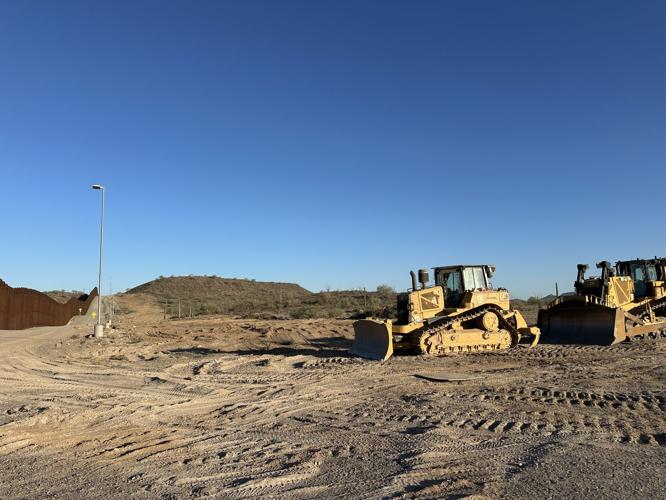
In an August photo, construction vehicles wait at a staging area being cleared for construction of a second border wall through Organ Pipe Cactus National Monument.
The desecration of her ancestors' final resting place did not come as a surprise to Lorraine Eiler, an elder of the Hia-Ced O'odham people, who have ancestral ties to the Tohono O’odham Nation and deep roots in the borderlands.
Eiler, who spoke to the Star Friday, said she had warned that her people, the Hia-Ced O'odham, have many burial sites in the borderlands and that fast-moving, "irresponsible" wall construction was bound to unearth human remains.
"It doesn’t surprise me that they found remains," she said. "They don't know the history of the area, so they’re just going blindly along. Even if they did, it's not going to stop them."
The disturbance came five months after CBP contractors in April bulldozed through an Arizona archeological site, estimated to be older than the Egyptian pyramids. Two experts in rock-art dating said the 270-foot-long, fish-shaped geoglyph, known as Los Playas Intaglio, was scraped into the desert floor by ancient Indigenous people at least 6,500 years ago, the Star reported.
It was partially destroyed by heavy equipment clear-cutting the land to make way for a second border barrier through Cabeza Prieta National Wildlife Refuge.
For Eiler, it's hard to believe the level of negligence that would be required to destroy the geoglyph accidentally. Contractors had been warned it was there just the day before machinery drove through it, she said.
"To me, its a deliberate act," she said. "Just to get it out of the way, so they won't have to face a lot of people that will say, 'Don't do that.'"
A CBP spokesman previously told the Star that "the remaining portion of the (intaglio) site has been secured and will be protected in place."
Waiver authority
The tool that's allowed for such rapid construction of miles of border wall, and secondary border wall, without regard for the environmental impacts or Native American consultation, is the "waiver" authority granted by the Real ID Act, passed into law four years after the Sept. 11, 2001 terrorist attacks.
In the name of border security, the law allows the Department of Homeland Security secretary to waive dozens of laws that were designed to prevent the kind of desecration CBP has been committing in the borderlands, said David Martínez, professor of American Indian and trans-border studies at Arizona State University.
"I think everything goes back to the 2005 Real ID Act. There was that provision in there that basically gave the federal government carte blanche to waive everything," he said. And the Trump administration has been treating the Arizona borderlands as if it's a war zone, he said.
"The Trump administration has been operating on the basis that we're confronting a national emergency," Martínez said. "It's put the nation on a war footing. The thinking when you're going to war is that sacrifices have to be made. Unfortunately, it's Indigenous people like the Tohono O'odham who seem to be making most of the sacrifice."
U.S. Rep. Adelita Grijalva, D-Arizona, called the latest incident "an outrage" and called for an end to the waiver authority, in an emailed statement Thursday.
"For months, Tribal leaders and elders have warned DHS about the devastating consequences of bulldozing through their ancestral lands, beginning with the destruction of the Las Playas Intaglio. For months, those warnings have fallen on deaf ears. Now, we are seeing exactly what they feared: sacred sites destroyed and burial grounds desecrated," she said.
Grijalva said she plans to introduce legislation to put an end to the waiver power.
"This is precisely why we must end DHS’ sweeping authority to waive laws designed to protect Tribal sovereignty, sacred sites, and environmentally sensitive lands," Grijalva said. "I will be introducing legislation to repeal that authority and void existing waivers that have allowed DHS to ignore these protections and carelessly bulldoze through much of our southern border."

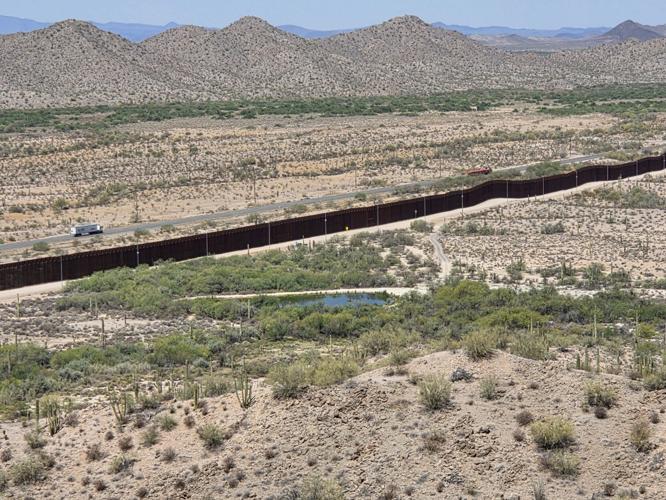
The view from a nearby hilltop shows Quitobaquito Springs with the border wall just south of it. The U.S. plans to build a secondary border barrier there, through Organ Pipe National Monument.
Russ McSpadden, Southwest conservation advocate for the nonprofit Center for Biological Diversity, said the environmental advocacy group would welcome such a reform.
"We absolutely support any legislation that would bring law back to the construction of border wall," he said.
McSpadden said he was in Organ Pipe in 2020 to document border wall construction. He watched as CBP "dynamited Monument Hill, which the Tohono O’odham tribe had announced contained burial remains," he said. "They blasted it anyway."
The U.S. Congress, to be controlled by Democrats starting in January, could move to rescind the waiver authority from CBP and its contractors, McSpadden said.
"At that point there would be real accountability. They would have to take into account these important laws," he said. "Of course, they'd have to move slower. But we wouldn’t have these kinds of issues."
The Native American Graves Protection and Repatriation Act, or NAGPRA, would have helped prevent the unearthing of human remains, but it was among the dozens of laws waived by DHS to clear the way for wall construction, Martínez said.
To casually waive such crucial protections is "offensive," said Martínez, who is a member of the Hia-Ced O’odham and Gila River Indian Community.
"When you bury someone, when you send them on their journey, then where those mortal remains are placed becomes sacred ground. That shouldn’t be disturbed at all," he said.
Under NAGPRA, "any construction that's going on in the site in question should come to a complete halt" after the discovery of human remains, Martínez said. "The site should remain undisturbed, according to the law, so the proper authorities can come in and survey the area."
Cash driving projects
The Department of Homeland Security, parent agency of CBP, was given $47 billion for border-wall construction under President Donald Trump's signature 2025 spending package.
CBP has since rushed to build two 30-foot-tall steel barriers along the entirety of the southern border with Mexico, leading to tensions and legal stand-offs with tribal leaders and environmental advocates along the U.S.-Mexico border, and even with Republicans in Big Bend, Texas.
Tribal members and conservationists are also concerned about the desert oasis at Quitobaquito Springs, in Southern Arizona's Organ Pipe Cactus National Monument. A CBP map showed the path of the second border wall cutting directly through the pond itself, McSpadden said.
Among CBP's major wall projects is the so-called "Tucson 5 project," to build the first of two 30-foot border walls planned along the Tohono O'odham Nation's 62-mile southern boundary with Mexico, where the Nation's ancestral lands stretch to the Sea of Cortez in Sonora.
The contract award, listed on USAspending.gov, gave $1.3 billion to a subsidiary of Texas construction company SLSCO LTD, with a "potential award amount" of up to $2.2 billion.
In June, the Tohono O’odham Nation sued the federal government, seeking to block the project, but a federal judge has twice rejected the tribe's injunction requests.
CBP told tribal leaders it would begin removing thousands of saguaro cacti, sacred to the Tohono O'odham, and other vegetation from the Nation's ancestral lands in mid-October.
Tohono O'odham Chairman Verlon Jose said last month that the Nation's members are preparing for potential confrontations with border-wall contractors carrying out the removal. But those contractors haven't shown up yet.
CBP did not respond to the Star's Friday query about when those pre-construction activities are expected to begin.
The enormous funding outlays to private contractors for border-wall construction need to be redirected, said Eiler, of the Hia-Ced O'odham.
"I would like to see the Congress stop all the money" for the border wall, she said. "I think if they stopped all the money, all the contractors would disappear."
In lieu of canceled contracts, Eiler envisions nature reclaiming the sacred lands.
"I would like to see a lot of rains come and wash down the wall," she said.
Contact reporter Emily Bregel at ebregel@tucson.com. On X, formerly Twitter: @EmilyBregel

Emily Bregel
Border reporter


 Plans for border walls on Tohono O'odham land a 'betrayal,' chairman says