An undocumented man from Honduras, who has lived on Tucson’s south side for more than a decade, narrowly avoided being picked up by immigration agents who initially claimed to be utility workers, according to neighbors who witnessed the apparent immigration operation.
While watering flowers in her front yard Wednesday morning, Christine Cariño was approached by two men claiming to be from Tucson Electric Power, she said. One said they were looking for a neighbor of hers.
“He said, ‘We’re trying to find somebody that wanted a free estimate,’” said Cariño, 37, a mother of three and long-time resident of the close-knit neighborhood, near South Sixth Avenue and Ajo Way.
Cariño recalled TEP workers had been in the area recently, but the two men weren’t in uniform, as TEP requires; one had a bright reflective shirt on and the other a black T-shirt.
People are also reading…
Their questions about the undocumented neighbor made Cariño suspect that the men were agents with Immigration and Customs Enforcement, she said, speaking to the Arizona Daily Star at her home Thursday.
As one of the men moved toward her neighbor’s yard, Cariño said, she noticed the other wearing a badge under his shirt.
When she asked if he was from HSI — Homeland Security Investigations, ICE’s investigative arm — “he just smiled. So I took off running” across the street to warn her neighbor, Cariño said.
Cariño filmed her interaction with the two men while they were inside the yard of her neighbor’s home, after the undocumented man’s stepson let them inside the front gate, believing they were TEP workers, she said. The young man and his stepfather declined to speak with the Star.
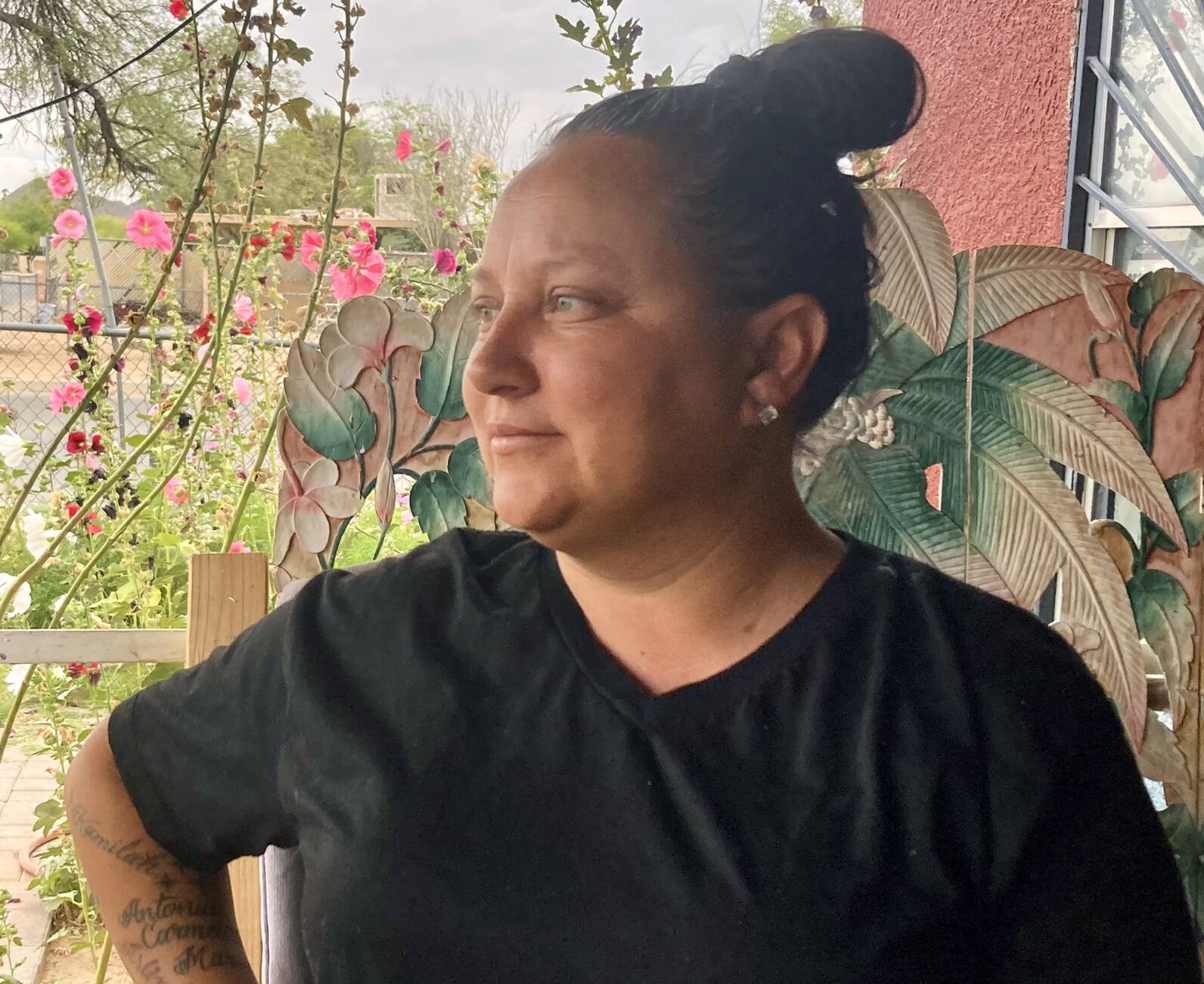
Long-time southside resident Christine Cariño intervened recently when two men who told her they were utility workers questioned her neighbor about his immigration case. Her effort kept the neighbor, who is from Honduras, from allowing the suspected ICE agents into his home.
Cariño said she intervened just before the undocumented man, who was inside, was about to let the suspected agents into his home, which would have made the man vulnerable to arrest.
“They’re lying! They’re not in uniform,” Cariño says in the video, which she shared with the Star and which KGUN 9 first reported. “Don’t let them in; they don’t have a warrant.”
Immigration agents can’t enter a private space such as a home without consent, unless they have a judicial warrant signed by a judge. ICE agents usually have only an administrative warrant, which doesn’t carry the same authority, or no warrant, advocates say.
Speaking outside the undocumented man’s front door, the suspected agents then said the man had missed an immigration court date, which the man denied, saying he attends all of his scheduled court dates, Cariño said.
An ICE spokeswoman declined to comment on the allegations of agents impersonating TEP workers, saying, “It’s an ongoing investigation,” in an email response to the Star’s questions.
The spokeswoman, Yasmeen Pitts O’Keefe, told the Star twice via email that if she were in the reporter’s position, “I’d be very careful with the TEP storyline.” She declined to elaborate.
All TEP employees wear uniforms displaying the TEP logo, and all of their vehicles are marked, to avoid concerns about impersonation, TEP spokeswoman Rhonda Bodfield said in an email.
Cariño said the incident will make TEP customers scared to let utility workers into their homes.
“That should be considered a crime, impersonating a company to try to remove somebody from a home,” she said. “If he had a warrant, the situation would have been different. Do it the right way.”
4th Amendment protections
The apparent immigration operation on Wednesday appeared to use the type of deceptive tactics that were the subject of an American Civil Liberties Union lawsuit filed in California in 2020, a civil rights attorney said Friday.
Immigration agents misrepresenting their identity or purpose is “unfortunately a tactic we’ve seen employed in Southern California and across the United States,” said Stephanie Padilla, staff attorney at the ACLU Foundation of Southern California.
“The home has a lot of protections under the Fourth Amendment. You cannot misrepresent your purpose or your identity when you’re doing ICE enforcement operations at or around the home,” she said.
The ACLU’s complaint centered on the practice of ICE agents trespassing on civilians’ porches and private areas around their homes, without permission or a warrant, in order to make arrests. It also alleges the common practice of ICE impersonating local police or probation officers to gain access to a home, or to “lure” someone outside so they could be arrested, is unconstitutional.
“As part of these ruses, ICE officers routinely wear uniforms that have ‘POLICE’ written on them. Typically only after arresting unsuspecting residents do ICE officers reveal their true identities and purpose,” the complaint said. “The Fourth Amendment does not permit ICE officers to coerce ‘consent’ to enter the home by impersonating another government official and misrepresenting their purpose in seeking entry.”
The latter claims are the subject of a still-pending settlement agreement with the Department of Homeland Security, which as currently written prohibits ICE from misrepresenting their identity and purpose in enforcement operations.
A May 2024 court order on the trespassing claims ruled for the plaintiffs, calling ICE’s actions a violation of the Fourth Amendment protection against unreasonable searches and seizures.
The ruling applies only to ICE’s L.A. field office, which operates in seven Southern California counties, but sets a precedent for future litigants who might fight back against these tactics, Padilla said.
South Tucson Mayor Roxanna Valenzuela says the immigrant community has been living with heightened fear amid the Trump administration’s deportation campaign.
She praised Cariño’s actions, in response to the apparent ICE ruse, which took place about a mile south of South Tucson.
“That lady is a hero,” Valenzuela said. “We need to protect each other. Now is not the time to be silent.”
Cariño said she and her south-side neighbors have been “vigilant” about looking out for immigration agents, as enforcement operations have increased in frequency, and they stay closely in touch to protect one another.
“You have to stand up for what is right,” said Cariño, who said she considers herself the “community mom.”
Her daughter, Ashley Salazar, 21, said ICE shouldn’t target long-time residents like her neighbor, whose wife is now returning early from a visit to see her husband’s family in Honduras, due to Wednesday’s incident. The couple has lived across the street for more than 10 years, and they gave Cariño her first lemon tree for her garden.
“We know them and they’re good people,” Salazar said. “He’s been here many years. Why now?”
ICE arrest quotas rising
Immigration officials — facing aggressive arrest quotas for the Trump administration’s mass-deportation campaign — have been frustrated by advocates’ work to educate the public on their right to refuse entry to immigration agents who don’t have proper documentation.
In February, President Donald Trump’s “border czar” Tom Homan suggested he would have Democratic U.S. Rep. Alexandria Ocasio-Cortez investigated for supporting “know your rights” sessions for her constituents.
White House Deputy Chief of Staff Stephen Miller told Fox News this week that ICE is now expected to make at least 3,000 arrests a day, triple the daily arrests at the start of the Trump administration.
The White House has been working to increase the pool of deportable immigrants on multiple fronts, including the administration’s moves to revoke legal status for people who entered the U.S. legally, at a port of entry, via the now-canceled CBP One app, and to give DHS access to IRS taxpayer data for undocumented filers.
Agents also have been targeting immigrants as they attend required court hearings, attorneys say, with a slew of courthouse arrests in recent days in major cities across the U.S., including in Phoenix and to a lesser extent in Tucson.
And on Friday, the Supreme Court ruled to let the Trump administration revoke humanitarian parole protections granted to 500,000 people from Venezuela, Haiti, Cuba and Nicaragua, which came after the high court also allowed the administration to revoke temporary protected status for another 350,000 Venezuelans provided by the Biden administration, the Associated Press reported.
DHS has argued former President Joe Biden abused humanitarian parole and says those protections were always temporary in nature. In her dissent, Justice Ketanji Brown Jackson said Friday’s Supreme Court order will “have the lives of half a million migrants unravel all around us before the courts decide their legal claims.”
The Trump administration’s due process violations and unconstitutional practices not only harm undocumented immigrants, but also U.S. citizens, who have been the subject of wrongful arrest by ICE, said Alba Jaramillo, organizer with Tucson’s Coalición de Derechos Humanos, or Human Rights Coalition.
“Once law enforcement officials like ICE agents begin to violate our constitution, then it’s not just immigrants that are at risk of not having their due process rights protected,” she said. “It is all of us, regardless of our immigration status.”
Former Pima County Board of Supervisors Chairwoman Adelita Grijalva, now a candidate for U.S. Congress, said Friday reports about immigration agents potentially impersonating TEP workers are “deeply troubling.”
“Our communities deserve safety, transparency, and trust — not fear at their own front doors,” Grijalva said in an emailed statement. “I commend our community for standing up for transparency. The Trump Administration is attempting to chip away at the very rights that make our country great. Resorting to acts like this are unfathomable and we deserve better.”
Jaramillo said Derechos Humanos’ Rapid Response network connects volunteer advocates with vulnerable people who can request witnesses to quickly show up and provide support during immigration operations, or to accompany them to court hearings.
This moment requires everyday people to stand up for one another, Jaramillo said.
“We cannot leave it in the hands of law enforcement to do what’s right. We can’t even leave it in the hands of our elected officials to protect us or to make public statements,” she said. “It’s up to us to organize and to use our Rapid Response network to defend our own community. We shouldn’t be living in a country where we have to do that but sadly, our protection is now left in our hands.”
Contact reporter Emily Bregel at ebregel@tucson.com. On X, formerly Twitter: @EmilyBregel

Emily Bregel
Border reporter


 Deportation campaign turns to courthouses, re-opening closed cases