When Tucson residents hear the roar of military jets overhead, most assume they're watching aircraft from Davis-Monthan Air Force Base.
More often than not, they'd be wrong.
Those jets belong to the Arizona Air National Guard's 162nd Wing.

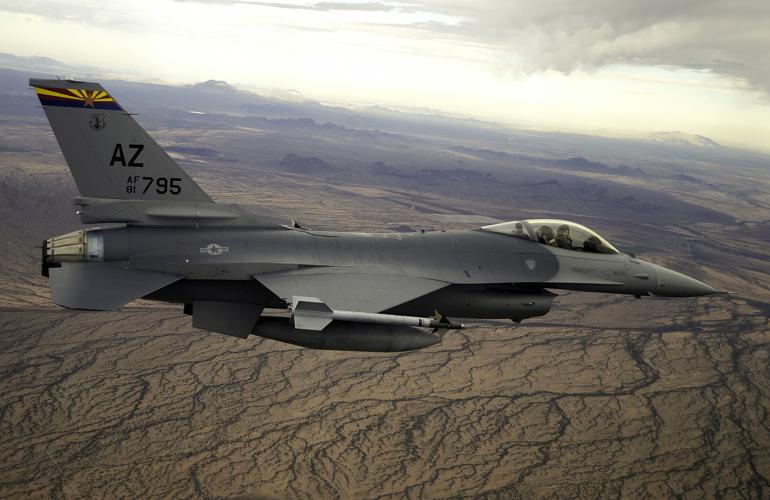
This 2019 file photo shows an F-16 Fighting Falcon from the Arizona Air National Guard’s 162nd Wing at Tucson International Airport.
Small base with global impact
Tucked along East Valencia Road, just northwest of Tucson International Airport — with whom it shares runways — the 162nd occupies only 92 acres.
But don't let the footprint fool you.
It is the largest F-16 pilot training base in the world, having trained pilots from 33 allied nations. Among them: the first Ukrainian F-16 pilot, trained here two years ago, with 12 more Ukrainians trained since.
The 162nd is also the largest Air National Guard Fighter Wing in the country. It operates three F-16 fighter squadrons of 24 planes each — no other Guard Wing has more than one — plus an MQ-9 Reaper squadron for unmanned reconnaissance and strike missions. An Aerospace Control Alert Unit, housed at Davis-Monthan, can be airborne in minutes. A Launch and Recovery Unit operates out of Fort Huachuca.
People are also reading…
In total, the base fields 78 F-16s, including a handful of the latest variant, the Block 70. The F-16 may not be the newest fighter jet in the sky, but it remains the workhorse of air forces around the world — and the 162nd is where the world comes to master it.
The Wing's mission runs three tracks: warfighting, through its F-16 and MQ-9 programs; homeland security, patrolling the skies over Arizona and across the U.S.; and international partnership, providing pilot training, maintenance support and military collaboration to allied nations.
A next door neighbor
Wing Commander Colonel Brant Putnam is about as Tucson as it gets. He's a Sabino High School and University of Arizona alumnus who arrived at the 162nd in 1990 and never left. Thirty-five years later, he's still here. And he's far from alone.
Of the base's nearly 2,000 Airmen , roughly 60% are full-time personnel. The other 40% are traditional Guardsmen — "weekend warriors" who hold civilian jobs, many of them continuing to serve as first responders.
Unlike active-duty bases where personnel rotate every two to three years, the people of the 162nd plant roots. This is their home base, in every sense. The result is a deep sense of family, both on the flight line and in the neighborhoods of Tucson.

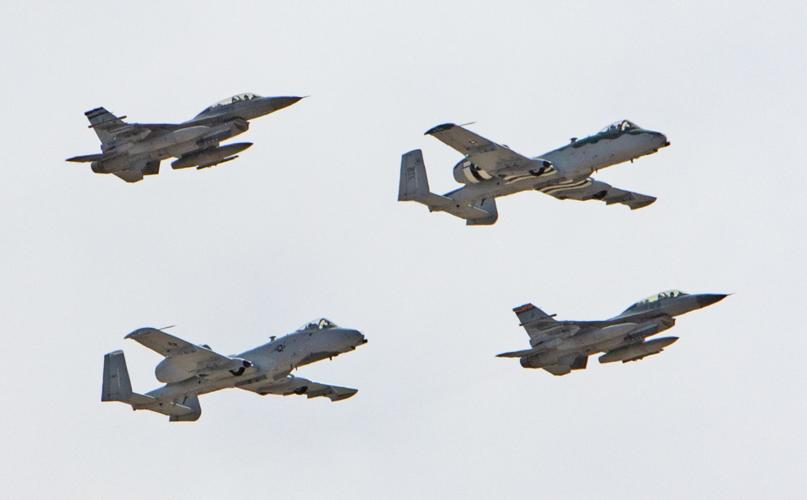
In the 2020 file photo, two F-16 Fighting Falcons from Arizona Air National Guard’s 162nd Wing and two A-10 Thunderbolt II's from the 355th Wing, assigned to Davis-Monthan Air Force Base, fly over Northwest Medical Center, as a flyover to honor hospital workers during the pandemic.
No one embodies that continuity more than Senior Master Sgt. Erica Carpenter. She is a third-generation 162nd Airman. Her grandfather came first, serving as a maintenance crew chief starting in the 1950s and retiring as a chief master sergeant. Her uncle followed the same path, earning the same rank. Today, Erica serves alongside a cousin — also third-generation — who rose to become a commissioned officer. Three generations. One base. One family.
Community Support
That stability doesn't just build esprit de corps — it builds the local economy. A 2023 Military Affairs Committee study estimated the 162nd's annual economic impact on Tucson and Southern Arizona at $616 million, with $117 million in payroll alone. Nearly 2,000 military families live, shop and invest here.
The Tucson business community has taken notice. The Air Guardians, a nonprofit formed specifically to support the Wing's personnel and families — and to advocate for keeping the base in Tucson — has become an important civic partner.
John Orcutt, a business leader and philanthropist, took over as the Guardians' President this year, bringing new energy, initiatives, and funding support to the organization. He's joined by 14 other board members drawn from business, the community, and retired military service.
"The Guardians are there to serve those that serve us," Orcutt says, "both locally and nationally." The organization delivers where it's needed most — funding scholarships, assisting with housing, providing computers to families, and even covering a service member's airfare home to bury his grandfather.
Their primary fundraiser, an annual golf tournament, takes place Monday, May 11, at Tucson National. Every dollar raised goes directly to the base and its personnel. With only 200 spots available, foursomes fill quickly — and a few sponsorships remain. To register, visit 162airguardians.org or contact Orcutt directly at john.orcutt@me.com.
The growth of a region is rarely built by a single institution. But some contributors are more essential — and less recognized — than others.
The 162nd Wing is one of them.
So the next time a fighter jet rattles your windows, remember: it's likely one of theirs, and the people keeping it in the air probably live right down the street.