

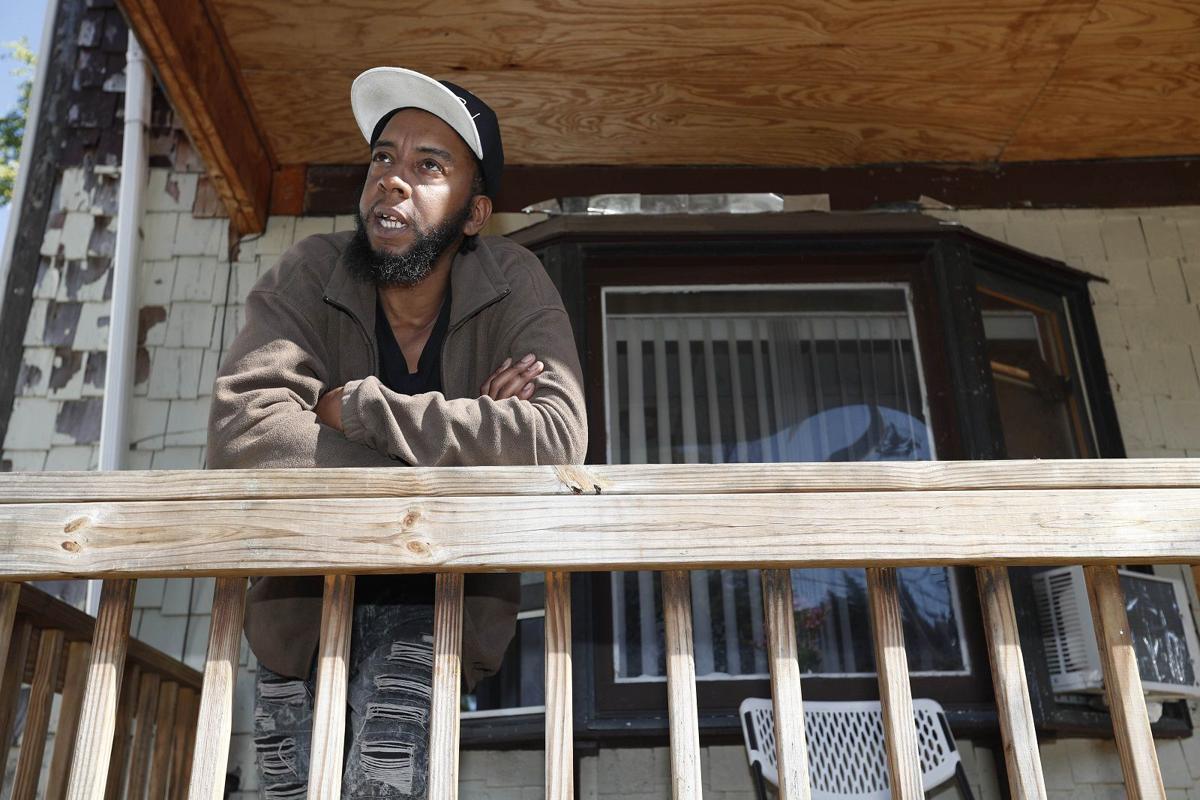
Kareem Allen knows what it's like to live in a part of Buffalo where gun violence is commonplace.
Allen owns a business in a section of the city – a slice of the Schiller Park neighborhood near the Cheektowaga border – that's had among the highest concentration of shootings over almost the last nine years.
The neighborhood has made progress and is in better shape now than it was perhaps 10 years ago, said Allen, who owns City Swagg Fashion on Genesee Street.
"For the most part, it's a lot better," he said.
While the number of people shot through the end of summer this year in Buffalo dropped to the lowest point in at least nine years, the steady drumbeat of gunfire continues on some city streets.
And even with the recent downturn, gun violence rattles some neighborhoods more than others. In this part of Schiller Park, an average of one person has been shot each month for the last 8 1/2 years, according to a Buffalo News analysis of Buffalo Police Department statistics. Across the city over that period, 2,119 people have been injured or killed in shootings.
People are also reading…
Citywide, gunfire has been less prevalent so far this year. Through the end of August of this year, 119 people were shot in Buffalo. That’s the lowest number over the eight-month period in at least nine years, according to Buffalo Police Department statistics.
That figure represents a 28% decrease in persons shot compared to the average over the same period from 2011 through 2018, according to department statistics. It’s a 29% drop compared to the same period in 2018.
Buffalo police officials have attributed the overall drop in shootings this year to an increased focus on community policing.
They have also cited ramped up departmental efforts to reach out and engage with individuals who fall into one of three categories: people police believe are involved with group violence, those who carry guns and "vulnerable people hanging around with bad actors."
Hardest hit
The pocket of the city within the Schiller Park neighborhood, which makes up less than a quarter of a square mile, is among the hardest hit by gun violence since the start of 2011.
To a person walking through the neighborhood, this tiny piece of Buffalo appears not unlike many other parts of the city. But it sees much more gun violence. A roughly six-block area that straddles Genesee Street south of East Delavan Avenue has had four homicides from July 2018 through the end of August. From January through August of this year, six people were shot; two of those victims died.
The News analyzed incident data from Buffalo police of more than 4,000 incidents of gunfire across the city from the start of 2011 through the end of August.
In the area south of East Delavan, from East End Avenue just before the city line with Cheektowaga to Floss Avenue, and then south of Genesee from Countess to Humason avenues, there have been 177 total shooting incidents. That includes reports of the sound of gunfire, as well as persons shot.
In the 104-month period from January 2011 through August of this year, 102 people were shot in this relatively tiny pocket of the city, according the News' analysis of police data.
Over the same period, other larger neighborhoods in Buffalo have seen far lower rates of gun violence.
In Riverside and Black Rock combined, 86 people were shot, according to The News' analysis. On the West Side – a much larger section of the city than this portion of Schiller Park – 133 people were shot.
But the high incidence of shootings in Buffalo extends beyond just Schiller Park. Many of the places in the city with the highest shooting rates sit adjacent to Genesee Street; in fact, Genesee runs through four neighborhoods where shooting rates are among the highest in Buffalo.
This part of Schiller Park consists of a main commercial area along Genesee, which includes a Save A Lot grocery store, a church, some corner stores and several other businesses, including a restaurant, barbershop, photography studio and a custom T-shirt store. Along East Delavan are a couple corner stores, the former Buffalo Public School 171 and several shuttered storefronts.
Use the interactive map below to view shootings in Buffalo month by month from January 2011 through August 2019:
Some residents were hesitant to talk with a News reporter about gun violence in the neighborhood. Levels of concern among residents appeared to vary. One woman said the only reasons she lets her 10-year-old grandson go outside are to walk the dog and take out the trash because of concerns for his safety.
Allen, the clothing store owner, grew up near Bailey Avenue. Despite the statistics, he believes conditions in the neighborhood have improved. He credits business owners who he says have placed an emphasis on engaging with youth and not allowing individuals to loiter outside their businesses.
Gunfire is more commonly heard around the area in the summer months, said Jermaine Lester, who lives on Eller Avenue.
Does Lester feel unsafe living here? "No, not really," he said, standing on the front porch of his home one recent afternoon.
Lester has lived on Eller on three different occasions, moving to the street in 2008, 2012 and again last year. His frequent moves back to Eller came because, he said, there's "nowhere to live."
"The first house you find, you gotta take," he said.
Not just shootings
In Schiller Park, it's not only shootings that plague the residents. The neighborhood had the most reported incidents of all types of violence in seven years from 2007 through 2016, a 2017 News analysis found.
One of the most high-profile incidents was a double-shooting on Humason Avenue in June 2016 in which an 11-year-old boy was shot in the head.
Maurice Frazier is one of the business owners in the neighborhood fighting to make things better. Co-owner of the Clipper Gods, Frazier's barbershop has been operating since 2003.
While there are incidents, crime is not an issue for his business and conditions in the neighborhood have improved, he said.
Frazier said he believes many of the perpetrators don't actually live in the neighborhood, which has seen an increase in African American-owned businesses.
"You don't see kids hanging on the corner," he said. "It's just not going on down here."
That's happening, he said, in part because of business owners who've been working to develop "a good culture" and be a positive influence for young people.
"We've got a great community over here," Frazier said. "I love it over here."


