
Shaving four years off a prison sentence on compassionate grounds, a federal judge Friday granted an immediate prison release for former Buffalo teacher Michael Masecchia, who an accomplice fingered as a member of organized crime during last year’s trials of former Drug Enforcement Administration Special Agent Joseph Bongiovanni.
Prosecutors opposed the emergency motion from Masecchia’s lawyer.
Brooklyn lawyer Elizabeth Budnitz of the Last Prisoner Project, a nonprofit organization that advocates for ending incarceration for marijuana-related crimes, said in court Friday that Masecchia has not received the medical treatment he needs inside his federal prison in North Carolina, and was also unlikely to get the care he needs in the future, putting him at risk of serious deterioration of health or even death.
People are also reading…
Since his imprisonment, Masecchia has been diagnosed with prostate cancer. At the time of his May 2022 sentencing, Masecchia had been diagnosed with lymphoma and had undergone chemotherapy treatment.
“He had one cancer when I sentenced him. Now he has two,” U.S. District Judge John L. Sinatra Jr. said during the hearing.

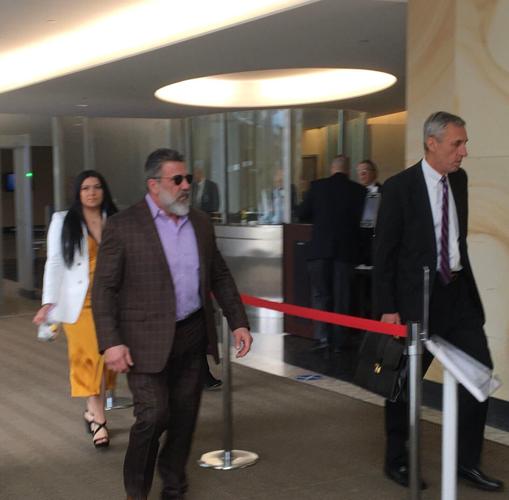
Michael Masecchia, left, walks out of federal court accompanied by his lawyer, Patrick Brown, after being sentenced to seven years in prison in 2022 for trafficking marijuana.
Assistant U.S. Attorney Joseph Tripi said Masecchia has been diagnosed with a low-risk prostate cancer. Doctors he has seen outside of the prison have closely monitored the cancer, and Masecchia himself has not sought immediate treatment, Tripi told the judge, saying Masecchia has received appropriate medical treatment.
“He’s not any worse today than when you sentenced him,” Tripi said in court.
Ruling from the bench, Sinatra said Masecchia had to show “extraordinarily compelling reasons” for an early release, and “this is one of those deserving cases.”
Lawyers from both sides made strong, valid points, the judge said. What helped tip the decision in Masecchia’s favor is that radiation is not an option for his prostate cancer because that was used to battle his lymphoma, Sinatra said.
So his treatment options are limited, creating a “heightened need for persistent monitoring.” While Sinatra was careful to craft his decision “without a stain” on the quality of the Bureau of Prison’s medical care, he said Masecchia’s prognosis is markedly better if he’s not imprisoned.
Sinatra, remarking on a letter Masecchia sent to the court, told Budnitz to deliver a message from him to Masecchia.
“I would say to your client he should keep that prayerful humility as he goes forward,” Sinatra said. “He’s created a debt to society he hasn’t paid back yet.”
Masecchia was three years into a seven-year prison sentence when his lawyer filed a motion for compassionate release. Most of the medical information is redacted in the court filings from prosecutors and Masecchia’s lawyer. Friday’s oral argument before Sinatra offered a glimpse of his condition, and most of it related to his new cancer diagnosis.
Sinatra heard a give-and-take between the lawyers on whose fault it was for missed doctors’ appointments and delayed biopsies.
Masecchia, 59, pleaded guilty in December 2020 to possession with intent to distribute marijuana and possession of firearms in furtherance of drug trafficking, and his sentencing was put off to 2022 after he was diagnosed with lymphoma and underwent chemotherapy treatment.
Masecchia’s lawyer described him as “a beloved high school English teacher and coach for 30 years” who touched the lives of many people. More than a dozen family members, including his wife, children and mother, attended Friday’s court hearing. They left the courtroom jubilant, but declined to comment on the judge’s ruling. The family members, former colleagues and community members submitted letters “attesting to his upstanding character,” according to a court filing from Budnitz.

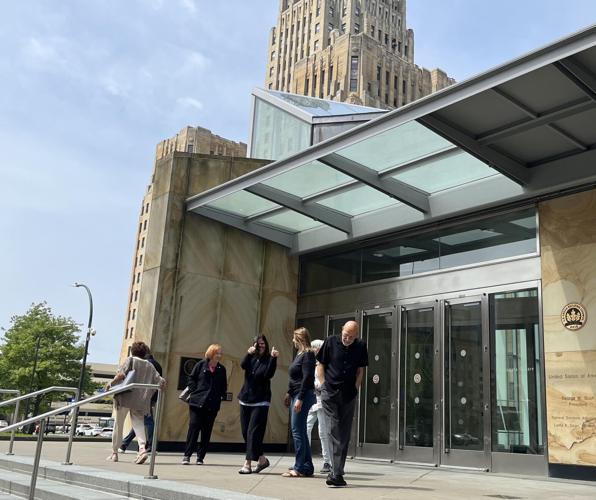
Family members of Michael Masecchia reacted with jubilation Friday, May 30, 2025, after a federal judge granted him an early release from prison.
“Given Mr. Masecchia’s age, rehabilitation, remarkable history in the community, and family support, he is extremely unlikely to recidivate and return to prison,” Budnitz said in a court filing.
Prosecutors scoffed at describing Masecchia as remarkable.
“Referring to him as some type of pillar of the community because he was able to blend in polite society as a teacher, while committing sustained drug-trafficking activity for decades, does a disservice to the public and is antithetical to the term ‘remarkable,’ “ Tripi said in a court filing.
Tripi described Masecchia as “a criminal who, since the time of his guilty plea and sentence, has been publicly exposed as a self-admitted member of an organized crime family.”
“To release the defendant now, far short of the completion of his bargained-for sentence, and without any real new justification, would result in a sentence that fails to reflect the seriousness of the offense, to promote respect for the law, and to provide just punishment for the offense,” Tripi said. “He has been a lifelong criminal operating in the drug world undetected while protected by a corrupt federal agent – all while blending into polite society.”
Ties to La Cosa Nostra
Masecchia, who admitted trafficking up to 3 tons of marijuana beginning around 1999, did not testify in either of Bongiovanni’s trials, which resulted in Bongiovanni being convicted on nine counts. But he acknowledged in his plea agreement that Bongiovanni helped him and others in the drug trade avoid arrest by providing law enforcement-sensitive information, including the names of potential cooperating witnesses.
Masecchia’s plea and sentencing came before Bongiovanni’s trials, and Tripi said the public testimony from witnesses in both trials made clearer Masecchia’s criminal conduct.
Budnitz downplayed the prosecution’s references to organized crime in its written argument opposing Masecchia’s release.
“This case is not about the Mafia,” she said. “It’s about Michael Masecchia.”
She said testimony in the Bongiovanni trials about organized crime connections were not reliable, and came from people who said “they heard this back in the day” without offering proof Masecchia was a member.
Lou Selva, who testified that he was involved in Masecchia’s Southern Tier marijuana-grow operations and trafficking, said Masecchia admitted to him to being a member of Italian organized crime.
Selva testified about organized crime connections in the case, saying he viewed Masecchia as a “tough guy” and listed Masecchia in his phone contacts as “gorilla.”
“I asked him, ‘Are you connected? Are you a made guy?’ ” Selva recounted at Bongiovanni’s trial. “He said yes.”
“Specifically, trial testimony during the trials of former DEA Special Agent Joseph Bongiovanni established that the defendant admitted to a co-conspirator that he is a member, and soldier, in the Buffalo La Cosa Nostra family, or Mafia,” Tripi said in his court filing.
Selva reported that Masecchia’s status as a member of Italian organized crime was known to Bongiovanni while the federal agent was providing protection to the drug-trafficking operation, Tripi said.
During Bongiovanni’s trials, prosecutors did not have to prove the existence of organized crime in Buffalo, but simply that Bongiovanni thought he was helping those associated with Italian organized crime.
Prosecutors relied on testimony from Selva, among others, to accomplish that.
“Trial testimony also established that (Masecchia) told a co-conspirator that he had to essentially kick up portions of his lucrative drug proceeds to individuals above him in the criminal organization,” said Tripi, citing Selva’s testimony.
“He admitted to someone he was a soldier,” Tripi told Sinatra on Friday.
Tripi said Masecchia already got “a sweetheart deal” in his plea agreement with the U.S. Attorney’s Office.
Although Masecchia was involved in drug trafficking over decades, the government agreed to the plea so that the public and law enforcement would see Masecchia’s public acknowledgement that Bongiovanni provided law enforcement-sensitive information to him, including names of potential informants.
“You don’t have to believe anything from the Bongiovanni trial,” Tripi told the judge Friday.
Look at his plea, the prosecutor said.
As for receiving information about informants, “it doesn’t get more dangerous than that,” Tripi said.
The government should get the benefit of its agreement with Masecchia, and that’s a seven-year prison sentence, Tripi said.
‘I am not the same person’
During Masecchia’s sentencing and as he sought early release, former students and colleagues portrayed Masecchia as a kind and dedicated teacher who took time inside and outside the classroom looking out for students.
Letters to the court from former colleagues recalled Masecchia, who taught English and coached soccer at Grover Cleveland High School, as someone always willing to help students, many of them from impoverished backgrounds. He bought breakfast sandwiches for his classes because students were hungry. He also took students tubing at Holiday Valley, and he helped one student get an athletic scholarship and even drove him to the Ohio college at the start of the student’s freshman year.
In a letter to the court, Masecchia said, “I am not the same person that entered prison on June 8, 2022.”
“I live with guilt, sadness, regret and remorse every day of my life,” Masecchia wrote. “Sadly, it takes longer for some of us to realize what’s important in life and what is not. Every day that I wake up, I try to be a better person than I was the day before.”
Masecchia called himself a role model to generations of students as a high school teacher and coach for more than 30 years.
“Today, due to my self-seeking actions, to this legacy is blemished, flawed and reversed,” he wrote. “But because I have faced the consequences of my conduct and learned numerous valuable lessons, I am now able to work tirelessly to reclaim a measure of that esteem, respect, dignity and trust that I previously held.
“I ask Your Honor to also consider that I am now 59 years old and that my health struggles have given me a new and different perspective on the value of life and liberty,” Masecchia wrote.
Sinatra took note of Masecchia’s youth mentoring and coaching along with other factors, while also considering the “significant” marijuana trafficking and weapons convictions.
“Three years in custody is certainly not a trivial amount of time to serve,” Sinatra said. “I am confident Mr. Masecchia will not disappoint all those folks who supported him or this court. That’s my expectation.”
Masecchia will be released immediately, as the judge denied the government’s request for a stay to his release. But Sinatra imposed home confinement until June 20, as the government weighs whether to appeal his release order.
Patrick Lakamp can be reached at plakamp@buffnews.com