

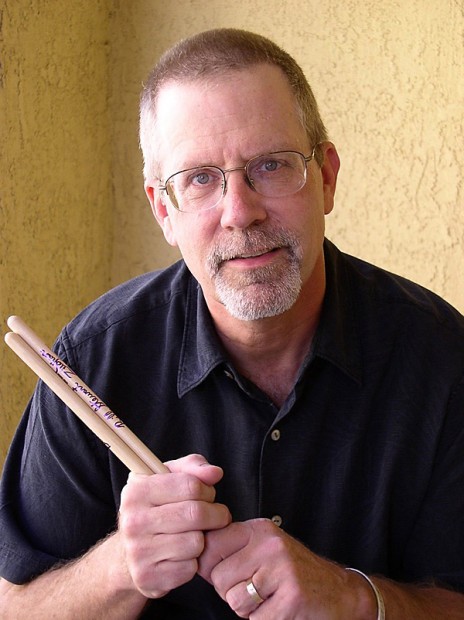
KUAZ listeners may know Dan Kruse as the station's afternoon announcer and local host of National Public Radio's "All Things Considered." They might be surprised to learn he's also a lifelong rock 'n' roll fan who has taught the University of Arizona's Rock and Popular Music in America course for five semesters.
Kruse will share his insights into the history and evolution of rock in a four-part lecture series that begins Wednesday at Academy Village, an active-adult community just off Old Spanish Trail six miles southeast of Saguaro National Park East.
The series is sponsored by the Arizona Senior Academy, and the four lectures will be held on consecutive Wednesdays in the academy's great hall, adjacent to the community center, beginning at 11:30 a.m. The series is free and open to the public, though seating is limited.
Kruse will include musical examples and video clips and encourage members of the audience to share important "musical memories" from their youth.
People are also reading…
But the series will be more than just a nostalgia trip - Kruse said the lectures will offer an examination of the cultural significance of rock music.
"As with all forms of music, rock music is a vehicle both for personal expression and a reflection of our society," he said.
"Since its birth in the early to mid-1950s, rock music has served as an outlet for the energy, passion and rebellious spirit of the youth culture. I'm convinced that rock could ONLY have been born in the 1950s, after the rise of Frank Sinatra as a pop music phenomenon, with the influence of Tin Pan Alley in our musical culture, and America's rich heritage of blues, gospel, country and doo-wop music.
"Rock 'n' roll exploded onto the scene in the post-war America of that time, with the growing affluence and the rise of the middle class, America's growing industrial might, the growth of suburbs, the building of the Interstate Highway System and the Cold War. In my first lecture of the series, I speculate (somewhat tongue-in-cheek) that the birth of rock 'n' roll may have been the result of a Communist conspiracy."
Kruse has lived in Tucson since 1997. He worked in radio broadcasting on the East Coast in the 1970s and early '80s, then had a two-decade career in corporate film and video before moving to Arizona with his wife.
Since arriving in Tucson, Kruse has enjoyed a career in music, performing and touring with a variety of jazz, pop and world music ensembles, and is now pursuing a master's degree in ethnomusicology at the UA School of Music, focusing on the production of documentary films on musical culture and history.
If you go
• What: Rock 'n' roll lecture series
• Time: All lectures will be 11:30 a.m.-12:30 p.m. on Wednesdays, starting Aug. 3 and continuing on consecutive Wednesdays.
• Where: Arizona Senior Academy Building, 13715 E. Langtry Lane.
• Cost: Free.
• For more information: Call 647-0980.
• Lecture 1: Tin Pan Alley, regional styles (country, doo-wop, R&B, bluegrass), independent record labels and the emergence of the 1950s "youth culture" and "auto culture." The birth of rock 'n' roll, Elvis, and the late '50s; record charts, marketing practices. "The Years the Music Died," including Buddy Holly and the payola scandal.
• Lecture 2: The "Between Years" (1959-1964): The Brill Building, the mainstream folk movement, girls groups, the "West Coast Sound," Phil Spector, "American Bandstand," rockabilly, "sweet soul," surfer music.
• Lecture 3: The Beatles and the British Invasion, and America's response in the form of folk rock, garage bands, etc. The growing role of television. Motown and black artists of the mid-'60s. The psychedelic movement, music and drugs, San Francisco, the "concept album" and the culmination of '60s hippie culture with Woodstock.
• Lecture 4: "Rock's Maturity, Diversification and Hubris." This special lecture examines the world of rock as it reaches its "late teenage years." Political turbulence, the "rock opera," jazz-rock, singer-songwriters, and an examination of Don McLean's "American Pie" as a historical/poetic landmark.
Fill out the form at azstarnet.com/east to contribute a story.


