

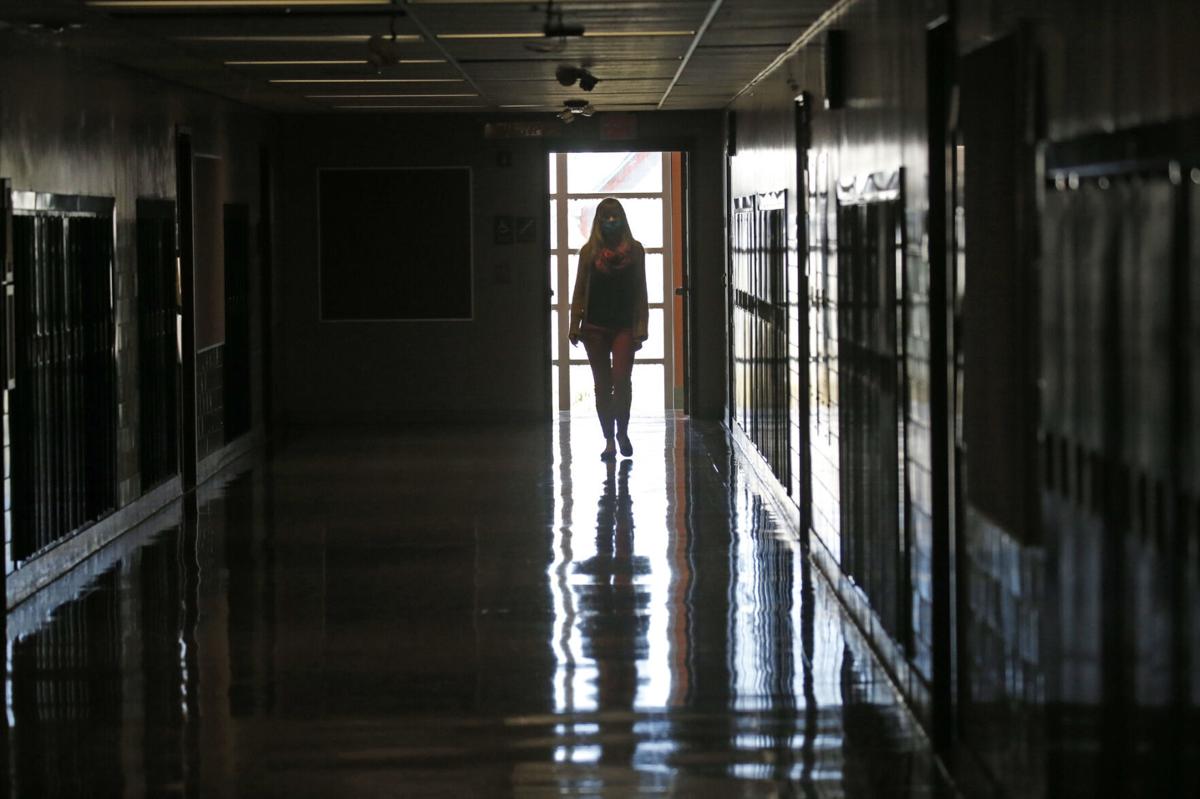
Students in Buffalo Public Schools haven't seen the inside of an actual classroom since March.
That's uncommon compared with most of their peers in Western New York and across the state.
Though the district announced Wednesday plans for a phased reopening to begin no earlier than Feb. 1, pressure continues to mount to allow at least some students to return to the classroom sooner.
Gov. Andrew Cuomo on Friday weighed in on Buffalo Public Schools' plans to stick with remote learning, as did Erie County Executive Mark Poloncarz.
Both Cuomo and Poloncarz have pointed to data that indicates the level of transmission of Covid-19 inside school buildings is lower than the spread seen in the community overall.
People are also reading…
"It is fair to say the governor and I are both concerned about lack of in-school learning in some districts, and the governor noted his concern regarding the Buffalo Public School District's plan to not reopen until February," Poloncarz wrote Friday on Facebook.
Schools Superintendent Kriner Cash has said his decision to keep Buffalo schools fully remote is based on the level of Covid-19 spread in the community, which in recent weeks has seen the number of cases and the number of people hospitalized explode past previous high levels set in the spring.
Read the full story from News Staff Reporters Keith McShea and Sandra Tan
There's "just way too much community spread right now," district Medical Director Dr. Dennis Kuo said Wednesday.
Of the "Big 5" districts in the state, only Buffalo and Rochester have not had any in-person learning since the pandemic hit in the spring. New York City, Syracuse and Yonkers have all allowed, at least at some point, students to return to school buildings. Since September, almost every school in the Buffalo suburbs has offered in-person instruction.
An analysis published in early October by the Education Trust-New York, a non-profit that advocates for low-income students and students of color, found 82% of all students in Buffalo, Rochester, Syracuse and Yonkers were learning remotely and only Yonkers had "significant hybrid learning" at that time.
Under Buffalo's plan, the first students to go back Feb. 1 would be several thousand of the district's highest-need students. More students would be phased in, until the full complement of the district's 32,000 students in grades pre-K through 12 would be back in the classroom in mid-March. Parents would have the option to send their children to school or continue remote learning, district officials have said.
District officials have already faced pressure to allow some students to get back to in-person instruction. Reaction from parents to the district's latest plans has been mixed, with many concerned about their children's safety if they return to school.
Others believe the risks can be properly managed and that sending students back to school, in addition to raising the quality of instruction, provides benefits children don't get from virtual classroom experiences.
"We're hearing from public health and child development experts that we should be getting kids back to school, if at all possible. So I think that needs to be done carefully and with mindful planning," said Jessica Bauer Walker, of the Buffalo Public Schools Community Health Worker Parent Association.
"But the fact that we haven’t had any of our children in school since March and some of our kids are really at significant risk and doing poorly in terms of academics and just overall health and well-being, being out of school, I think Buffalo needs to step it up a bit," said Bauer Walker, who is also the executive director of Community Network for Engagement, Connection and Transformation, a public health and education non-profit.
Students with special needs and those who have limited English proficiency seem to be struggling the most with virtual learning, said Bauer Walker. Learning remotely can be managed for a period of time, but for it to go on this long means young people are being hurt by not being around other people.
"It's really taking a toll on our families," she said.
For Bauer Walker, it's also an issue of equity.
"Our kids are so in need and families that are higher income and whiter than the families in Buffalo Public Schools are still getting access to education in schools and our kids aren’t," she said.
Many high school students want to go back to school and many are struggling without the in-person learning experience, said Gina Burkhardt, CEO of Buffalo Center for Arts and Technology, an after-school program for high school students in Buffalo.
Students have been back attending the program since October and the center hasn't had any issues with Covid spread, she said.
The value of peer-to-peer interaction shouldn't be underestimated, she said.
Also, some students are faced with complicated situations at home, with some older students being put in charge of their younger siblings while trying to do their own school work.
"There's way too much pressure on families right now," she said.
And while some students want to return to the classroom, Burkhardt said already there are some juniors and seniors who have found low-paying jobs and don't see any reason to go back to school when they do reopen.
On Friday, Cuomo reiterated his belief that, for both health and educational reasons, children are better off in school.
"The City of Buffalo recently announced they’re going to keep their schools closed. I respect local governments, I respect the prerogative of local governments with education, I understand the balance," Cuomo said. "But my advice … most informed experts will say test in the schools but if the schools are safer, then leave the schools open."
Poloncarz has said data on Covid-19 cases in schools shows some transmission among staff, but in general it hasn't been shown to be spreading among students.
The county executive also said in his Facebook post he was concerned about the county's ability to fund virtual learning centers beyond Dec. 30. The learning centers, which are open during the day to supervise students learning remotely and are free for low-income families, are funded with emergency assistance from the federal government through the county. Poloncarz said he has spoken to Cash and Cuomo about it.


