

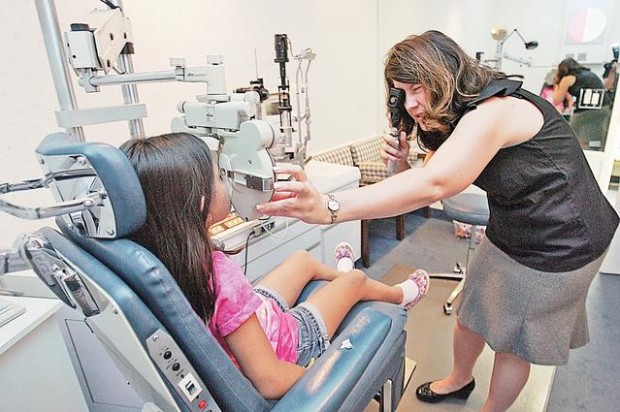
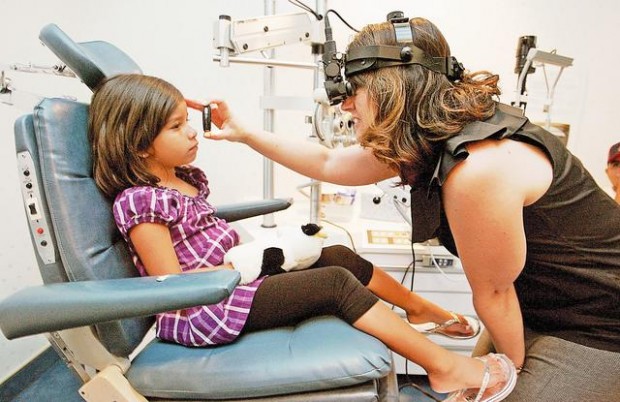
If Junior is coming home with poor grades, it might be worth checking how well he can see.
With nearly one in four children having vision problems, experts say many children with academic issues actually could be having trouble because they can't see up close to read or can't see far enough to make out what's on the board.
Cheryl Schmitt, an optometrist at Hodges Eye Care and Surgical Center, recalled one high-school-age student who was incredibly relieved to be diagnosed with farsightedness, which makes doing up-close work extremely difficult.
"She and her mom were taken aback. All these years, they just thought she was a bad student," Schmidt said, adding that the girl's studies since have improved and the frequency of her headaches has diminished.
Schmidt said children with undiagnosed vision problems often have problems following what the rest of the class is doing or get to a point that they just don't want to read at all. In extreme cases, it can be mistaken for a learning disability, she said.
People are also reading…
Many school districts do perform vision screening. In the Tucson Unified School District, for example, vision is tested in kindergarten and the first, second, fourth and sixth grades.
Sandra Valenzuela discovered her daughter Clarisa needed glasses when she failed the first-grade eye test offered in the Sunnyside Unified School District.
It wasn't noticeable in kindergarten, Valenzuela said, because the class didn't do as much work on the board. "I was surprised. She had never complained about not being able to see anything," the stay-at-home mom recalled.
Valenzuela said she was struck that once her daughter had glasses, she noticed the popcorn ceilings in the family home for the first time.
A number of students still slip through the cracks, however, in part because some simple vision screenings offered at schools often don't provide the comprehensive workups that catch more complex sight issues.
A recent American Optometric Association survey of 1,001 respondents found that adults far underestimate how frequently children have vision problems, with nearly 90 percent unaware that a quarter of children have some sight issues.
According to the association, studies indicate that as many as 60 percent of children identified as "problem learners" actually have undetected vision problems that may be stunting their academic development.
Schmitt said there are a number of reasons vision problems go unnoticed. Children don't know what's normal, she said, so they don't know how to explain why they're struggling. And, she said, "when most people think of vision, they're thinking about distance vision, and that's easily picked up. They're less inclined to think of learning issues connected to near-vision issues."
Frances Banales, a 15-year teacher at Lineweaver Elementary School, said she's not surprised at the statistics.
She has worn glasses since fifth grade, so she's sensitive to vision issues — she always leaves a space in front so kids can move there if they're not able to see the board. Still, she said, many children don't want to move because they don't want to bring attention to themselves.
Banales, 52, said she has her class read a book on eyeglasses to increase awareness and has a discussion with students about how sometimes, kids need tools to help their eyes. Although she has contacts, she makes a point to wear glasses in the classroom.
And she also brings the possibility up at parent conferences. "It may not be the reason they're having difficulty, but it is an indicator. And if we rule one thing out or get one thing to help, it makes a difference."
Banales said she shares with parents the story of one boy who was getting marginal grades in a gifted-education class. He had a quick wit, but he was quiet and reluctant to participate. She encouraged him to be screened.
"From the beginning, his confidence had turned around," she said. "His grades improved overwhelmingly. Kids started asking him questions and wanted him to be in their group."
She tells of another boy with a similar story. Quiet. Not participating. Straining to see the whiteboard. After a screening and glasses, she recalled, "he said: 'Wow. I can really see better.' From then on, he wanted to be at the front table all the time and the kids saw him as a contributor and valued his input. His scores improved dramatically.
"I don't think I've ever had a child who hasn't had some improvement."
Warning Signs
Although studies indicate nearly 60 percent of children don't receive their first eye exam until age 5 or older, optometrists recommend that a child's first eye exam take place at 6 months old. Unless problems are detected, the next exam should be at age 3, and then every two years once a child begins school.
Some indications that a child may have undetected vision problems:
• Losing his or her place while reading
• Avoiding close work
• Holding reading material closer than normal
• Tending to rub his or her eyes
• Having headaches
• Turning or tilting head to use one eye only
• Making frequent reversals when reading or writing
• Using finger to maintain place when reading
• Omitting or confusing small words when reading
• Consistently performing below potential.
SOURCE: American Optometric Assn.


