


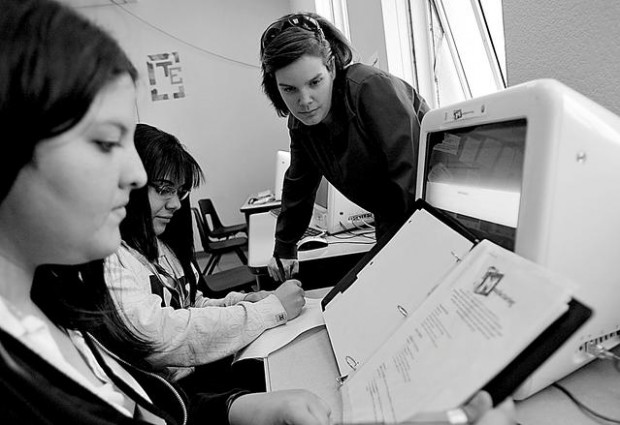
Students at Cholla High Magnet School, in the city's largest school district, are working with a bandwidth so small that even dial-up would be faster.
At Pueblo High School last year, just four streaming videos running simultaneously sucked up 85 percent of the network's capacity, dragging the system to a crawl.
At Fruchthendler Elementary School, one first-grade teacher was supposed to give an online assessment, only to find it took 10 minutes to load each question. She finally gave up and printed out the tests.
In the middle of last month, Mansfeld Middle School teacher Marie Little had finally had it.
She shot off an e-mail to the technology staff at Tucson Unified School District headquarters, asking why her students couldn't do simple Internet searches. Her class in career explorations is supposed to be Web-based, but because only five of the 16 computers can get online at once, she had to put hard copies of the materials in binders.
People are also reading…
Students are being shorted a quality education because they aren't learning the skills they need to be tech-literate, the 29-year-old said in an interview last week. "We are a 21st-century school running on 20th-century bandwidth," Little said. "I feel like I'm back to what I had in high school, which is pretty much nothing."
Once at the top of the technology heap, TUSD has been surpassed by other area districts, such as the Vail School District, which provides laptops to all students at its Empire High School, and the Sunnyside Unified School District, which has tied attendance and grades to new laptops.
TUSD may ask voters for an override in November to help update its aging tech systems.
District officials know the override won't be an easy sell, in part because the outdated technology is in some measure their own fault — poor contract decisions with vendors, a years-long investigation of the technology department that precluded federal grant eligibility and a host of administrators who spent years developing plans only to repeatedly change their minds.
Then there's the fact that district leaders just asked voters — unsuccessfully, with 51 percent of the vote against — for an override for arts-education programs and class-size-reduction moves that they also called essential.
And that's all on top of the horrid state of the economy.
Regardless of blame, the bulk of TUSD's computers are more than five years old. In many cases, they can't play DVDs and they don't have enough memory to run newer versions of even standard software applications.
Computers can't talk to one another efficiently because the local area network is so antiquated.
Things would be bad even with new computers. With the exception of a handful of "hub" schools, such as Sahuaro and Palo Verde high schools, the average household has an Internet connection two to three times faster than the schools.
Brian MacMaster, TUSD's chief technology officer, was at a school technology conference in Washington state last week, comparing what districts are offering in Miami, Chicago and Denver. "When I see what they have in place and the kinds of curriculum they have for their kids, I'm jealous. We're starving our kids of opportunities."
Ask teachers or administrators and they'll typically say classroom technology keeps kids engaged. With scholastic technology still largely in a fledgling state, proving its academic impact is another matter.
In 2007, the National Center for Education Evaluation and Regional Assistance drafted a report for Congress that showed test scores weren't significantly higher in classrooms using educational software products designed to improve students' reading and math abilities.
And the non-profit Texas Center for Educational Research hasn't been able to find any statistical difference in standardized test scores between 21 middle schools in a control group and 21 other middle schools where students have been using laptops since 2004.
Catherine Maloney, the center's director, said the study demonstrated that just investing in the equipment won't work without commitment from the staff and training to successfully marry technology with coursework.
In retrospect, she said, putting such a focus on test scores was a mistake because it didn't place any value on student interest or the skills they learned that wouldn't show up on a multiple-choice test. Overlooked in the fallout, she said, was that students reported becoming more comfortable using technology and appreciated the immediate feedback on their work.
Despite the findings, she remains convinced that it's worth the investment. "In today's world, I think it is important. When I was growing up, a typewriter was as much as we needed to know, but technology has transformed every aspect of our lives, from the workplace to our entertainment."
Back home in Tucson, Keegan Lapp, a 16-year-old sophomore at Cholla, signed up for a Web and graphic design course. He looks forward to going to his fifth-period class because it's a technology area he wants to explore — but he also dreads it.
"You can't really do your work," he said. "It will take an entire class period to upload one picture. Other times, if we have to do animation or something, the documents won't load."
He has to come in at lunch to work on his assignments, just because of the download time.
So what does he do while waiting? "It's frustrating. Mainly, I just sleep and wait for it to load. Or we just sit there. That's all we can do."
Parent Abby Mogollón complained to TUSD in January, saying she found it "extremely frustrating" that she couldn't communicate with her son's teacher at Davis Bilingual Elementary Magnet School through e-mail because the school computers couldn't access the Internet.
Mogollón, a 33-year-old book editor, said it makes her wonder how her son, Gabriel, and his peers will meet technology standards. "I'm less concerned now, because he's in first grade, but as he moves up, there will be other students who have these skills and I want him to be on an equal level with all of them."
TUSD's new technology vision doesn't yet have a price tag, but it could be somewhere in the neighborhood of $9 million a year for seven years.
With most of the schools running at a bandwidth of 1.5 megabits per second, the new plan would upgrade the connection to a minimum of 100.
New computers would be leased, so that when they age out, they could be refreshed, without a huge capital outlay every three years.
And there would be a wireless hot spot at every school.
District officials concede they'd be in better shape if previous administrations hadn't missed out on multiple opportunities to be reimbursed millions of dollars in federal E-Rate funds, intended to help schools and libraries afford technology upgrades. Some of the procurement problems turned up in the investigations, such as a staff member sharing an internal password with a potential vendor, violated E-Rate protocols.
MacMaster said not having the money earlier "has been the major factor contributing to the lack of bandwidth," exacerbated by the lack of long-term commitment to technology. The district has applied for $12 million in funding, he said, but when the logjam breaks, the district won't be getting a big check for that amount. It would only get back what it has paid during each application cycle, and so far, the board has mostly approved bandwidth improvements based on E-Rate acceptance.
To meet election deadlines, the board will likely have to decide within the next month whether to proceed with an override.
Debbie Niwa, an opponent of the last override attempt who raised a son in TUSD, said she's no more enamored of this one.
She isn't convinced that more technology spending would do anything to increase academic performance and she doesn't like TUSD's spending priorities, arguing too many resources are spent on programs that have little to do with direct academics.
And, politically, it's a bad time, she added. "If people have to worry about keeping the utilities on and having enough money to eat, they aren't going to want to support this."
But Paul Eckerstrom, an attorney and Democratic activist who helped spearhead the last override effort, said he thinks the district has little choice.
Much of the criticism over the district's management, he said, can be traced to its technology shortcomings. With payroll data being entered by hand, there's too much room for human error, he said, which leads to high-profile payroll glitches.
And economic conditions may actually fuel support, Eckerstrom suggested — there's enough anger about cuts that people could be willing to support public schools.
"We can't have our schools held together with a patchwork of Band-Aids and shoestrings."
"We are a 21st-century school running on 20th-century bandwidth. I feel like I'm back to what I had in high school, which is pretty much nothing."
Marie Little, Mansfeld Middle School teacher


