

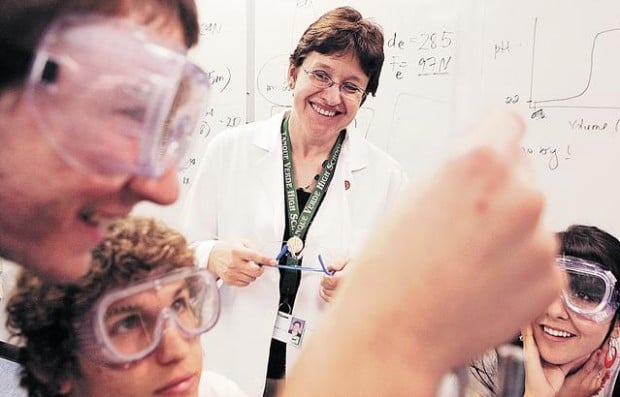
Competition was ratcheting up between two teams of earth-science students one recent afternoon at Tanque Verde High School.
Team One ran into trouble with the definition of dew point, allowing Team Two to capitalize on the error and storm ahead with the right answer on relative humidity.
Then Team Two stumbled by missing the name for the process by which cloud droplets collide and form larger ones. That would be coalescence, team.
The class was reviewing for a big test the next day.
"I'm nervous," one of the students blurted. "About the test?" asked teacher Grazyna Anna Zreda. "Yes," the girl replied.
Now, some teachers might advise students to breathe. It will be fine. Not Zreda. The epitome of brevity, she responded, "Good."
People are also reading…
Zreda just returned from Washington, D.C., where she picked up one of the highest awards a teacher can get in the United States — the Presidential Award for Excellence in Mathematics and Science Teaching.
Zreda's no-nonsense reputation led 17-year-old Lauren Aboud to be rather anxious on her first day of chemistry class.
It would have been intimidating enough that the 47-year-old Zreda has a doctorate, wears her trademark crisp white lab coat every day and speaks in a precise Polish accent.
She also had a long list of rules and expectations.
Students aren't to chew gum. They aren't to wear hats. They will work hard, completing complex lab reports on a weekly basis.
But it didn't take long for the junior to realize compassion and understanding resides within that strait-laced exterior. "Out of all the high school teachers, I think I've learned the most from her. She teaches in a way we can understand," Aboud said.
One advantage is that Tanque Verde remains a small, albeit growing, school. This is the first year it's had 12th-graders. The result is that Zreda's had many of her students for several years and classes remain small.
Zreda has a handful of chemistry and physics students, which allows more one-on-one attention and more lab work possibilities. There's not much lecturing. Instead, students are actively investigating scientific hypotheses, with a strong focus on the communication end — effectively explaining what it is that they've discovered.
Zreda, who has been in the United States for 20 years and in Tucson since 1994, has a doctorate in geochemistry and specialized in volcanologyr. As research funding dried up and it became harder to get grants, she decided to give teaching a try. Even though it meant yet more school, she took all the courses she needed to become certified to teach.
"It is extremely challenging," Zreda said. "It is much harder than most people think." Even after nine years in the classroom, she said, "It's still very much an adventure to me."
When she heard she would be teaching physics this year, for example, she was terrified. Not because she didn't understand the content, but because practically everyone she's met has some story to tell about the wrenching, night-sweat-inducing experience that was high school physics. "The only thing I wanted was not to create this experience for my kids."
Now, if she had to choose between teaching her first love, chemistry, and her second romance, physics, she'd have a hard time picking.
It's also fulfilling. The day she got back from D.C., a student came to her, waving an envelope, and sharing her acceptance into a medical summer program that Zreda had encouraged her to apply for.
Sue Sprague's 17-year-old daughter has had Zreda for the past three years. "I feel like my daughter is learning more than I learned in some of my college science classes," said Sprague. Her daughter has indicated she plans to study something in the sciences in college, perhaps pharmacy. "That's all because of Dr. Zreda's influence," Sprague said.
And that's why Zreda continues to teach: "This is the reward — when a student comes to you and tells you that in some way, you inspired them."
DID YOU KNOW
The 77-square-mile Tanque Verde school district, on the northeast side of Tucson, was first organized in 1886.
Tanque Verde High School opened in 2005 on the campus of Emily Gray Junior High School at 4301 N. Melpomene Way.
Previously a kindergarten-through-9th-grade district, Tanque Verde added a 10th grade in 2005 and an 11th in 2006. Twelfth grade was added this school year, bringing the high school's total enrollment to just shy of 200.
Before the high school's opening, the district paid for its students to attend nearby high schools, primarily Sabino and University in the Tucson Unified School District.


