

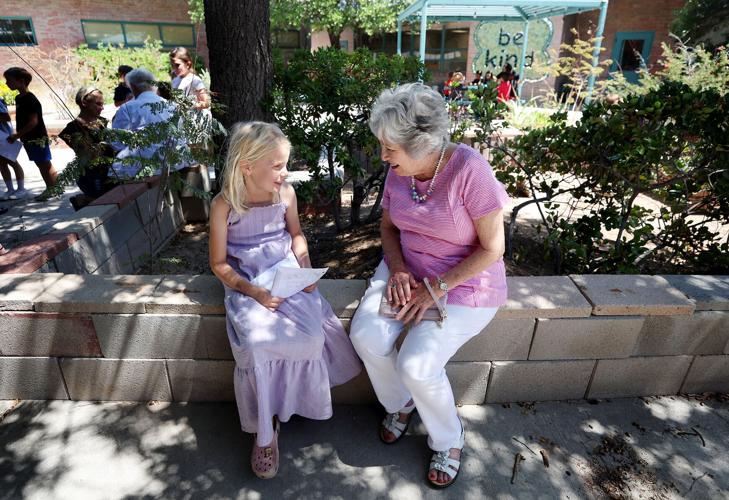
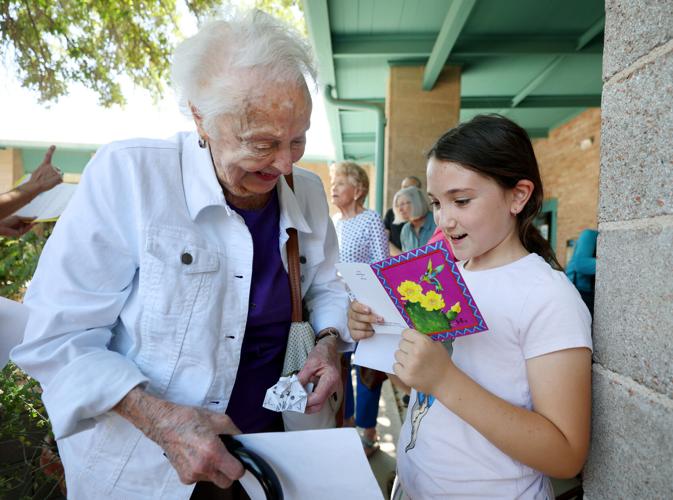

Ellen Poulson and her friend, Carmen Doubleday, are meeting for the first time.
Doubleday, a third grader at Lineweaver Elementary School, hands Poulson, 92, an origami cat that Doubleday made of notebook paper, complete with carefully drawn spots and stripes.
Poulson and Doubleday were paired in a letter exchange between La Hacienda at the Canyon residents like Poulson and Lineweaver third graders.
Poulson smiles broadly and graciously takes the cat from her pen pal.
“Which class did you make this in — arithmetic? English?”
Doubleday smiles.
People are also reading…
“I learned how to make it on YouTube.”
Poulson says she doesn’t know much about technology. After a brief conversation, however, it’s clear there are plenty of things she does know about. Among them, the Midwest native shares that she used to be a yoga instructor and enjoyed skiing.
“They’ve lived all over the world,” says Missy Paschke-Wood, Hacienda’s associate executive director. “They do all sorts of different things.”
Residents have included retired fighter jet pilots, librarians, CEOs – even Ed McMahon’s former assistant, she said.
Oftentimes sharing the stories of elders’ lives is challenging, particularly when it comes to intergenerational programming, Paschke-Wood said.
When Lineweaver third grade teacher Christy Masengarb was coming up with a way to delve into the school’s cursive and letter-writing lessons, she and Paschke-Wood conceived of a pen pal exchange between Lineweaver third graders and La Hacienda residents.
“This is more than, ‘Hey, we’re here to entertain you,’” Paschke-Wood said. “It’s, ‘Hey, we’re here to help.’”
Having a friendship like those fostered by the Lineweaver-La Hacienda exchange is powerful, Masengarb said.
“It’s great to have an adult be interested in you,” she said. “I understand how powerful that is.”
Masengarb added, “It’s not about telling about yourself, but asking about how the other person is doing.”
A total of 28 students participated in the exchange. There were 26 La Hacienda pen pals. Thursday at Lineweaver’s courtyard, those who could be there met their friend for the first time.
The seniors waited as Masengarb called out each student’s name, matching the third graders with the group of La Hacienda residents waiting in the shaded courtyard.
Some students were shy and had to be guided to their friend. Some of the third graders made a beeline for their pen pal as soon as their name was called.
‘Something wonderful about the act of writing’
Doubleday recalled the anticipation of waiting for Poulson’s letters.
“When would it come? Would they come?”
The letters always came.
“There’s an importance to impatience,” Masengarb said. “I do worry about what kind of behaviors and experiences we’re giving our kids and which ones we’re losing.”
One of those being able to write and read in cursive. Having those abilities matter, but it goes beyond signing one’s John Hancock, Masengarb said.
“It’s sort of frightening to me that there are kids who won’t know how to read a historical document.”
Now Doubleday and her classmates can read and write in cursive, as well as compose a letter.
“It’s a meditative process,” Masengarb said. “There is something wonderful about the act of writing and exercising patience.”
Poulson said some of her grandchildren don’t read or write cursive. If she writes to them, they can’t read it.
A person’s handwriting can tell something about their personality; some scratch rushed letters across paper, others write in loopy cursive.
Does Doubleday match her handwriting, now that the pen pals have met?
Poulson smiles gently at her friend.
“She has beautiful handwriting.”


 U of A program gets unorthodox teacher hopefuls into classrooms


