



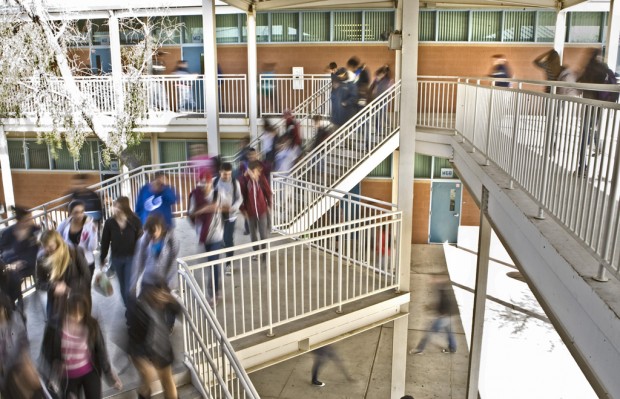
The schools at Flowing Wells are too clean. The doors stay open too long. The teachers are trained too well. And apparently the students are learning too darn much.
Those are the main findings of the state Auditor General's Office, which spent a year poking and prodding this small north-side district where a quarter of the students live in poverty and 71 percent are on free or reduced lunch.
When it comes to reading, writing and math, the Flowing Wells district not only outperforms other districts with similar demographics, it also beats state averages.
A recent audit of Flowing Wells (the district was chosen randomly) notes this small miracle, but it drones on and on about operation costs, utilities and efficiencies. The district's students might be thriving, but the district has spent too much money keeping the lights on and the hallways clean.
People are also reading…
"Although research suggests that students' achievement outcomes are influenced by poverty level," the report says, somehow, "Flowing Wells Unified School District achieved AIMS passing rates that were similar to averages for the state and for districts with much lower poverty rates.
"However," the report later notes, "the plant operations costs were significantly higher than peer districts averaged because it employed more plant staff, paid higher salaries due to employee longevity, and used more electricity."
Talk about missing the point (and in dry, bureaucratic fashion). This is a district we should be celebrating.
Down at district headquarters, Flowing Wells Superintendent Nicholas Clement was amused and a little confused by the findings.
"There is a difference between efficiency and effectiveness," he told me.
Efficiency and effectiveness. When it comes to schools, in this age of standardization, those two words get scrambled. To be more efficient is to be more effective, right?
But the success at Flowing Wells, coupled with the state's robotic audit, reminds us it's far more complex. Because here - not far from Miracle Mile and all that name implies - we have an effective school district that is viewed as inefficient. And what makes it so inefficient?
Well, the district's utilities are high because it runs a number of after-school programs and provides summer school and summer camps. Its maintenance costs are higher because Clement believes clean, graffiti-free environments make a difference. Its training costs are high because it invests in teacher development. Instead of training teachers after school or on half-days, the district hires subs to give teachers a full day of training and students a full day of classes.
"If you have your doors open longer at the end of the day, and the end of the year, then your costs are going to go up," Clement said. "The idea is, the school day may be over, but school isn't over."
This doesn't fit into the state's equation because it often doesn't count as classroom spending.
"I think taxpayers want to know that their money is being spent efficiently," Vicki Hanson, who manages school audits for the Auditor General's office. "So, obviously if the district is spending money outside of the classroom, that's less that they are spending inside of the classroom."
Sort of. Classroom spending at Flowing Wells was characterized as "low" in 2010, according to the audit. But the district also spent significantly more than other districts on instructional and student support.
Clement, a tall and affable man whose views on cleanliness were shaped by Disney theme parks, sees this as one and the same. Clean schools, teacher training and student support all tie into classrooms. As we strolled the grounds of Flowing Wells High School, he pointed out these dynamics: an energized biology class, a gym that stays open before and after school, a spotless campus.
Besides, the district gets results. It had better attendance in 2010 than the state average or its peers. It had a better graduation rate in 2009 - not just in comparison to districts with similar demographics, but it also beat the state average. It has seen big increases in the number of students taking Advance Placement classes and the SATs.
Fair or not, for years now, educators have been put under the microscope based on test outcomes, so why rip the methods when a district succeeds?
"If Flowing Wells does really well on the outputs, then it seems to me that's the end game. And being picky about how the input side works is, in a sense, unfair because they have been asked to deliver on the outputs, and they did," Ronald W. Marx, dean of the University of Arizona's College of Education, told me.
Today's lesson? It's fine to be efficient, but not at the expense of effectiveness.
Contact columnist Josh Brodesky at 573-4242 or jbrodesky@azstarnet.com


