

It's no secret that Covid-19 has negatively impacted the finances of Buffalo as well as other upstate cities – and that a financial crisis may be imminent.
The $519 million operating budget for the fiscal year that began July 1 contains $65 million in federal pandemic aid. But with Congress stalemated over a bill, there's no telling when – or even if – that money will arrive.
The same is true for $11 million in Seneca Nation casino money, which has been stalled in a legal dispute, and for the "temporary" $20 million cut – out of $98 million – in state aid to help Albany cope with the pandemic.
People are also reading…
Buffalo borrowed $25 million to close out the $509 million 2019-20 budget, but some Common Council members say the city can't keep borrowing its way out of a financial hole because the debt still has to be repaid even if interest rates are low.
It might be time, they say, to make the cuts that Mayor Byron W. Brown has been warning may be necessary to services and personnel if the federal aid doesn't arrive. But the Buffalo Fiscal Stability Authority says the city can't cut its way out of a financial hole.
All of which is leading some Council members to raise the question: If – or when – will the authority reimpose hard control over the city's finances?
"I couldn't say specifically," said University Council Member Rasheed N.C. Wyatt. "However I think that our current financial path ... as far as our fiscal instability, would certainly be one of those things I just couldn't see the control board not engaging."
"It was mostly Rasheed Wyatt that was really concerned about the control board becoming a hard control board because of (deficit-borrowing). I agree with him," Niagara Council Member David A. Rivera said.
"I think it's possible," said North Council Member Joseph Golombek. "I do have concerns about it. The unfortunate thing is if there was no Covid-19 this year, our finances would have been better."
The control board was created in 2003 by the State Legislature after declaring that the city faced a “severe fiscal crisis" which “could not be resolved absent assistance from the State.” The board became "advisory" in 2012, but could go back to control status if it determines a fiscal crisis is imminent or if the city fails to meet certain conditions, such as adopting a balanced budget or paying off its bonds on time.
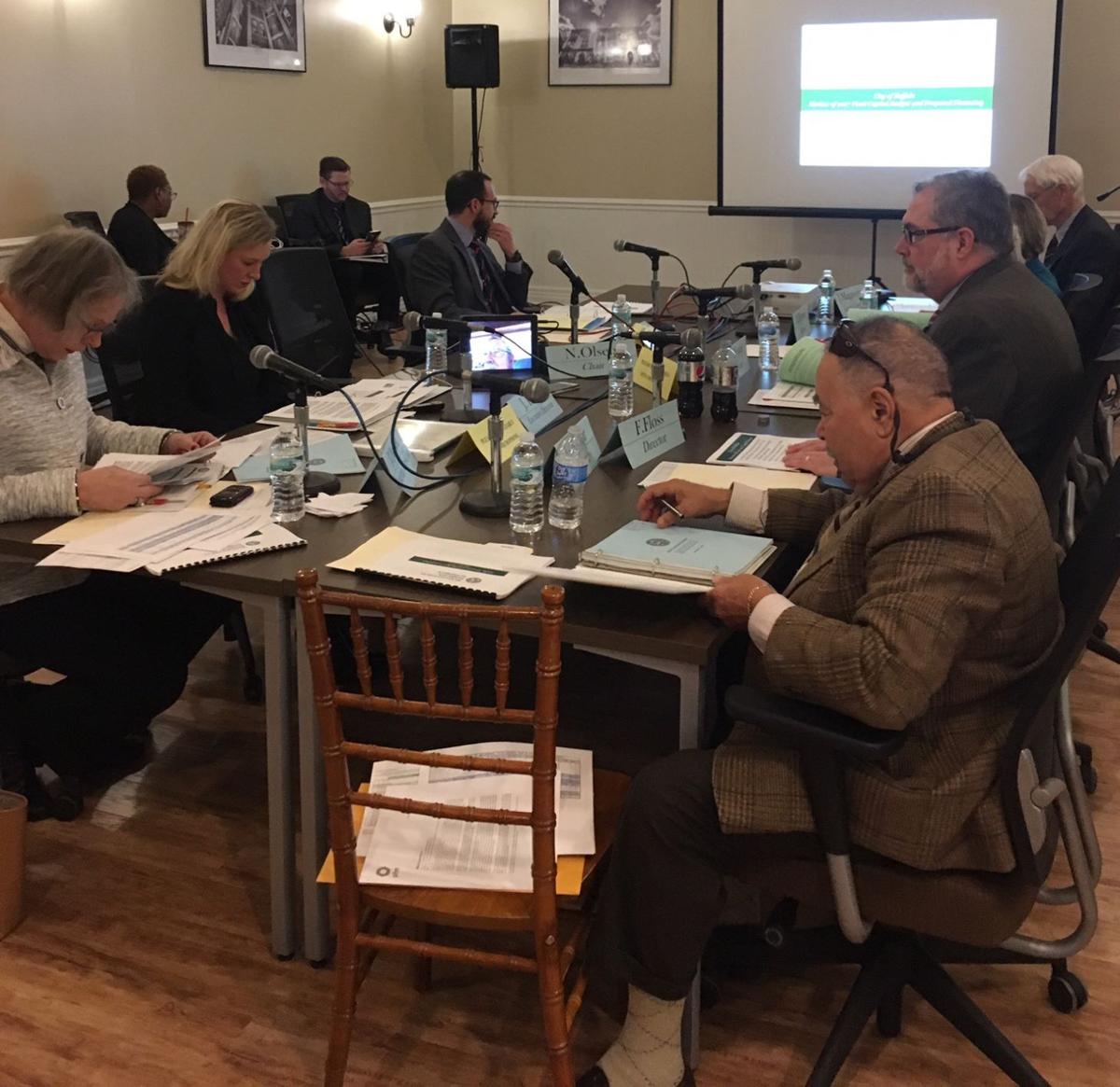
Right now, "a discussion regarding the reimposition of a control period is premature," control board Chairman R. Nils Olsen Jr. said in an email.
“There is enormous fiscal pressure facing municipalities across the country and state, including Buffalo, due to the drastic reductions in revenues and increases in expenditures resulting from the Covid-19 pandemic," Olsen said, calling federal help "critical to the City of Buffalo in order to balance the budget while maintaining essential services."
He added that the board "has acted proactively by requesting state legislation to be able to issue bonds to finance operating deficits" if necessary.
An initial control board resolution July 20 noted that the city's four-year financial plan didn't meet the standards set out in the act establishing the authority – such as ensuring that revenues and expenditures balance – and also sought state permission to issue up to $121 million in bonds on the city's behalf to finance operating deficits in the current fiscal year and the next.
“The estimated projected budget impact from the Covid-19 pandemic is so significant that budget cuts alone could not address this issue while maintaining essential services,” control board Executive Director Jeanette M. Robe told the Council's Finance Committee a week earlier.
But that multi-part resolution failed, getting only four votes on the nine-member board, which has three vacancies. One member had an excused absence, while Brown's proxy abstained, leaving it one vote short of the necessary five for passage.
However, with the proxy's support, the board then passed a second resolution to send all of the information to state officials and to seek legislation authorizing it to borrow for the city. It has not received a response yet from state officials, principal analyst Bryce E. Link said in an email.
For its part, the board does not want to reimpose hard control.
"Under a hard control board, our powers are quite limited," Robe said during the Finance Committee meeting. "Even under a control period we cannot effectuate revenues. What we can do is we could implement a wage freeze. We could implement a hiring freeze. That's probably the one area where we could effectuate change that the city would not be able to."
She said the authority preferred "a collaborative approach towards getting out of the hole" rather than "imposing a control board's will," adding that board members are "very aware that they are not the elected officials."
Some Council members, even those who acknowledge the possibility, say they are not in favor of a hard control board again, either.
"I would not want to see another hard control board because to me it negatively reflects on our leadership as a city, and you don't want that," Wyatt said.
Rivera said he wants the city to do what it can now to avoid a hard control board.
"I'd rather make the decisions now than have a control board make those decisions," Rivera said. "They're decisions that we should have been making all along and that we have not made ... that have caused us to be in this dire situation that we're in right now. We probably should have raised taxes gradually. There are things that we could have done that we didn't do, and I think it's starting to show now."
Golombek, who was elected in 1999, is the only current Council member who served when the control board was created in 2003. He had a "philosophical issue" with the concept of the control board when it started – not with the board members.
"I saw it in certain regards as being an end-run around elected government," Golombek said. "I felt they had control based from Albany rather than the constituents from Buffalo. I don't have a problem with control board members. It's the whole idea of the state imposing the control board on the City of Buffalo."
About two weeks ago, Brown repeated his warning that, "If federal action is not forthcoming in the near future, jobs, services and new investments will have to be reduced and eliminated."
The city's spokesperson did not respond to questions about when the administration will decide to make the cuts and if the administration has any other contingency plans.
Rivera said the Council is concerned about the length of time it's taking to make decisions on cuts "because every month that goes by, every week that goes by, we're further in debt," adding that the city "can't go on borrowing because that's unsustainable."
"We really at this point and time have no other way to get out of this situation other than Draconian cuts," Wyatt said. "I don't see any other way to do it but to make cuts to services and workers."


