

It encompasses a vast swath of upstate New York stretching from two Great Lakes shorelines to the Finger Lakes, with some communities counting more cattle than people.
And though the 27th Congressional District is usually associated with metropolitan Buffalo and Rochester, at best it claims only the big cities' outer suburbs. The rest is marked by some of New York State's most fertile farmlands, especially for dairy.
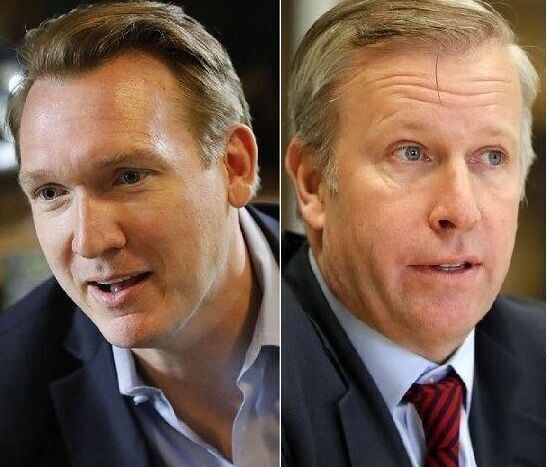
That's why both contestants for the area's seat in the House of Representatives – Republican incumbent Chris Jacobs and Democratic challenger Nate McMurray – place agricultural issues at the top of their priority lists. In addition, they now add Covid-19 and a host of other matters to their congressional "to do" lists.
And while President Trump was a big issue in June's special election for the seat, both candidates also recognize the importance of district issues.
People are also reading…
Here is a rundown of how Jacobs and McMurray view the district's priorities:
Agriculture
Jacobs sought and received appointment to the House Agriculture Committee immediately after narrowly defeating McMurray in a June special election. Like his predecessor, former Republican Rep. Chris Collins, the city kid from Buffalo has immersed himself in the concerns of farmers.
"In the first few months that I've been in the job, I've seen it firsthand," he said of the district's farm interests, "and it's a big deal."
Jacobs sees the appointment as key because hearings begin in January on a new farm bill that will guide federal programs for years to come.
"I will really try to be the best advocate for additional money in the farm bill next year," he said, "and make sure our municipalities are aware of that, and that they position themselves for those grants."
Already, Jacobs has come to understand that farmers need markets for their products, and that the food processing companies sprouting in communities like Batavia are just as crucial to the rural economy as barns full of dairy cows.
He cites firms like Batavia's HP Hood and its 300 employees turning out those little coffee creamers on restaurant tables. He also points to Western New York Energy in Medina, where 50 employees have provided a new market for corn processed into ethanol even as the commodity was hurt by globalization.
"I want to see what we can do to build on those examples," he said.
McMurray, a lawyer and former Grand Island supervisor, takes a broader view of the area's farm needs. He recognizes "a level of desperation that's hard to explain."
"I'm scared for the future," he said, "and we need to treat farming like a national security issue."
Drawing on his experience in Asian business development when he was a lawyer in South Korea and China, McMurray will seek to open foreign markets for Western New York agricultural products. He even credits President Trump for recognizing the U.S. need to parlay defense agreements into more favorable trade deals.
"Trump was right on that," he said. "We provide all this military power and ask for nothing in return. We should say: 'No tariffs on our goods in your markets.' "
McMurray says he, too, will seek an appointment to the Agriculture Committee, as well as to the Foreign Affairs Committee.
Experts like the candidates' focus on projects like the Medina ethanol plant, but corn farmers won't benefit if the Environmental Protection Agency establishes unreasonable standards for clean fuel, according to Dean Norton, president of the New York Corn and Soybean Growers Association.
He said farmers across the region also wonder what new rules and regulations might stem from a Biden administration, especially after President Trump worked to relax them.
He points to the Waters of the United States rule that often required permits to deal with "ditches or puddles."
"The Trump administration streamlined those rules to make them less onerous," he said
Broadband and infrastructure
Both candidates say that the district's rural nature may produce agricultural advantages, but they mean little without stronger access to the internet. McMurray cites his work for a major tech company like Samsung as well as his efforts to expand internet access on Grand Island.
"When I was in South Korea 10 years ago the internet speed was twice as fast and we paid half as much," he said. "Our country needs broadband to compete."
As cities empty out in response to the Covid-19 pandemic, he said, places like the 27th District will prove inviting to urban refugees only if the necessary technology is available.
"Broadband just means putting up glass wire," McMurray said, before lamenting what he considers the country's unwillingness to tackle big issues. "And the only reason we're not doing it is we have no guts anymore."
Both also cite the need for a transportation infrastructure program, with Jacobs pointing to the Western New York Science and Technology Advanced Manufacturing Park in Genesee County as a project benefiting from quality access. If infrastructure money becomes available, the road, water and sewer needs of it and similar plants will enhance the area's position, Jacobs said. Ditto, he said, for opportunities associated with the Niagara Falls Air Reserve Station.
Lake Ontario levels
Property owners along Lake Ontario's south shore across New York State continue looking to Washington for relief from rising water levels that caused severe flooding in 2017 and 2019. Michael Borrelli of Rochester, a leading voice for more regulation and president of the Blind Sodus Bay Improvement Association, says whoever is elected must hold accountable the U.S.-Canada body that regulates outflow into the St. Lawrence River.
Borrelli said the 2014 Plan adopted by the International Joint Commission remains flawed because the amounts of precipitation and snowmelt it considers "normal" are virtually guaranteed to flood homes and property in 27th District counties like Niagara, Orleans and Monroe.
"An executive order protects the IJC from lawsuits, so six people are responsible for managing that water," he said. "If that were repealed, they could be subject to accountability personally and legally."
He acknowledged the difficulty attached to international negotiations, but said members of Congress need to be attuned to the property owners' needs.
McMurray said he reconsidered buying a shoreline home a few years ago when he discovered the need for $300,000 worth of breakwall protection. He is unsure about blaming the IJC.
"It's not so simple as to say the IJC is wrong," he said. "The fact is there is more water than ever, partially from flow and partially from environmental factors. We need to address all of them."
Jacobs said he has already signed onto a bipartisan letter to allow for more outflow into the St. Lawrence, which the IJC did last year and which proved helpful.
"The state has spent a lot of money to build resiliency and pay for damages," he said. "But I believe the federal government still needs to play a bigger role with the IJC."
He said he is "all for" any effort to reopen the negotiations that led to current plans for water level management.
Economic development
Dottie Gallagher, president of the Buffalo Niagara Partnership, said Covid-19 has set new priorities that temporarily take precedence over normal economic development goals. As the pandemic ravages the economy, her business advocacy group sees new need for "paycheck protection plans," employee retention tax credits and added flexibility for loan forgiveness.
Another pressing need remains aid for state and local governments facing overwhelming deficits from the loss of normal tax revenues.
"Without relief from the federal government, those deficits will trickle down to employers and taxpayers," she said, "and there will be an inevitable cut in essential services."
Gallagher said the new member of Congress needs to seek liability protection for employers dealing with Covid issues, immigration reform that supports refugee resettlement, a transportation bill aimed at aging infrastructure and proper staffing of customs facilities on the northern border.
"There are certain things only the federal government can do," she said.
The candidates seem to recognize the need for extraordinary measures. Jacobs expressed doubt that Congress and the White House can agree on a new stimulus bill before the Nov. 3 election, but supports the concept and has co-sponsored legislation extending paycheck protection.
And he is all for finding a way to separate states' normal budget deficits from those caused by Covid-19 concerns to facilitate negotiations for a new stimulus package.
"I think that's an exercise we can do," he said.
McMurray also backs many economic development efforts underway, but again adopts a broader view. He believes a Medicare for all program is needed during a pandemic more than at any other time. He will listen to concerns, he said, but remains "committed to covering every single American."
"I support it because I lived in a single-payer system," he said of his time working in Asia. "It does not mean the end of private insurance. Can we get there overnight? I don't know. But this is not some crazy socialist idea."
Read the full story from News Washington Bureau Chief Jerry Zremski


