

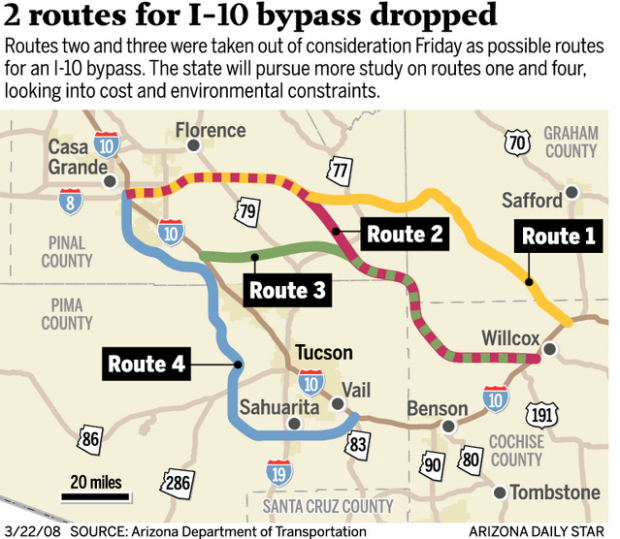
The San Pedro Valley is no longer threatened by the possibility of an Interstate 10 bypass running through its fragile riparian environment.
But the state will continue to study other routes to divert interstate traffic around Tucson.
After more than a year of study, the State Transportation Board voted Friday to eliminate the two San Pedro Valley bypass routes from further consideration.
The two other proposed routes, which also have a lot of public opposition, will remain on the table as the state begins a second phase of study of the feasibility of diverting trucks and other interstate traffic around the Tucson and Phoenix metropolitan areas.
The Transportation Board and study contractor URS Corp. say further study is needed to solve the transportation problems that will occur with continued growth.
People are also reading…
Supporters say growth cannot be ignored and planning ahead is necessary.
Opponents of the proposals say the population and traffic-growth estimates are not reliable. They say the state should consider traffic management solutions beyond building more roads.
They want the state to consider providing alternative forms of transportation, such as high-speed and light-rail systems. They believe the impact of increasing gas prices will get people out of their cars and into other modes of transportation.
In Friday's 6-0 vote, the Transportation Board asked for more study on the cost and environmental impacts of a possible bypass route through the Aravaipa Valley east of Tucson and another through Avra Valley on the west side of the metropolitan area. Board member Robert Montoya was absent.
"A lot of what I heard today made a lot of sense," said board member Felipe Zubia, who made the motion to remove the San Pedro routes and continue studying the other two.
"I disagree that the process should be stopped. In order to evaluate multimodal and other transportation, you need to be able to weigh it against something," he said.
Board member Victor Flores said he was unsure whether a bypass would solve traffic issues in Tucson and Phoenix, but he wanted more information, including how much further studies would cost the state.
The state paid URS $340,000 for the year-long study it recently completed, said Dave French, URS project manager.
Of the 16 people who addressed the board in a 45-minute public hearing on the bypass meeting, most opposed at least one of the routes. Only one person spoke in favor a bypass proposal.
"We cannot simply do nothing" about growth, L.J. Allen told the board. "Tucson has a population that's not going to shrink; it's going to grow."
But planning for growth doesn't have to mean new highways, others said.
"We do need to plan for growth. We need to look at how much water we have and how many people that will support," said Sean Sullivan, co-chair of the Sierra Club Rincon Group.
"This type of plan is archaic and needs to be left in the last century. It's not a good idea today, and it will not be a good idea 50 years from now," he said.
Many cited the need to consider other transportation options.
"We have billions of dollars going into road projects and pennies going into other forms of transportation," said Daniel Patterson, a city planning commissioner and Southwest director of Public Employees for Environmental Responsibility.
He said building a bypass would be expensive and would encourage growth in sensitive areas.
"Let's kill this bypass boondoggle now. Let's do better. Let's invest in rail," Patterson said.
After the San Pedro Valley proposals were eliminated from further study, several audience members yelled to the board, saying the members were not listening to the public, that the entire proposal should be stopped.
But it was a small victory in a months-long fight for some.
"It's a tremendous relief," said David Omick, member of the Cascabel Working Group, which has opposed the bypass routes in the San Pedro Valley since the first round of public meetings on the topic in early 2007. "We will also be active in opposing the Aravaipa route," he said.
2 possible routes
Two routes are included for future I-10 bypass studies by the state. These bypass options routes would:
• Divert westbound traffic off I-10 near Willcox, northwest through the Aravaipa Valley and then west toward Casa Grande, where it would meet again with I-10.
• Take westbound traffic off I-10 near Vail, directing it south and west through the Green Valley and Sahuarita area, crossing Interstate 19 before heading north through Avra Valley. It would connect with I-10 near Casa Grande.


