


"The most valuable knowledge we can have is how to deal with disappointments."
— Dr. Albert Schweitzer
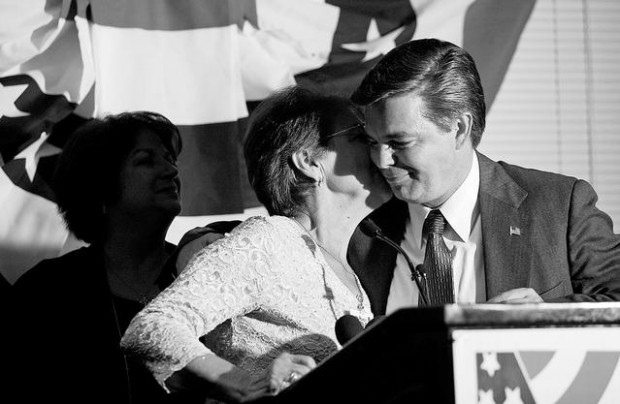
He'd been trailing all night, and his discouraged supporters were already leaving the election party, but Randy Graf maintained hope.
A band continued to play upbeat music in the corner of the hotel conference room where his Republican supporters gathered. Screens flashed the words "Randy Graf Victory Party."
"The night is still young," Graf said around 9:30 p.m. "This has been a long campaign and I've got thick skin."
Indeed.
Another hour went by before Graf called to congratulate his opponent, Democrat Gabrielle Giffords, for winning the Congressional District 8 seat vacated by outgoing Republican Congressman Jim Kolbe. Kolbe already had been to the Democratic festivities to congratulate Giffords by then.
People are also reading…
After a year and a half of high-adrenaline campaigning, Graf remained positive to the end. It was nearly 11 p.m. when he took the stage with his family and announced to a room choked with emotion that the race was finished.
In between arranging rides home for some of his ardent supporters, Graf, 47, quietly said he would need some time to figure out what he's doing next.
The way candidates cope after election losses can vary greatly. When he failed to win re-election to the Tucson City Council last year, Fred Ronstadt said someone asked whether he was on muscle relaxants because he didn't look "sad enough."
But defeat isn't always agony. Some local election losers, past and present, say that while it's disappointing, losing can bring epiphanies, career changes and, in some cases, relief.
And local politicians aren't shy about sharing those experiences — all but one of a dozen politicians and campaign managers contacted by the Arizona Daily Star during the past week were very willing to talk.
Most said they were discouraged with the amount of money required to run for office, and the special interests that control federal campaigns, but all said they were grateful for the experience.
"I think the immediate next day is hard. All of a sudden this enormous, intense energy level has stopped," said Tom Volgy, a University of Arizona political-science professor and former Tucson mayor who lost his bid for another mayoral term in 2003. Volgy, a Democrat, also has lost two bids for Congress.
"A lot of it depends on your personality. If you are the kind of person who needs to be loved by everyone, the very act of an election is difficult, even if you win," Volgy said. "A landslide is considered 60 percent — that means four out of 10 people said, 'I don't like you.' When a majority of people are telling you they don't like you, it hurts even more."
Fortunately, most politicians — as Graf himself noted — have thick skin, said Dr. John Racy, a professor of psychiatric medicine at the University of Arizona College of Medicine.
"You are not going to find self-effacing, humble politicians," concurred Republican Bill Heuisler, who lost the Pima County assessor's race to Democrat Bill Staples in 2004. "Most have huge egos. The fact that you are out on a stage during the campaigning, that is kind of a narcotic. … There's nothing greater than running for political office."
Also, Racy said, the brain is remarkably powerful in finding some consolation somewhere. The UA's College Republicans, for example, smoked cigars and celebrated outside the Pima County Republican gathering Tuesday night, though the Republicans as a whole did not fare well this election.
"I think we're winners. I know people are going to call us losers, but I don't see it that way," said group Vice President Mike Sistak. "The Democrats can celebrate what they took, but we can definitely celebrate what we kept."
Racy said often those most affected are politicians' relatives, particularly their children. But he added that politicians who say they're not hurt by a loss are not telling the truth.
"There is a part of every politician that wants to be loved," Volgy agreed. "That's why it's really important to have a strong support system of friends and family."
Democrat; lost in September's primary in a bid for a seat in the Arizona Senate, representing District 28.
Downing, 63, said he has moved on.
"If you try to cling to things past or present, that creates suffering," he said.
A University of Arizona professor of social development, Downing said campaigning is what he loves — it's like fieldwork, and he has no regrets.
"Everyone faces disappointments in life. Losing an election is minor compared to losing a spouse or having a child sick, things my constituents face."
Republican; lost in the District 26 primary to Al Melvin.
Hellon said she hasn't shed a tear nor had a moment's remorse about the September primary, though she suffered a surprising defeat, putting at least a temporary end to her career as a member of the Arizona Legislature, where she served since 2001. She became involved in Arizona politics in 1976.
"The only experience I hadn't had was losing, so I guess it's full circle for me," she said. "Now I've experienced everything, and I'm looking forward to whatever the future brings."
Republicans; defeated in their re- election bids for City Council in 2005.
Ronstadt considers his election loss one of the biggest blessings of his life.
"I probably should have never run. I think I was really done with the job in a general way but still very passionate about Downtown redevelopment," Ronstadt said. "The daily drudge of the council — I was not into that any more."
Two days after losing the election, he and his family left for a previously planned trip to Europe. When he returned to Tucson, Ronstadt changed careers from residential banking to working for the Arizona Builder's Alliance developing apprenticeship programs for young people. He's grateful to have more time with his family.
Dunbar appeared less sanguine about her loss — she filed a lawsuit against Democratic victor Karin Uhlich, which was dismissed in September. She sued Uhlich and others about a campaign mailer she said contained defamatory statements.
Now, Dunbar said she's feeling happy. She didn't want to discuss her election loss, but she said she's leaving Tucson, her home since 1985. She and her husband, Dick, are moving to Prescott, where she'll work in real estate. A longtime animal-welfare advocate, Dunbar was involved in Proposition 204, the Humane Treatment of Farm Animals Act, which passed Tuesday.
Former Libertarian; lost bids for Tucson mayor, Tucson Unified School District board, Pima County Attorney, Arizona attorney general and Legislature.
Kahn has been a ubiquitous name in local elections, particularly during the 1990s.
"If you ever really want to feel like a loser, join a minority party and then run as a minority-party candidate," he said. "I didn't anticipate winning. The point is to get a chance to bring to the public's attention the philosophy of the party you are running for, and I think I did."
But Kahn, a 70-year-old attorney, since has re-registered as a Republican. "You get tired of losing," he said.
Democrat; served two terms on the Tucson City Council but lost a 1999 bid for mayor.
McKasson has no regrets about dedicating a year to her bid for mayor. Still, she doesn't plan to run for office again.
"It takes quite a bit of time to get over this sort of experience if you've been around for a while," she said. "I felt like I was kind of a helium balloon tied to Tucson, and my string had just been cut. I'd felt so connected to the community before that. I didn't feel angry, just like I didn't have a good, clear purpose to my work. Campaigning is so rigidly clear. All of a sudden I had to redefine myself."
In the final week of the election, she came down with a bad case of bronchitis and literally went to bed after her loss.
In the months that followed, she said she found solace in hiking with friends and in support from the community.
"I never felt like I wasn't appreciated or that I'd thrown away a year. It was pretty wonderful, actually," she said.
A writer and an actress, McKasson now teaches drama to students at Green Fields Country Day School.
Democrat; the former longtime local news anchor lost to Gabrielle Giffords in the September primary in the Congressional District 8 race.
Weiss said she had a rude awakening in her bid for election, discovering an emphasis on money and power.
"A lot of people at the high end of politics are kingmakers and queenmakers. I thought they'd have higher ideals," she said. "Politics is a money game more than idea game. It's discouraging to anybody who has run and lost, who realizes how much money controls how much you get your ideas out."
The day after she lost, Weiss said she spent the day taking down campaign signs and cleaning headquarters. The next day, she and her son went to see the movie "Little Miss Sunshine."
"It was for me the psychological end of this experience, to go to a matinee and sit there in the middle of the afternoon laughing," she said. "It was a realization to me that it was really over and I was getting my life back."
Weiss has no immediate plans to run for office again. She said her options are open at the moment, though she's leaning toward the nonprofit sector.
"It's not an ego thing so much as what I'm going to find that will give me a release for the energy I have, while at the same time giving me a feeling that my energy is being put to good use," Weiss said. "Right now, I'm a little lost with what to do with my adrenaline every day."
Democrat; lost to John McCain in a 1986 bid for Barry Goldwater's U.S. Senate seat.
Kimball, a former state legislator and Arizona Corporation Commission member, spent $1.5 million in his election bid, including his own funds, and slept on his office floor.
He was handily defeated.
"I was enormously depressed — not because I lost. It was because I spent all my time collecting money," he said.
The election experience left him feeling as though he'd run a bad campaign — twisting people's arms for money, figuring out what they wanted and then giving it to them. He felt as though he'd been part of a flawed system that he believes crushes citizens' ability to govern themselves.
After the election, he traveled through Mexico for several months. Rather than running for office again, Kimball, now 58, made a career change and helped start Project Vote Smart — a nonprofit voter education program that he said now gets 16 million hits per day online. He is the project's president.
Stephanie Innes


