

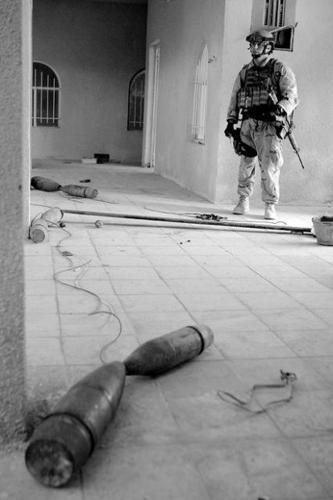



When Col. Ken DeVan goes to work at his Army office southeast of Tucson, the prayers of thousands of military families go with him.
He's part of a new Pentagon push to bring troops back from war alive.
DeVan, head of combat development at Fort Huachuca's military intelligence school in Sierra Vista, is involved in a growing national effort to neutralize the threat posed by IEDs, military-speak for "improvised explosive devices" — the top killer of U.S. troops in Iraq.
Simply put, IEDs are the makeshift bombs insurgents cobble together from scraps and switches, then hide along roadsides to target military convoys.
Nearly 900 of the 1,700-plus troops killed in action in Iraq have been felled by IEDs — including three from Tucson.
The devices also have injured more than 9,000 troops and recently wounded ABC News anchor Bob Woodruff and his cameraman, Doug Vogt.
People are also reading…
Efforts to combat IEDs began in 2003, but the Defense Department recently announced it was beefing up the drive with more money and personnel, and the addition of a retired four-star general to oversee what has become a permanent Pentagon operation.
The effort now has a $3 billion budget, and staffing will nearly double from 170 to 300 people this year.
Keeping up with insurgents
While the term IED is a new one coined during this war, the concept is old, DeVan said.
In wars past, makeshift weapons often were called booby traps, he said. Troops in Vietnam, for example, faced threats from hidden hand grenades hooked to tripwires, or trapdoors rigged into the jungle floor that led to pits lined with deadly bamboo spikes.
Now, experts say, insurgents are becoming increasingly sophisticated in the way they build, hide and detonate the devices, so the military must boost its savvy in response.
The Pentagon has been addressing the problem on many fronts, from buying bomb-detecting robots to training soldiers to detect suspicious activity along major travel routes.
Behind the scenes, people like DeVan are trying to figure out who's behind the bomb makers and how they can be stopped.
Outsmarting these insurgents "is one of our top priorities," said DeVan, who served in Iraq in 2003. He doesn't want to reveal too much detail on what is being done — terrorists read news stories, too, he said — but he does say Fort Huachuca is working on better intelligence-gathering to track the activities of those who make IEDs and the people who aid and finance them.
Every homemade bomb has a network of individuals behind it, he said.
"You have the people who go out and gather the explosive material, you have another person who may be an electrician who goes out and constructs a timer device or a trigger."
Fort Huachuca is training military intelligence soldiers how to elicit more useful information about IED support networks. Sometimes just talking to neighbors can shed light on bomb-making activities in a particular region, DeVan said.
There's a certain finesse required in such questioning, he said. "You can't just walk up to someone and say, 'Hey, do you have any bombs?' "
Fort Huachuca also has sent mobile training teams to Iraq to teach foot soldiers what types of things to pay attention to when they're on patrol, DeVan said.
A local electrician, for example, who suddenly acquires a pricey new vehicle shortly after being seen talking to suspicious people could be making extra money by working with insurgents, he said.
Going after the supply chain
Defense analyst Bob Martinage said Fort Huachuca's anti-IED efforts are crucial because bomb-busting robots and heavily armored Humvees can only do so much to prevent fatalities.
"None of those things are complete solutions. The only way to reduce the number and sophistication of these attacks is to go after the supply chain and intelligence is a very important tool in doing that," said Martinage, of the Center for Strategic and Budgetary Assessments, a defense think tank in Washington, D.C.
So far, he said, every time the Pentagon makes headway against IEDs, insurgents adapt.
For example, bomb makers initially used wires to detonate IEDs, but the wiring became a giveaway once troops knew what to look for. So insurgents began using wireless doorbells or garage-door openers. When the military started using electronic jammers to thwart those devices, insurgents switched to infrared devices similar to television remote controls.
They also have come up with clever hiding spots, Martinage said, such as inside dead animals and under trash piles, or encasing them in concrete to look like part of a street curb.
Still, the Pentagon says progress is being made: Up to 40 percent of IEDS are discovered and disabled by the military before they detonate, said Lt. Christine Devries, a spokeswoman for the counter-IED effort.
During the last half of the 2005 fiscal year, the number of IEDs in Iraq (exploded and unexploded) soared 47 percent, from 1,266 to 1,862. But deaths and woundings fell 14 percent during the same period, from 3,208 to 2,746.
Dan Lawrence of Tucson, whose son, 22-year-old Marine Cpl. Jeff Lawrence, was killed by an IED in Iraq in July 2004, said it comforts him to think the Pentagon may spare other families such anguish.
The two other Tucsonans felled by IEDs were Army Pfc. Sam Huff, 18, who died in Baghdad in April, and Army Spc. Tommy Byrd, 21, killed in Ramadi in October.
"I'm really proud of our government for taking this issue to the forefront," said Dan Lawrence, who also is a command chief for the 162nd Fighter Wing, an Air National Guard unit in Tucson. "There's not a day that goes by that I don't think about my son, and about all the troops serving over there," he said.
"If they can save other families from this kind of hurt, it's money well spent."
● An improvised explosive device is a formal name for explosive devices often used in unconventional warfare by terrorists, guerrillas and insurgents.
The device is placed or fabricated in an improvised manner incorporating destructive, lethal, noxious, pyrotechnic, or incendiary chemicals and designed to destroy, incapacitate, harass or distract.
An IED typically consists of an explosive charge, possibly a booster charge, a detonator and a mechanism either mechanical or electronic, known as the initiation system. IEDs are extremely diverse in design, and may contain any type of firing device or initiator, plus various commercial, military or contrived chemical or explosive fillers.
Source: iCasualties.org


