The Buffalo Bills' new Highmark Stadium will debut with its first event, the Return of the Blue and Red practice, on Aug. 8. From the Bills' pitch to New York State and Erie County for a 100% publicly funded $1.1 billion stadium in 2021 to the final touches and ribbon cutting on the new $2.2 billon stadium, The Buffalo News has covered every step on the road to a new home for the Bills.
But covering the long, arduous process of constructing a new stadium is nothing new for The News. More than 50 years ago, The Buffalo Evening News reported on the financing, construction an opening of the Bills' previous home, then called Rich Stadium. You can read that coverage in the pages of The News below.
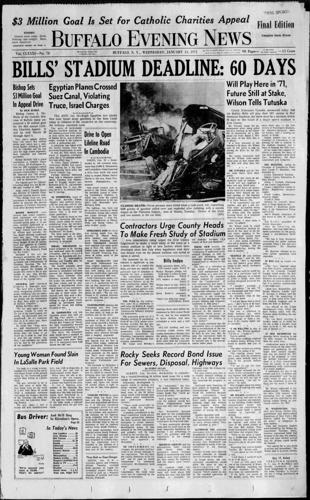
Jan. 13, 1971: Ralph Wilson gives Buffalo and Erie County an ultimatum
"BILLS' STADIUM DEADLINE: 60 DAYS" read the headline on the front page of The News. Then-Erie County Executive B. John Tutuska confirmed that the Bills would play the 1971 season at War Memorial Stadium on Buffalo's East Side, but Bills owner Ralph C. Wilson Jr. set a deadline of 60 days for the county to come to an agreement with the Bills on a new stadium, or else Wilson would move the team, possibly to Seattle.
People are also reading…

Before a deal was struck to build a new stadium for the Buffalo Bills in 1971, owner Ralph Wilson Jr. threatened to move the team, possibly to Seattle.
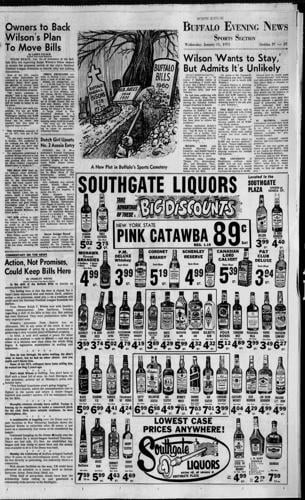
The News' sports page that same day featured a column by Larry Felser reporting that Wilson's fellow NFL owners were expected to back a Bills move to Seattle. "Nobody really wants to play in Buffalo," and NFL GM told Felser. "The conditions in the stadium are the worst I know of and you don't take that much out of the town. In money, I mean."
The sports page also featured a cartoon with a freshly dug grave and a headstone reading "Buffalo Bills: 1960 to ..." and an article, quoting Wilson: "Of course if Buffalo comes up with something, I would want to stay. But it doesn't look like it."

As seen on The Buffalo Evening News' sports page on Jan. 13, 1971, owner Ralph Wilson Jr. said it appeared unlikely that the Buffalo Bills would stay in Buffalo, and NFL owners were expected to back the proposed move.
Sept. 24, 1971: Erie County passes stadium lease and bond resolution
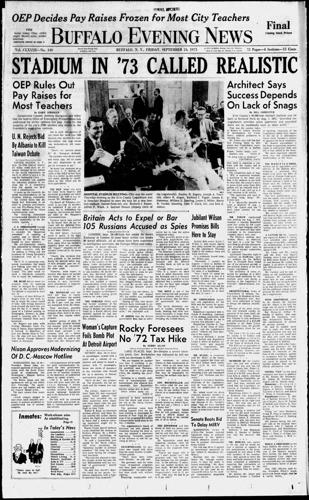
Despite Wilson's threat, the Erie County Legislature approved a lease and $23.5 bond resolution for a new, 80,000-seat stadium in Orchard Park that Wilson said "assures that the Bills will be in Buffalo for at least the next 25 years."
Robert Eskew of Atlanta-based Finch-Henry stadium architects, told The News it was possible the stadium could be completed by Aug. 1, 1973.

The front page of The Buffalo Evening News on Sept. 24, 1971 announces a possible new stadium timeline and the agreement of a lease to construct the stadium passed by the Erie County Legislature.
Oct. 13, 1971: Stadium lease signed
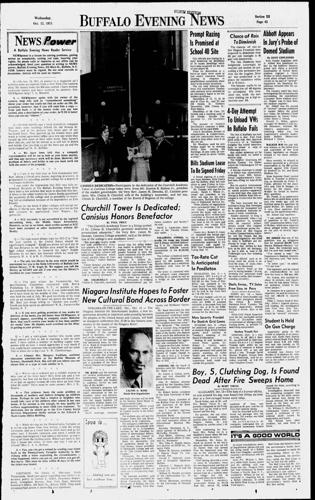
The Buffalo Bills and Erie County formally signed the lease for a new stadium in Orchard Park by Oct. 15, 1971.

A short item in the Oct. 13, 1971 edition of The Buffalo Evening News announces the formal signing of the new stadium lease between the Buffalo Bills and Erie County. Also on the page: an update into the grand jury probe of suspected bribes in Erie County for a previously-scuttled dome stadium project in Lancaster.
Oct. 31, 1972: Ralph Wilson makes offer to name stadium
Matching an offer made by Rich Products, Wilson offered the Bills $1.5 million to name the new stadium "Buffalo Bills Stadium," expressing his sentiment that the stadium should have a "community name" in order to prevent the naming of the stadium from becoming a "divisive issue."
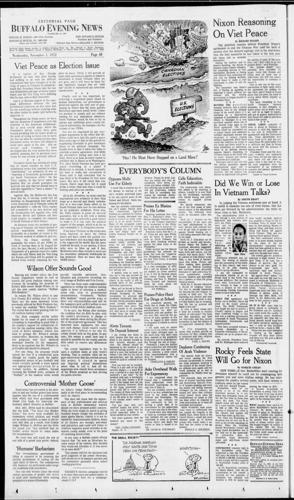
On The News' opinion page on Nov. 1, 1972, the Editorial Board sided with Wilson, saying that his proposal should be accepted to "convey far less of a commercial aura" and to "provide valuable nationwide identification and promotion benefiting the civic image of Buffalo and Erie County."

The Buffalo Evening News' editorial board expresses their opinion that Erie County should accept Ralph Wilson Jr.'s $1.5 million offer to name the stadium "Buffalo Bills Stadium," on the Opinion page on Nov. 1, 1972.
Nov. 8, 1972: Buffalo Bills accept offer for 'Rich Stadium' name
The Erie County Legislature officially accepted Rich Products' $1.5 million offer to name the stadium Rich Stadium for 25 years, rejecting other proposed names such as Erie County Veterans Stadium, Orchard Park Stadium and Erie County Stadium. The county rejected Ralph Wilson's offer to name the stadium Buffalo Bills Stadium because the team's offer contained a provision that it would be allowed to resell the name to a third party if it chose to.
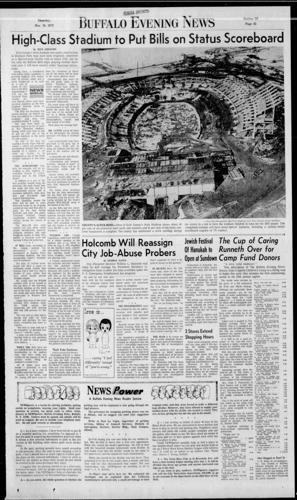
Nov. 30, 1972: Stadium work speeds up
A large photo in The News reveals that 40% of the stadium's structural steel work is complete, and 65% of its basic concrete framework. News reporter Rich Johnston reported on the amenities that the new stadium would contain, including a state of the art scoreboard with replay capability that would be "without peer in the United States," a club restaurant, 30 private suites and a press lounge, built at a cost of $3 million to the Bills. Erie County also authorized a "winter speedup" in construction in order to have the stadium ready for the 1973 NFL season.

The Buffalo Evening News' reports on the construction of the soon-to be-named Rich Stadium on Nov. 30, 1972.
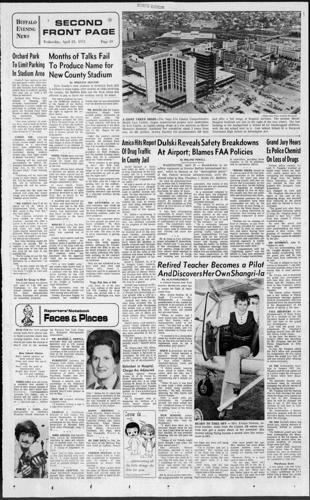
April 25, 1973: Stadium name hits snag
Though Erie County agreed to Rich Products' offer to name the stadium Rich Stadium, the Bills still had final approval of the name, and negotiations stalled over Rich's designs for the signs bearing the "Rich Stadium" name, which were rejected by the Bills over their size and proposed locations on the structure.

The Buffalo Evening News reports on negotiations between Erie County and Rich Products Corp. to finalize a stadium naming deal on April 25, 1973.
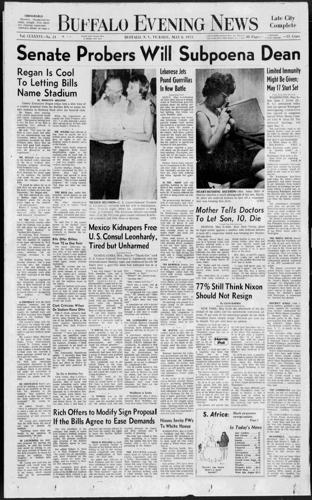
May 8, 1973: Bills make another offer to name stadium themselves
As negotiation over the stadium name bogged down, the Bills made another offer to name the stadium after the team after rejecting Rich's latest signage proposal because the signs proposed were "overabundant, oversized and represent obvious commercialization," according to then-Bills vice president and general manager Robert T. Lustig.
County officials, however, seemed to have a hard time taking the new Bills offer seriously.
"I have just finished reading the pontifical statement by Mr. Wilson and his concern over commercializing the stadium," County Legislator John V. Clark said. "Frankly, I think this statement is an insult to the intelligence of our community.

The battle over naming what would then become Rich Stadium continues on May 8, 1973.
May 17, 1973: Rich Stadium name officially approved
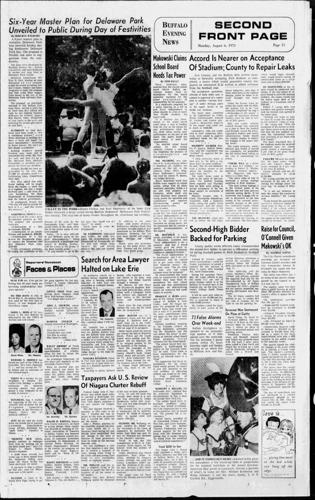
The Buffalo Evening News' Second Front Page reported the end of the stadium name impasse, voting to approve an amended proposal by Rich Products – with fewer signs – by a vote of 18-1.
Aug. 6, 1973: Official completion of stadium looms
Just days before Rich Stadium's official opening, The News reported that the Bills and Erie County were close to formally accepting the stadium as completed, though the sides needed to approve a plan by the county to fix "serious leakage" of water through joints in the stadium's upper levels. Since the county would absorb the cost of repairs to the leaks, which were discovered in late July, the Bills were inclined to accept the stadium as complete if the Legislature approved the funds.
If the stadium was not deemed complete by Aug. 8, Erie County stood to lose out on a significant portion of ticket sales revenue, as their share would be reduced to just 8% of the first $5 million in sales.

The Buffalo Evening News reports that the Buffalo Bills and Erie County are close to an agreement that Rich Stadium's construction is finally complete on Aug. 6, 1973.
Aug. 17, 1973: Ready for opening night
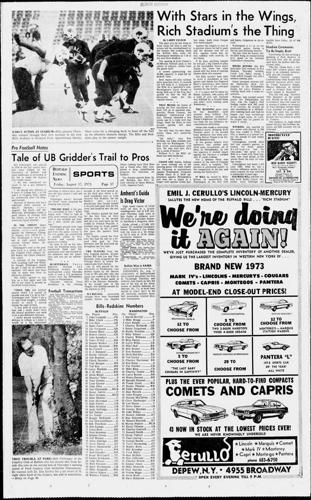
The News' sports section previews the opening of Rich Stadium as the Bills prepared to take on the Washington Redskins in a preseason game. There were no gala opening festivities planned, with former Bills player Glenn Bass tapped to give an invocation, and the presentation of silver engraved trays by NFL Commissioner Pete Rozelle to Erie County Executive Edward Regan, Buffalo Mayor Stanley Makowski and Orchard Park Supervisor Eugene Woodward.
A sing-along of "America The Beautiful" was planned for the fans, with the song's lyrics to appear on the stadium's scoreboard.

Buffalo Evening News sports columnist Larry Felser previews the first ever game at Rich Stadium, a preseason contest between the Buffalo Bills and Washington Redskins on Aug. 17, 1973.
Aug. 18, 1973: Traffic snarl makes for memorable debut
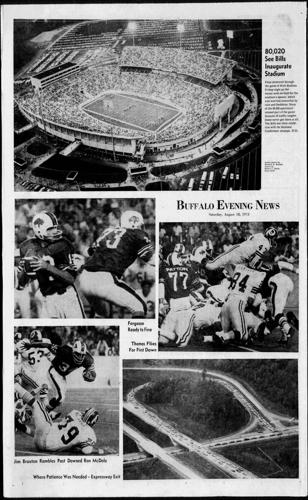
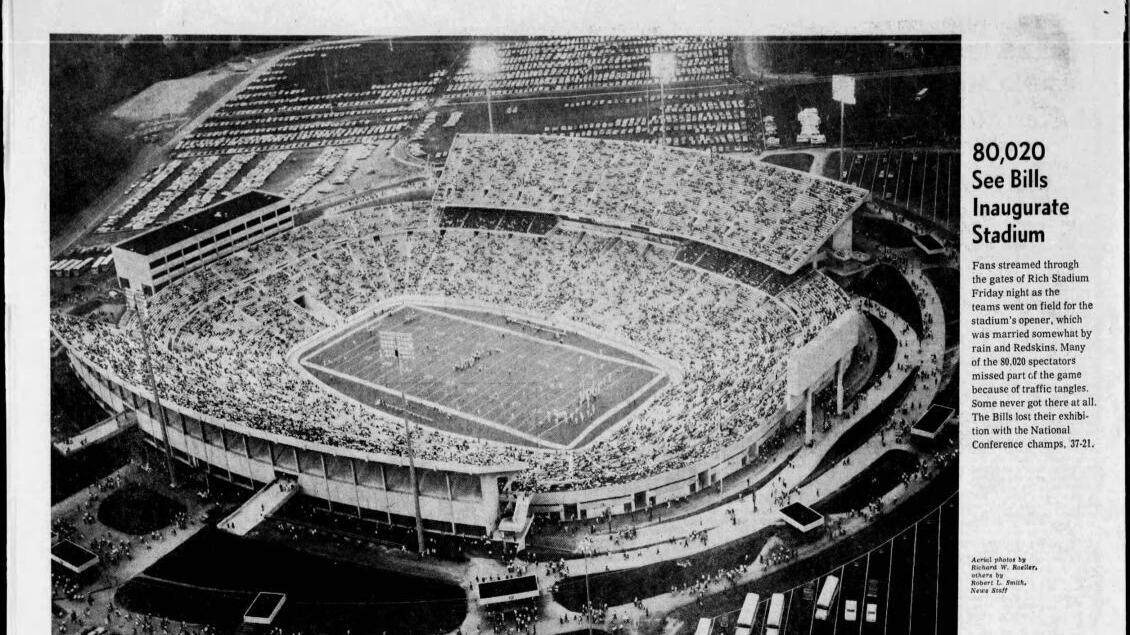
"Traffic Snarl Mars Stadium Debut," read the headline on the front page of The News on Aug. 18, 1973. Fans were still entering the stadium during the Bills' 37-21 loss to Washington. Nearly a quarter of the crowd of 80,020 fans – the largest crowd ever to witness a sporting event in New York State, at the time – missed the opening kickoff. Some fans reported being stuck in their cars for 4 1/2 hours, despite leaving home for the game two hours before it's 7:30 p.m. kickoff time.
However, despite the traffic jam, fans were impressed with the stadium's size and scoreboard, and they were treated to an opening kickoff return for a touchdown – albeit one by Washington's Herb Mul-Key. Fans also got to christen Rich Stadium with the time honored tradition of booing NFL Commissioner Rozelle, and the news reported a group of men partying with a quarter-keg of beer – a harbinger of the tailgating to come.

The picture page of The Buffalo Evening News on Aug. 18, 1973, documents opening night at Rich Stadium, and its related traffic jam.