

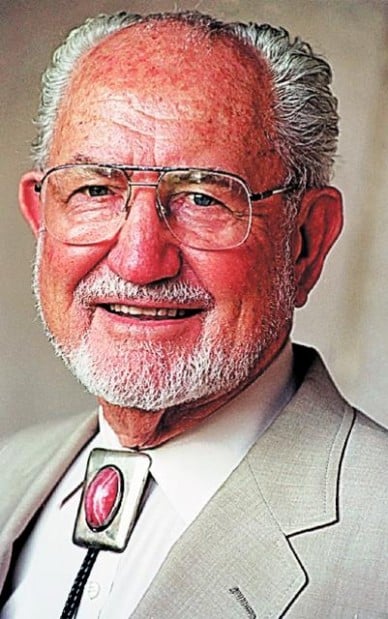
John Molloy, a former chief judge of the Arizona Court of Appeals who in later years became an outspoken critic of changes in the legal community, died on Saturday after an extensive battle with a number of ailments, including prostate cancer.
He was 90.
Often seen sporting a bola tie that was a Father's Day gift from his daughters, Molloy spent most of his legal career in Southern Arizona, serving as a Pima County Superior Court judge before heading to the appellate court.
Former Chief Justice Stanley G. Feldman of the Arizona Supreme Court, who practiced law in front of Molloy on several occasions, said Molloy was focused and was never short of an opinion.
"He always knew where he was on anything," Feldman said. "He was very forthright in stating his views."
With a passion for the law and life, Molloy seemed younger than he was, Feldman said.
People are also reading…
Born in Yuma in 1917, the former judge graduated from the University of Arizona in 1939 and became a naval fighter pilot during World War II.
He earned his law degree from the UA in 1946 after returning from the war.
Molloy, an active member of the community, at one time served on the board of the YMCA of Metropolitan Tucson and was president of the Marshall Foundation.
Despite Molloy's busy schedule and heavy workload, he always had time for his six children, said his daughter, Marjorie Letson.
"Even with all the things he was juggling, it didn't matter," she said. "The children were always first."
But that didn't mean he left work at the office.
After each spring's UA graduation, dozens of law students could be found in Molloy's backyard as he helped them prepare for the bar exam.
And when he disagreed with a court decision, he was vocal about it around the family dinner table, Letson said.
One decision never sat well with him.
Sitting with the state Supreme Court in 1966, Molloy wrote the final Miranda v. Arizona decision, which later was overturned by the U.S. Supreme Court in the landmark case that required police to inform suspects of their rights.
"He felt very strongly that he had made the right decision and that the courts were letting criminals go free," Letson said.
Upon retiring, Molloy wrote "The Fraternity," a critical examination of changes in the legal field that he felt were damaging the reputation and effectiveness of all lawyers.
Chief among his concerns was the fear that lawyers had begun to focus on billing rather than helping clients.
"I've had my fill of the law business. I'm tired of filling out time sheets," Molloy said in a 1992 interview with the Arizona Daily Star. "I never want to fill out another one. It's too mercenary to get so involved in trying to make money."
Despite his criticism, he still viewed the field as the best career he could have had, and he told his family daily how much he enjoyed his life, Letson said.
"He would always say, 'Life is good,' and he wanted to make things better," she said. "He knew that you just don't sit around and that you have to get out there to make your community a better place."
Preceded in death by his daughter, Eva Jo Bansner, Molloy is survived by his wife, Barbara "Bobbi" Boyer Lefferts Molloy; ex-wife Josephine Molloy; daughters Marjorie Letson and Karen Sebring; and sons John J. Molloy, Thomas Alexis Molloy and Craig William Molloy.
The family plans to hold a memorial service at 4 p.m. Saturday at Christ Presbyterian Church, 6565 E. Broadway.



 Tucson official: Air Force won't pay for D-M groundwater cleanup now


