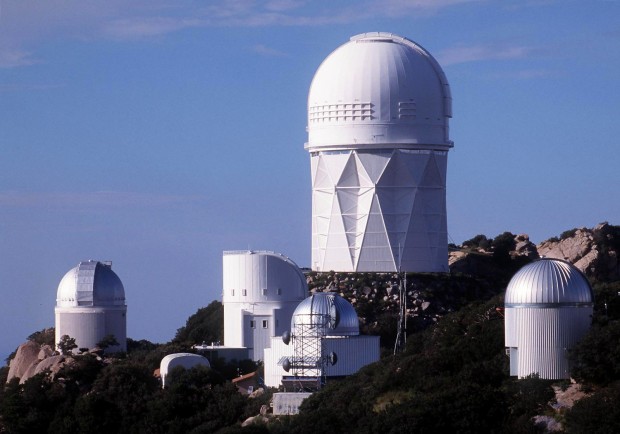
Cuts in federal spending on science could force the National Science Foundation to drastically reduce or end its support of Kitt Peak National Observatory, beginning as early as next year.
A recent message to employees of the National Optical Astronomy Observatory from director David Silva warns of "the very real possibility" that NSF's Division of Astronomical Sciences "may choose to close KPNO and possibly other NOAO facilities or sites as open-access resources in response to … budget pressures."
In a telephone interview Tuesday, Silva said his agency's budget will be disproportionately affected by expected cuts in federal funds.
Smaller sites will take a back seat to big-budget projects such as the Large Synoptic Survey Telescope and projects with international partners, he said.
No decisions have been made, but cuts could come as early as February when the president proposes his budget to Congress, according to an early October presentation made by Jim Ulvestad, director of NSF's Astronomical Sciences division.
People are also reading…
According to an NSF archive of his speech, Ulvestad proposed "significant long-term reductions in existing facilities in order to enable operation of the newest generation of NSF astronomy facilities."
Silva said continued federal funding on Kitt Peak had been predicated on a budget that grew yearly to accommodate inflation and new projects.
Instead of 3 percent growth, however, NSF now anticipates a 4 percent cut. NOAO could face yearly cuts of 10-to-20 percent a year, Silva warned in the most recent NOAO newsletter.
Withdrawal of NSF support would not necessarily mean closure of Kitt Peak, which has operated since 1960 on a mountaintop west of Tucson on the Tohono O'odham Nation. Some of its 26 telescopes are operated by universities and other institutions.
Kitt Peak's largest scope, the 4-meter Mayall, has been selected for a longtime wide-field study of dark energy from Lawrence Berkeley National Laboratory that would mean a $71 million upgrade, if it can snare funding.
The observatory's role in American astronomy, however, could be severely diminished if the NOAO pulls out.
Kitt Peak already faces the loss of its five solar astronomy instruments when the National Solar Observatory moves its headquarters to Boulder, Colo., in conjunction with construction of the Advanced Technology Solar Telescope on the Hawaiian island of Maui. That move is set for 2016.
In a forum on the NOAO website, astronomer Dieter Hartmann of Clemson University said the budget troubles are comparable to the "no tax increase for the millionaires situation in the country."
"Just like the money-makers are not necessarily the job creators, big scope 'owners' are not necessarily the paper creators and science producers. What I am most concerned about is the decay of the middle class, i.e., those with access to midsize telescopes.
"It would become increasingly hard, if not impossible, to train students so that they can successfully prepare for bigger programs," Hartmann wrote.
Education and public outreach will be the victims of a Kitt Peak closure, said J. Ward Moody, professor of physics and astronomy at Brigham Young University.
Moody, in a telephone interview, said he has spent about 200 nights on Kitt Peak over his career. Its open-access philosophy - which awards time to astronomers based on the merit of their proposals - is essential for the training of young astronomers, he said.
"I could hardly conceive of Kitt Peak closing. It is so foundational to American astronomy," he said.
Silva said the drop in funding is accelerating a trend that was already under way - the move to provide more open access on larger telescopes. The smaller ones can survive under different funding schemes, he said.
"One of the messages I've been trying to send to my staff internally is that things may have to change, but my goal is to find that non-federal funding that allows people to keep their jobs and allows the site to be scientifically productive," Silva said.
The fate of the largest telescope on Kitt Peak - the 4-meter Mayall - may hinge on a "portfolio review" being conducted by the NSF, which includes the Big BOSS dark-energy experiment.
"Big BOSS is a killer program. If funded and executed, it may be the highest-value scientific project ever funded on Kitt Peak," Silva said.
"I could hardly conceive of Kitt Peak closing. It is so foundational to American astronomy."
J. Ward Moody, professor of physics and astronomy at Brigham Young University
Metric Conversion
The size of a telescope is expressed in meters. A 1-meter telescope mirror would be 39.37 inches in diameter.
DID YOU KNOW?
No new telescope has located to Kitt Peak since the WIYN 3.5-meter telescope saw first light more than 17 years ago.
Contact reporter Tom Beal at tbeal@azstarnet.com or 573-4158.
 Japanese company invests in mine near Mount Lemmon