

While Southern Arizona is known for its porphyry copper deposits, Northern Arizona is better known for its nonmetallic commodities, including basalt, helium, potash and carbon dioxide (CO2).
More than 600 cinder cones comprise the 1,800-square-mile San Francisco Volcano Field and its south-central edge of Flagstaff in Coconino County.
Created by strombolian (low-level) eruptions over the past 6 million years, the San Francisco Volcanic Field includes Sunset Crater, the state’s youngest volcano and most recent example of an eruption that occurred 1,000 years ago.
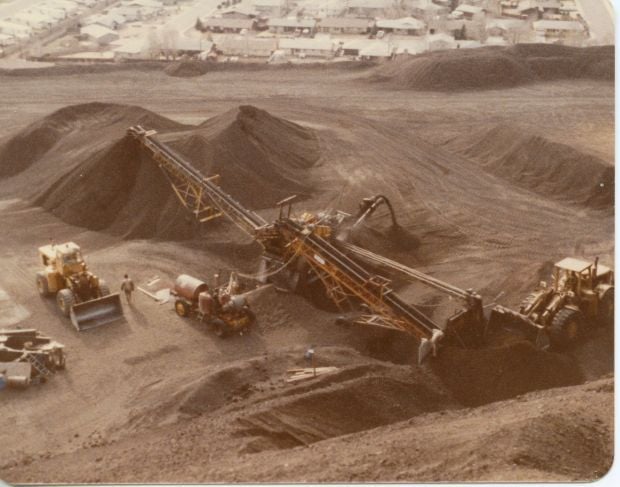
The area is known for its commercial production of scoria, a volcanic rock composed of basalt and andesite. These fine-grained, dark-colored, igneous rocks make up the cinder cones, which average 1,000 feet in height and a half-mile in diameter at the base.
People are also reading…
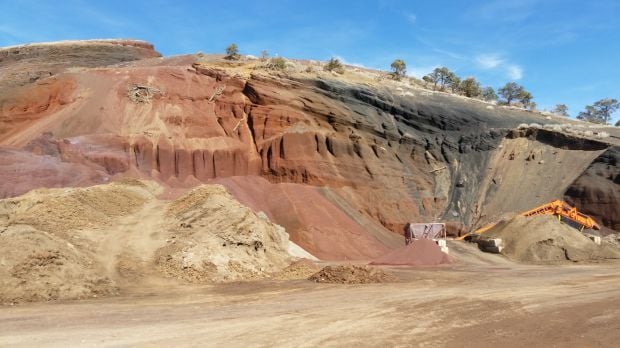
The Atchison, Topeka & Santa Fe Railway Co. quarried and stockpiled basalt at Winona for use in railroad ballast, concrete aggregate and cinder block. Sheep Hill, a large volcanic cone on the east side of Flagstaff, hosts a cinder pit mining operation clearly defined by the impacted disturbance on its western flank. Its colorful striations dominate the landscape, and its product is used to provide traction on winter roads and as a decorative landscape material.
Helium, a light inert gas, has many uses, including as an inert shield for arc welding and for pressuring rockets and missiles. Located in the Holbrook Basin and the Four Corners area, concentrations of helium vary from trace amounts to up to 10 percent.
Commercial concentrations average above 0.3 percent. As the first commercially produced gas in Arizona, notable helium fields include Pinta Dome, 35 miles northeast of Holbrook, and the nearby Navajo Springs and East Navajo Springs fields.
The Teec Nos Pos oil and gas field also produced helium in 1968. Today’s declining federal helium reserves may bring about renewed exploration and development of helium in Northeastern Arizona.
A major byproduct of helium production, carbon dioxide (CO2), was discovered in 1994 in several wells between St. Johns and Springerville. Liquid CO2 is processed by a local plant and distributed for use in Arizona’s beverage industry.
CO2 also is used as a refrigerant for perishable goods, firefighting and fog seeding. CO2 enhances oil recovery and, according to a 2011 Department of Energy report, 137 billion barrels of domestic oil could be produced through the use of CO2. CO2-enhanced oil recovery currently accounts for nearly 6 percent of U.S. onshore oil production.
CO2 is miscible, combining with oil at a supercritical pressure and temperature, allowing oil to travel through rock pore spaces for greater recovery to production wells. Above-ground facilities separate the CO2 from the oil, where it is then recycled to mix with oil for further extraction.
The St. Johns CO2 Field encompasses 260,000 acres. Since 1997, more than 10 wells in the St. Johns CO2 Field were hydraulically fractured for the purpose of drilling for carbon dioxide gas. Kinder Morgan CO2 Co. L.P. bought the field in 2012. It plans a $1 billion investment on a 213-mile, 16-inch-diameter pipeline from the St. Johns CO2 Field to oilfields in New Mexico and West Texas. That also includes drilling wells and building treatment and compression facilities at the St. Johns Field.
However, falling oil prices in late 2014 have caused Kinder Morgan to reassess these plans.
Exploratory drilling in the 1960s and 1970s by the Arkla Exploration Co. and the Duval Corp. led to a 2008 Arizona Geological Survey report that revealed a 600-square-mile, 2.27 billion-ton potash deposit averaging 1,200 feet below the surface seven miles east of Holbrook.
Over the past five years, the market price for potash has fluctuated between $840 and $350 per ton. Used primarily as an agricultural fertilizer, potash or potassium carbonate (K2CO3) was derived centuries ago by wood ash collected in metal pots used as fertilizer.
Companies including Passport Potash and American West Potash LLC, controlling more than 150,000 acres of land in the area, would like to open Arizona’s first potash mine by 2018 after extensive federal and state permitting providing a projected 750 jobs in the Holbrook area.
William Ascarza is an archivist, historian and author of six books, including “Southeastern Arizona Mining Towns,” “Arizona-Sonora Desert Museum” and “Tucson Mountains.” They’re available at Antigone Books, Cat Mountain Emporium, the Arizona-Sonora Desert Museum and the Arizona Geologic Survey’s Arizona Experience Store. Email him at mining@tucson.com
Sources: L.S. Melzer (2012). Carbon Dioxide Enhanced Oil Recovery. (CO2-EOR): Factors involving in Adding Carbon Capture, Utilization and Storage (CCUS) to Enhanced Oil Recovery; Mineral and Water Resources of Arizona. Arizona Bureau of Mines Bulletin 180, Tucson, University of Arizona, 1969; Steven L. Rauzi. Review of Helium Production and Potential in Arizona. 2003. Arizona Geological Survey Open-File Report OFR 03-05; Steven L. Rauzi, Arizona has Potash. Arizona Geology, Vol. 38, No. 2. summer 2008; Teri Walker. May 2012. Helium Shortage Looming, and Northeastern Arizona Can Help. Arizona Journal.


