

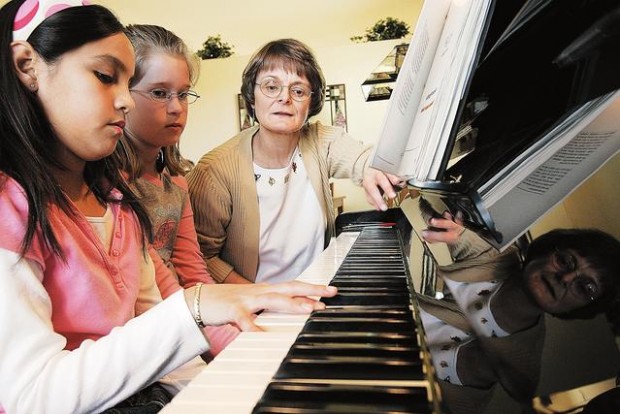
No rulers across the knuckles. No dirty looks, reading music or music jargon.
Marilyn Van Roekel has a novel approach to piano lessons: They're supposed to be fun.
Right from the beginning, Van Roekel says, her students play songs.
In fact, if you know your thumb from your pinky, she says, she'll teach you to play a recognizable song by the end of the first lesson.
Van Roekel, 53, learned to play the traditional way, listening when teachers said "arch those fingers" and memorizing the lines and spaces on the treble clef with the mnemonics "every good boy does fine" and "F-A-C-E." She stuck it out. A lot of kids didn't.
She taught piano traditionally for more than 20 years, before learning the Simply Music method two years ago.
People are also reading…
Van Roekel says the method, developed by Neil Moore, an Australian living in California, isn't just fun, it works very well. In fact, she believes the average Simply Music student will be a better player after a year than the average student using the traditional method.
"My experience is that the speed and quality with which they learn it is far superior to a reading-based method," says Van Roekel.
And then there's the whole matter that they may also be more likely to still be a student after a year, at least if enjoyment has anything to do with it.
Granted, you still have to practice, says 56-year-old Mike McCrory, at Van Roekel's Oro Valley home for a lesson. But McCrory says that's not a problem. "It's a lot of fun," he says.
"I played clarinet in elementary through high school. I was in marching band. I enjoyed it, but hated practicing. But this time around, I do practice better than as a kid," McCrory says.
Van Roekel says the system is based on a very positive idea — that everyone is musical and can learn.
Even the guy next to you at the basketball game who can't clap in unison with the cheerleaders and crowd?
Even him.
She says many of the things we do in everyday life show rhythmic and musical ability.
"After a show, you're walking out of a theater, you and your wife are talking about actors, narrative, talking about going to get something to eat — your feet are keeping a perfect pulse," says Van Roekel.
Then she says, "I don't have a musical bone in my body."
She repeats that phrase several times, each time further accentuating the natural pulses in the sentence, until it almost turns into a rap, proving the opposite of what she is saying.
"It's a very complex rhythm," she says. "Simply Music gives them a simple way to express that."
Another fundamental of the method is that students should learn a variety of styles. She teaches blues, a few traditional or folk songs, standards and a couple of simplified classical pieces.
Van Roekel charges $70 per month for once-a-week, shared lessons; there can be two or three students in the same lesson.
She wants students to take what they've learned and make the piano "a lifelong companion" and make playing it something they do with their friends and families.
Music, she says, should be a natural form of self-expression.
Van Roekel delays teaching students to read music for a year. By then, she says, they don't have to struggle with the mechanics of playing a familiar piece and can "reverse engineer" the music — seeing how what they were already playing looks on paper.
From then on, lessons combine reading and playing-based training.
Information session
What: Simply Music piano teaching method information session.
When: 2 p.m. Feb. 18.
Where: Casas Adobes Congregational United Church of Christ, 6801 N. Oracle Road
Cost: Free, but reservations are required. Call Marilyn Van Roekel at 797-3891.
On the Web: www.simplymusic.net


