With litigation over the Colorado River looking increasingly likely, Arizona has hired a high-powered, New York City-based global law firm to defend its river water rights before the U.S. Supreme Court if necessary, Gov. Katie Hobbs' office announced Monday.
Depending on how litigation proceeds, the firm Sullivan and Cromwell could represent Arizona in future administrative proceedings before the Interior Department, or in arguments before the Supreme Court.
The company, nearly 150 years old, employs more than 1,000 attorneys, has a long history of high-profile legal cases, and has 13 offices in the U.S. and other countries.
Most recently, it has represented President Donald Trump since last year on his appeal of a criminal conviction in the case in which he was accused of falsifying business records to conceal a hush-money payment to porn star Stormy Daniels. Robert Giuffra, a co-chair of the law firm, heads Trump's legal team on that case.
People are also reading…
Other recent high-profile cases the firm has handled include the SpaceX and xAI's $250 billion merger this year, Capital One's $35 billion acquisition of Discover in 2025, and a $14 billion Chapter 11 bankruptcy reorganization plan for the cryptocurrency firm FTX Trading.
Arizona has signaled its intention for some time that it's prepared to fight in court to prevent what its officials say would be an inequitable split of the river's shrinking supplies among the seven Colorado River Basin states. The Arizona Legislature has already appropriated $3 million for possible future litigation over the Colorado River, and a bill to appropriate another million dollars is moving through the Legislature now. The Governor's Office has not yet said how much the law firm will be paid.
The Governor's Office and the Arizona Department of Water Resources haven't decided yet whether they'll sue. In part, that's because the U.S. Bureau of Reclamation has yet to decide on a final plan for managing the river and its reservoirs for the next 20 years after its current operating plan expires at the end of September. A plan is due later this year when the bureau releases a final environmental impact statement on the river.

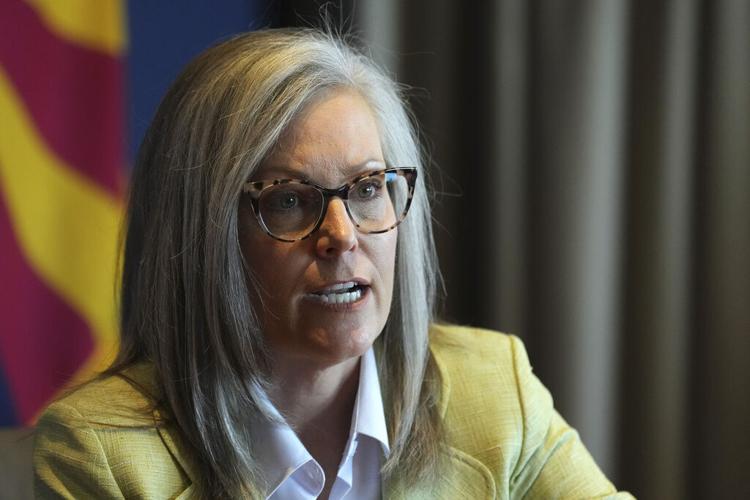
Arizona Gov. Katie Hobbs
The seven states are still negotiating after having blown through two federally imposed deadlines for reaching an agreement. At a press briefing held Monday to announce the hiring of Sullivan and Cromwell, Arizona governor's representatives said Hobbs remains committed to a negotiated solution but must be prepared for litigation if necessary. The office's ground rules for the briefing were that the representatives who provided the information could not be quoted by name.
The firm appointed by the governor will have to take on a complex, multi-faceted legal dispute that has dramatically heated up in the past two years but has roots dating back more than a century.
The three Lower Colorado River Basin states, of Arizona, California and Nevada, are likely to press a claim that the four Upper Basin states of Colorado, New Mexico, Utah, and Wyoming will be violating the 1922 Colorado River Compact. That's because as of this year, drought conditions on the river are so bad that it is almost certain to have carried less water over the past decade than the compact requires the Upper Basin states to deliver to the Lower Basin states, under the Lower Basin states' interpretation of the compact.
The Upper Basin states have disputed the allegations of compact violations, on the grounds that it's been climate change, not their own use of river water, that has depleted the river enough that it's no longer delivering the amount the compact requires.
Litigation is also possible over Reclamation's environmental impact statement, which all seven states have sharply criticized on different grounds. Arizona, in particular, has said some of the alternatives included in the bureau's draft environmental statement would "flatten" Arizona's economy over the long term, if implemented.

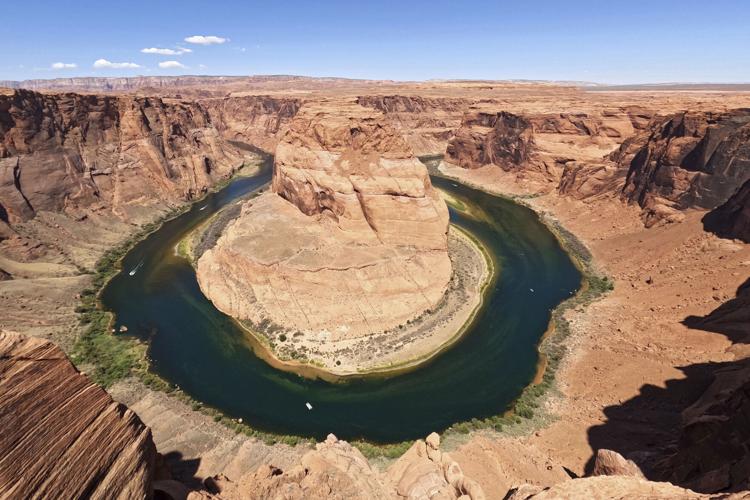
The Colorado River flows at Horseshoe Bend in Glen Canyon National Recreation Area near Page, Arizona.
The bureau has yet to select a preferred plan for the river but as the draft statement is written, the plan the agency would most likely adopt in the absence of a seven-state agreement would cut river supplies to the Central Arizona Project canal system by 77%.
If this case did go to court, and the two basins are legally pitted against one another, the Supreme Court can have immediate jurisdiction over the issue rather than have it proceed through lower federal court branches first.
Under that scenario, the Supreme Court would appoint a special master to hear the case and make a recommendation to the high court on how to deal with it, the governor's office staff said at Monday's press briefing.
The attorneys who would handle such a case before the high court together have dozens of cases that have gone before that court, Governor's Office staff said. They include former U.S. Solicitor General Jeff Wall and attorney Morgan Ratner. Wall and Ratner are also representing Trump in the hush money case appeal and are both former U.S. Supreme Court clerks.
Contact Tony Davis at 520-349-0350 or tdavis@tucson.com. Follow Davis on Twitter@tonydavis987.

Tony Davis
Reporter


 Report: Big CAP cuts would trigger huge economic hits, major job losses in Arizona