At Tucson’s top outdoor destination, you can enjoy sweeping vistas, seasonal waterfalls and occasional wildlife encounters along more than 30 miles of trails for hikers and cyclists of every skill level.
The only thing missing from Sabino Canyon is a fancy front porch.
Coronado National Forest and the nonprofit Friends of Sabino Canyon have teamed up on an ambitious plan to transform the entrance to the recreation area with a new $32.8 million visitor center and expanded parking lot.
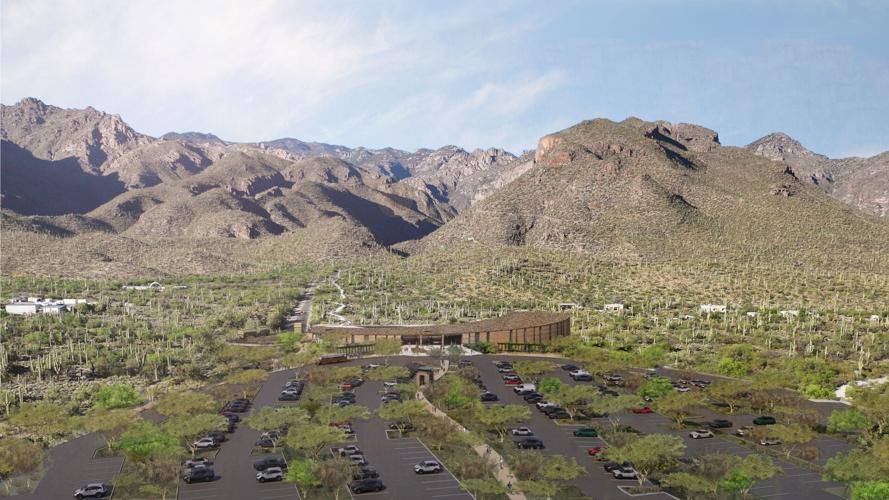
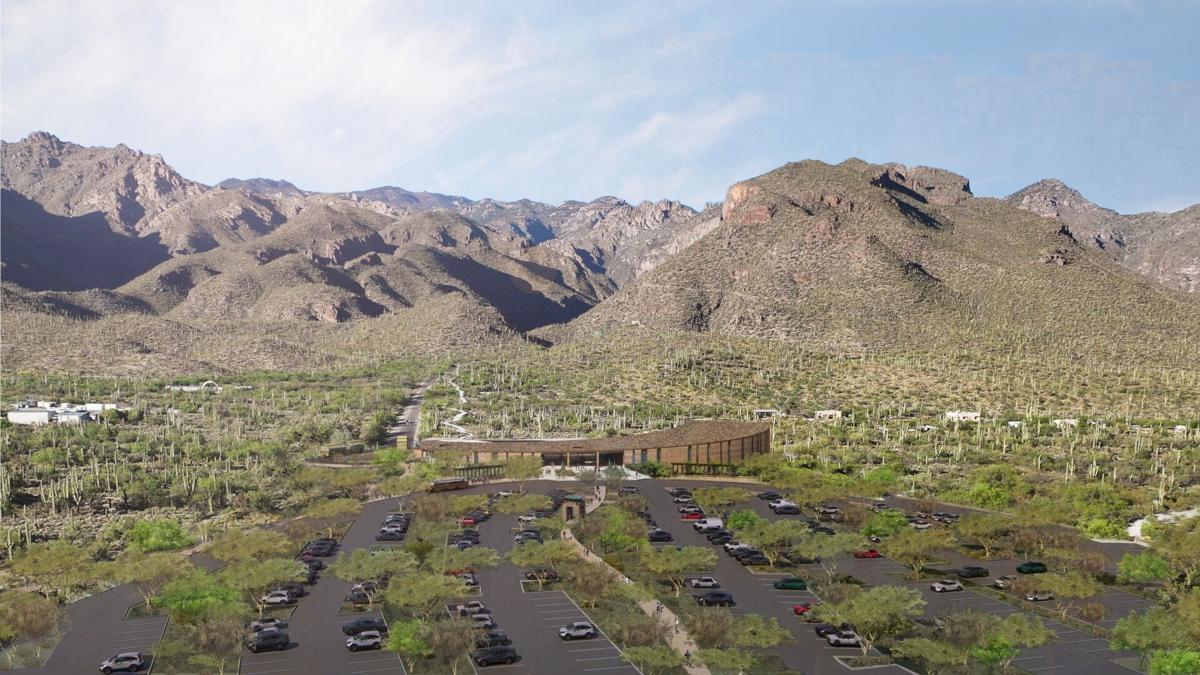
Under the proposal, the existing collection of nine buildings, some of them dating back more than 60 years, would be replaced by a single modern structure with almost triple the floor space. The parking lot would be enlarged and reconfigured to add up to 122 spaces, along with desert landscaping, solar panels and dedicated walking paths to improve traffic flow and pedestrian safety.
People are also reading…
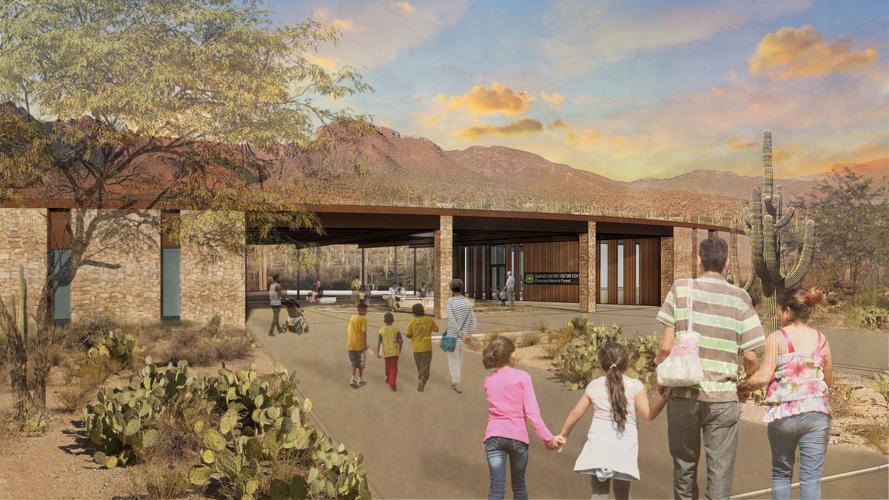
The design for the “reimagined” visitor center blends indoor and outdoor space into a crescent-shaped structure that opens toward the mouth of Sabino Canyon and the Santa Catalina Mountains beyond.
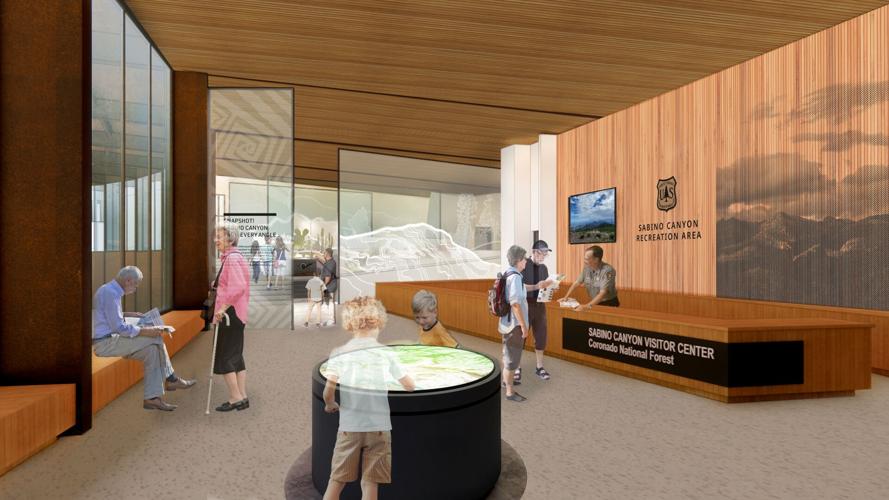
Covering up to 29,000 square feet, the facility would include dedicated exhibit space with new interactive displays, a gift shop and bookstore, a small café, a multipurpose room, dozens of offices for Forest Service employees and volunteers, and an improved ticketing and boarding area for the Sabino Canyon Crawler tram service.

The proposed visitor center blends indoor and outdoor space into a curved structure that opens toward the mouth of Sabino Canyon like a giant "front porch" for the popular recreation area.
“It's a generational project,” said Friends president Jim Darling. “I tell folks we're not building it for us. Quite frankly, we're not building it for our kids. We’re building it for our grandchildren, that couple of generations away. It's ambitious, there's no question about it, but I think it makes sense.”
Before they can roll out the welcome mat, though, they have to find the money to pay for it.
Cash for canyon
Local U.S. Forest Service officials have requested funding for the project through the agency’s “internal competitive process,” said Adam Milnor, recreation, heritage and lands staff officer for Coronado National Forest.
The most likely funding source is the National Parks and Public Land Legacy Restoration Fund, an almost $10 billion program created by Congress in 2020 as part of the Great American Outdoors Act and proposed for renewal as part of the America the Beautiful Act now under consideration in the Senate.
Darling said projects with strong community financial support “tend to move to the top of the list” for Legacy Restoration Fund consideration, so the Friends of Sabino Canyon have committed to raising almost $5 million for the new visitor center, 15% of money needed.

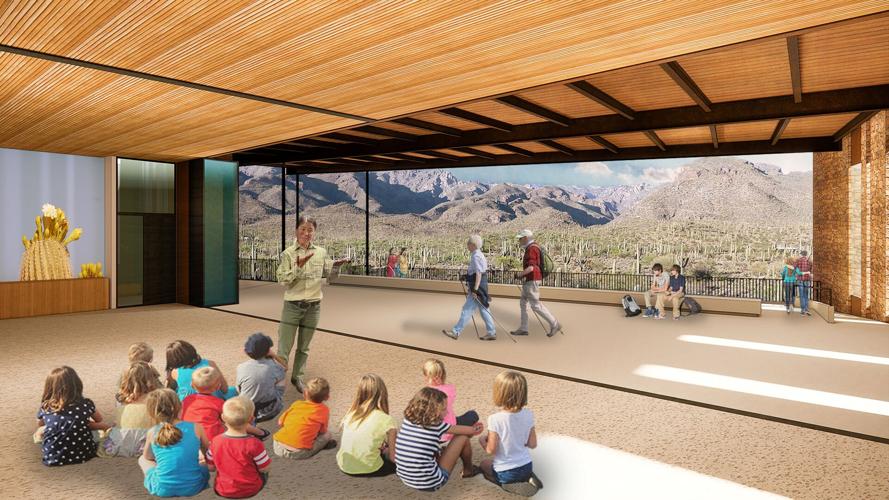
The planned multi-purpose room would offer sweeping views of Sabino Canyon and a folding glass wall allowing it to serve as indoor or outdoor space.
According to its website, the Friends have raised more than $1 million for past projects in Sabino Canyon, but this will be the largest fundraising campaign yet for the volunteer group founded in 1993.
Darling isn’t worried. He said their board includes several members with experience in “big institutional fundraising,” and they have also hired a part-time staff member who worked on the successful capital campaign for the United States Holocaust Memorial Museum in Washington, D.C.
“So we've got a pretty sophisticated crew put together to do it, and we're optimistic,” he said.
Coronado National Forest completed its environmental review and signed off on the master plan for the Sabino Canyon Visitor Center Reimagined Project in December, capping a two-year process that included community workshops and public meetings.
Darling expects the Friends to officially launch their fundraising campaign sometime in 2027, with a goal of collecting their share of the project costs within two to three years.
Out with the old
Sabino Canyon’s current visitor center was built in 1963 and expanded in 1996, with some additional improvements in 2002.
Darling said Forest officials have done their best to keep it in working order, but “its useful life is over, and it doesn't meet the needs of future generations.”
The facility is cramped and “showing its age,” with interpretive displays relegated to hallways next to the front door, he said.
The water and sewer lines serving the site are old and prone to problems, and the air conditioning system has been known to stop working in the heat of summer.
Staff members from the National Forest’s Santa Catalina District work inside the rotting wood walls of adjacent modular office buildings that were installed in 1991 and never meant to last 35 years in the desert sun.
Meanwhile, visitation has surged by 50% or more at the recreation area in recent decades, fueled by an increase in tourism to Southern Arizona and housing development near the canyon. According to the master plan for the new visitor center, there are now roughly 2,000 residential lots within a mile of the entrance to Sabino.

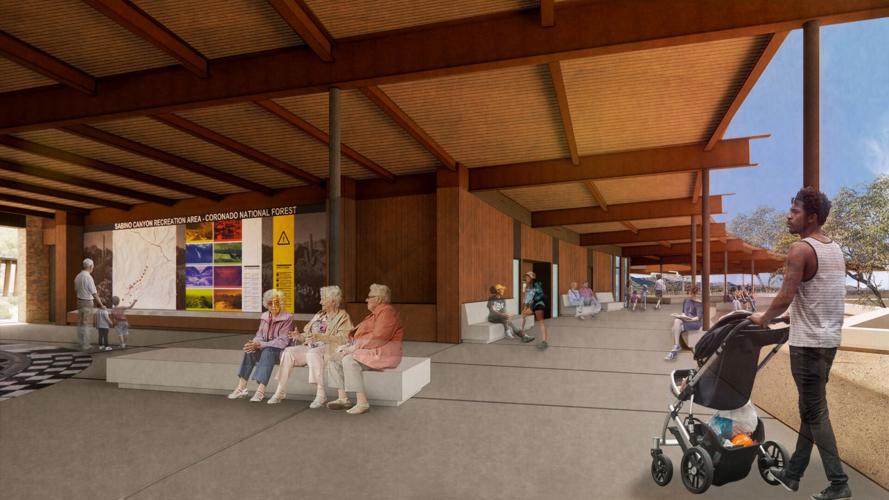
A master-plan rendering shows the "arrival plaza" at the proposed Sabino Canyon Visitor Center.
Getting exact visitor counts is “difficult due to multiple access points and growing walk- and bike-in traffic,” Milnor said, but the recreation area easily ranks as the most popular spot in Coronado National Forest, drawing between 1.1 million and 1.4 million people a year. That’s several hundred thousand more than Saguaro National Park sees annually.
The main parking lot at Sabino Canyon — with its 378 spots — tends to fill to capacity on 40 to 50 days a year, Milnor said. And on the 10 to 15 busiest of those days, the park’s nearby overflow lot fills up, too.
The idea of replacing the old visitor center has been in the works since at least 2016. The Forest and the Friends agreed to share the $250,000 cost of a master plan for the project in 2022.
The 58-page plan was developed by Weddle Gilmore Architects, a national firm with studios in Scottsdale and New York City and experience with park visitor centers and other public facilities. Its stated goal: to deliver an architectural design that achieves "the vision of the visitor center being the 'front porch' for Sabino Canyon."
The firm's renderings for the project show a modern structure built to the latest energy-efficiency and sustainability standards, but using materials with natural finishes to match the colors and textures of the surrounding landscape and the historic stone bridges and dams within the canyon.
For an example of another Weddle Gilmore design with a similar look, Darling pointed to the Gateway to McDowell Sonoran Preserve at the eastern edge of Scottsdale.
Still years away
The plan for Sabino Canyon calls for the new center to be built to the north of the current complex, which would remain open throughout construction. Once the new facility is finished, the existing buildings are to be demolished to make way for additional parking.
“A community-based steering committee identified early that maintaining public access during construction was essential,” Milnor explained. “Designing the project this way minimizes impacts on regular visitors and high year-round use of the main parking area.”
Work on the new building is unlikely to begin until 2028 at the earliest. Milnor said it would take about 12 months to complete the construction drawings, followed by additional time to solicit competitive bids, select a contractor and procure materials.
The construction itself is expected to take another 18 months at least, he said.
But visitors won’t have to wait for some upgrades at Sabino Canyon. Work is scheduled to begin in the coming months on several smaller projects, including reconstruction of the stone stairs at Sabino Dam, installation of a permanent restroom at the overflow parking lot and construction of a new and improved Bajada Loop trail.
Darling said the old trail has deteriorated and needs to be moved to make way for visitor center construction. It will be replaced with an accessible interpretive trail that has already been designed and is ready to be installed later this year, he said.

Plans for the new visitor center at Sabino Canyon Recreation Area include an expanded welcome desk and exhibit space.
Ultimately, money will determine how much of the reimagined visitor center gets built and how soon.
“If full funding is not secured, the plan could be scaled down or implemented through interim repairs and smaller improvements,” Milnor said.
But Darling is confident that the project will get built — and not just because he’s the self-described optimist of the group.
“Oh, it'll get done. There may be some modifications to it, but I think the need is there. The physical and financial need is there, and the community support is huge to do it,” he said. “If you look at the great visitor centers around the country, at either national parks or in the forests, they were all ambitious for their time, and they all got built.”