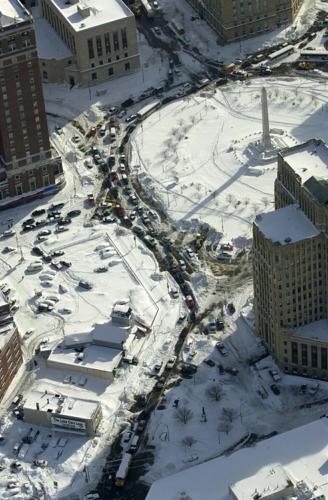

Abandoned vehicles sit in front of City Hall the day after the storm.
At 7:30 a.m. on Nov. 20, 2000, snow began to fall in downtown Buffalo. Though skies were dark, snow was intermittent before intensifying after noon.
The afternoon commute was snarled by intense lake-effect snow squalls, and a slow commute home for workers and schoolchildren was soon brought to a standstill as vehicles were abandoned.
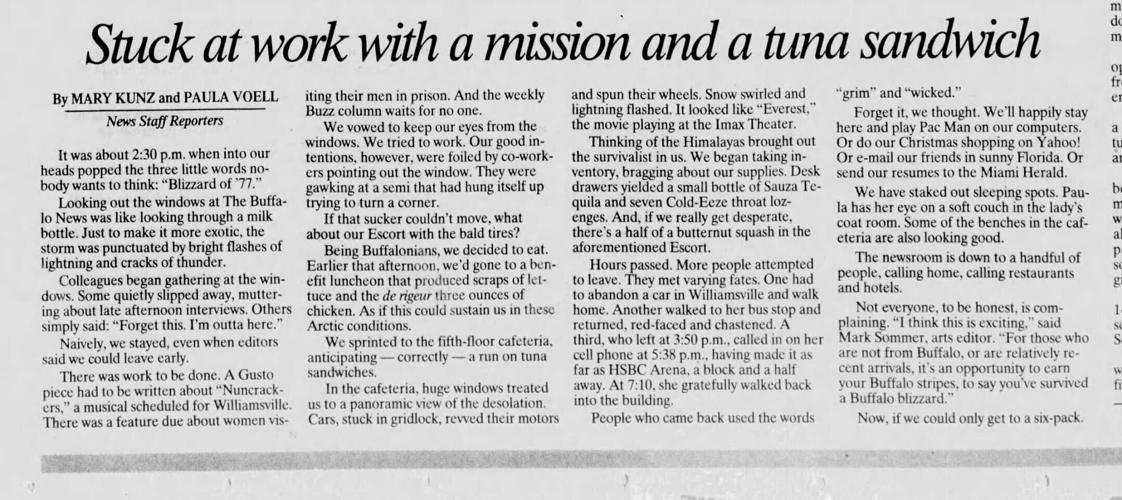
Thousands of downtown workers spent the night marooned in the places of business, and about 2,000 children slept on floors and chairs at their schools, not their homes, wrote Buffalo News reporters John F. Bonfatti and Mike Vogel.
The Thruway was closed and driving bans were instituted in Buffalo and Amherst. By 9 p.m., Buffalo Mayor Anthony Masiello declared a state of emergency in the city.
By the morning of Nov. 21, 24.9 inches of snow had been logged at the Buffalo Niagara International Airport.
People are also reading…
Despite all the chaos, there were no reports of serious injuries.

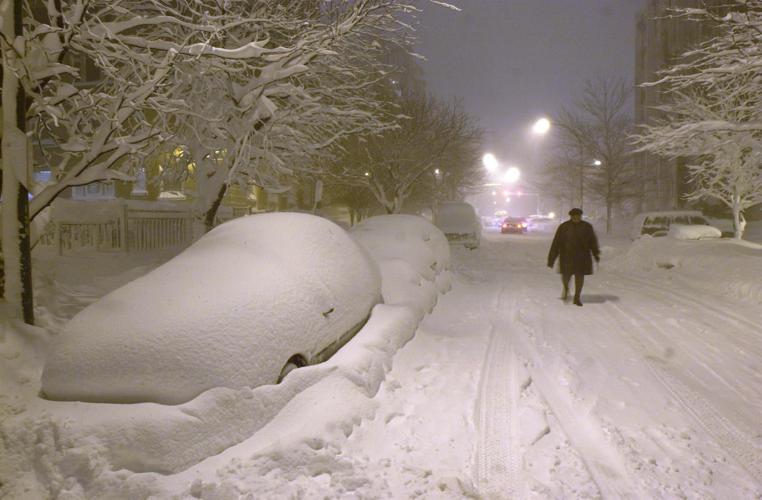
A pedestrian walks down snow-covered Bryant Street.
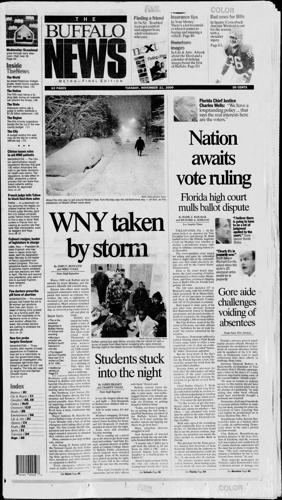
The front page of The Buffalo News on Nov. 21, 2000

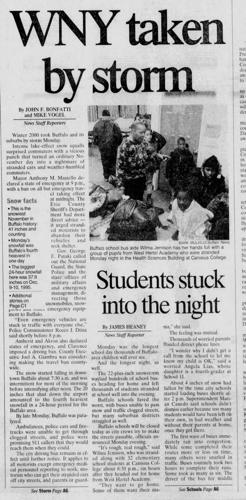
WNY taken by storm
John F. Bonfatti and Mike Vogel
Winter 2000 took Buffalo and its suburbs by storm Monday, and the season's officially still a month away.
Intense lake-effect snow squalls surprised commuters with a vicious punch that turned an ordinary November day into a nightmare of stranded cars and weather-humbled commuters. Major arteries were littered with abandoned vehicles today, as crews tried to salt and plow roads.
Buffalo was closed for today, under a state of emergency and a driving ban so that street crews could work. Thousands of marooned downtown workers and some 2,000 stranded schoolchildren awoke on floors and chairs to a morning of blue skies and sunshine, but getting home remained a challenge.
The Thruway remained closed to Rochester early today. Travel was banned in Buffalo and Amherst. In hard-hit Cheektowaga, crews worked all night to clear Union Road before tackling other thoroughfares.
But Hamburg, East Aurora, Orchard Park, Depew, Boston, the Tonawandas and Kenmore all were reported passable. State Police reported improving conditions in Clarence, although Main Street and Transit Road were a mess. Lackwanna was digging out.

Mayor Anthony M. Masiello declared Buffalo's state of emergency at 9 p.m. Monday, with a ban on all but emergency travel taking effect at midnight. The Erie County Sheriff's Department had more direct advice -- it urged stranded motorists to abandon their vehicles and seek shelter.
Many commuters just slept in their cars, anyway.
Gov. George E. Pataki called out the National Guard, the State Police and the state offices of military affairs and emergency management, directing those agencies to bring snowmobiles, snowplows and other emergency equipment to Buffalo.
"Even emergency vehicles are stuck in traffic with everyone else," Police Commissioner Rocco J. Diina said shortly before 8 p.m.
Amherst and Akron also declared states of emergency, and Clarence imposed a driving ban. Another 6 inches of snow was expected in squall bands over Chautauqua and Cattaraugus Counties today.
The snow started falling in downtown Buffalo about 7:30 a.m. Monday and was intermittent for most of the morning before intensifying after noon. The 24.9 inches logged at the airport, which remained closed early today, amounted to the third heaviest snowfall in a 24-hour period for the Buffalo area.
By late Monday, Buffalo was paralyzed.
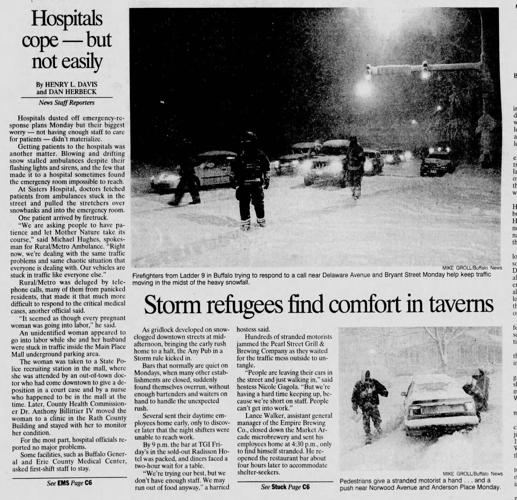
Ambulances, police cars and firetrucks were unable to get through clogged streets, and police were promising 911 callers that they would reach them when they could.
The city driving ban remains in effect until further notice. It applies to all motorists except emergency medical personnel reporting to work, motorists who can get their stranded cars off city streets, and parents or guardians picking up schoolchildren from emergency shelters.

A region that prides itself on winter readiness ground to a halt as the warnings many considered routine gave way to a narrow but intense lake-effect storm. Streets in downtown Buffalo and some of its harder-hit suburbs turned into bumper-to-bumper parking lots, and snow-fighting equipment couldn't even get into some major thoroughfares.
Traffic gridlock, fierce gusts and stinging snows forced commuters and schoolchildren by the thousands into hospitals, schools and office buildings for shelter.
"The car's been idling for an hour and a half," said Margaret Rafferty, who was stuck in traffic on Main Street near Ferry Street. In an hour and a half, she had made it less than three miles from her downtown office. "I'm scared I'm running out of gas."
But the storm was far from catastrophic.
There were no reports of serious injuries, although medical officials were investigating the death of an Amherst woman who may have suffered a heart attack while shoveling snow. There also were several minor fires from overheated car engines, but no major building fires.
Snowfall, punctuated with vivid lightning and the sharp crack of thunder, capped a wild weather day. At the National Weather Service office, forecasters logged a sequence of conditions that shifted quickly from haze to fog, increasingly heavy snow, hail and thunderstorms. The day's two-foot snowfall brought November's total to 42.2 inches.
For many unprepared motorists, misery stretched on for hours until winds finally shifted the heaviest bands through the Southtowns and into ski country.
The second major snowstorm in three days forced the early closing of offices, derailed a train car on the Metro Rail line and snarled traffic so badly that snowplows couldn't leave city garages.
The storm
Workers who had expected no more than a normal day of routine lake-effect snowfall scrambled for their cars when skies went black and snow streamed horizontally past office windows, but the sudden exodus quickly turned to massive traffic jams.
Traffic snarled as cars and trucks failed to negotiate even gentle ice-slicked grades, and urban streets gridlocked. Journeys of a few blocks turned into hour-long crawls, when traffic moved at all.
"This is the worst situation I've seen since the Blizzard of '77," said police Capt. Mark Antonio, referring to the snowstorm that has become the standard by which Buffalo area residents judge other storms. "The real bad part about this storm is that it hit so close to rush hour."
As was the case in 1977, snow accumulated rapidly.
City plow crews, who had cleared Saturday's snowfall by early Monday morning, tried to get back out on the streets in the afternoon, but traffic in front of the Broadway barn kept them idling inside.
"We can't get out," said deputy streets commissioner Paul Sullivan. "We're starting from scratch."

The gridlock
With the plows unable to get out of their barns and commuters getting stuck on the city streets, gridlock set in.
Many people, like nurse Monica Meredith at Millard Fillmore Hospital, didn't bother leaving work.
"I couldn't get out of the parking ramp. There's nobody moving on Delaware Avenue and nobody moving on Linwood Avenue," she said.
And it was much the same in the suburbs.
Cheektowaga Highway Superintendent Christopher Kowal said his trucks were also stuck in the garage.
"We can't get out of the driveway," Kowal said from the town's headquarters on Union Road, a busy thoroughfare that was nearing gridlock as rush hour approached. "The traffic is totally backed up. We have 30 snowplows. We can't deploy them."
Cheektowaga Mayor Dennis Gabryszak said there will be much work to do before plows can head out.
"Cars are abandoned," he said. "We have to get tow trucks to start towing cars off the streets so we can get the plows out."
Gridlock was also a problem in Amherst, where traffic on Main Street, Harlem Road and the Millersport Highway also came to a stop.
Police late Monday couldn't even estimate how many accidents there had been, but said the number far outnumbered the patrol cars available to help.
"There's so many we can't get cars out to them," said Amherst Lt. David Sperrazzo.
Even those who got out of the gridlock found the going tough because many roads out of the city, including the Skyway, the Peace Bridge and the New York State Thruway from Hamburg to Rochester, were closed.

Mass transit shut down
Many who tried to make it home by mass transit were similarly frustrated. Buses also crawled through streets already jammed with cars.
"We've had just the sort of problems you'd expect with this kind of weather and traffic volume," said C. Douglas Hartmayer, Niagara Frontier Transportation Authority public affairs director.
The Metro Rail was running, albeit behind schedule, until one of the cars derailed near Court Street about 7 p.m.
The accident, which shut down service between the Theater and Auditorium stops, was caused by the rapid buildup of snow and ice on the twin-track line. The derailed train could not be put back on the rails quickly because maintenance crews were stuck in the NFTA maintenance facility at the foot of Main Street. Trains continued to run through the evening on the five-mile underground section between the Theater District and South Campus stops.
"We're still carrying a pretty decent volume," Hartmayer said.
Meanwhile, Buffalo Niagara International Airport runways closed around 3 p.m. and were not expected to reopen until 11:30 at the earliest, delaying dozens of flights leaving Buffalo or trying to get here from other cities.
Metro buses slowed to a crawl throughout much of the city -- along with every other kind of traffic.

Shutting down
Buffalo City Hall turned into a makeshift emergency shelter, with dozens of city workers and schoolchildren expected to be in the building all night.
Mayor Anthony M. Masiello, who set up a command center in Fire Headquarters, said nothing could have been done to prevent the city streets from shutting down. The storm hit the hardest as schools and offices closed early, and a few stalled cars quickly turned into hundreds.
"Our first priority was to get our children home," the mayor said, referring to the thousands of schoolchildren stuck in school buildings, buses and makeshift shelters around the city. "Now our effort will focus on how we clean up our city to move vehicles and unclog streets. We're going to need all day (Tuesday) to do that. I want to make it clear: This city is closed except for emergencies."
All city offices and Buffalo public schools will be closed today. The state of emergency also allows the city to call on a list of privately operated tow trucks and snowplows to help clear the streets. Anyone who can lend a snowmobile or four-wheel-drive vehicle to the cleanup effort should call 898-3691, the mayor said.
Masiello said Monday's storm was the worst weather emergency in the city since the Blizzard of 1977.
"We didn't get the cold weather as in the Blizzard of '77, nor did we get the amount of snow, but because of the wind in the last 24 hours, it's created significant havoc," he said.
He had only to look out the windows of his offices at City Hall to see an example: Niagara Square completely filled with abandoned cars, buses and trucks.

Seeking shelter
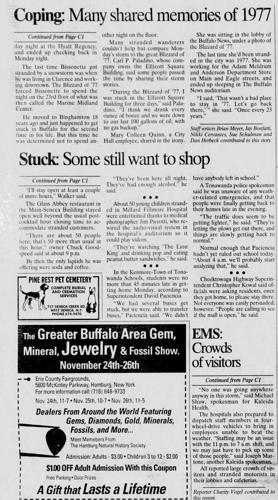
School bus drivers started bringing children into the nearest shelter -- restaurants, convenience stores and city buildings -- and then notifying worried parents.
City Hall threw open its doors and city staff workers summoned motorists stuck in their cars into the building.
At least two dozen students from Buffalo Public Schools sought shelter in the mayor's office after their buses got stuck in snow. After an initial round of telephone calls home to parents, city employees shepherded the children to other city offices.
The cafeteria in the basement of City Hall opened and workers began producing sandwiches. Administrators pressed into makeshift child care duty worked quickly to feed and entertain their charges.
"We've been out there since 2 o'clock, stranded," said Lolita Whitely, an aide on a bus that had been carrying five pupils from School 3 and got stuck in Niagara Square. The children were ages 4 to 11.
Even some of the rescuers got stuck. Ralph Smith, a mechanic for the Laidlaw bus company, was dispatched to City Hall to pick children up and try to get them home. Instead, Smith's bus got stuck and he ended up helping care for his stranded charges in City Hall.
Many children won't have to worry about school today: They are closed throughout the area.
Stranded cars
Auto emergency services were flooded with calls all Monday but were in no position to help stranded travelers by late afternoon because of gridlocked traffic and poor visibility.
Tim Ryan, vice president for AAA Western and Central New York, said they had offices in Syracuse and Rochester helping to handle the more than 1,000 calls that poured in from Buffalo city drivers who were stuck in the snow or had run off the road and landed in ditches.
"Right now, we're telling the folks who are at home we'll get them tomorrow," he said. "We're taking all the calls from people on the roads and will get to them as soon as we can."
Staff reporters Dan Herbeck, Charity Vogel, Susan Schulman, Darryl Campagna, Niki Cervantes, Henry L. Davis, Sandra Tan and Patrick Lakamp contributed to this report.
Read the stories (and a photo gallery) about the storm reported in the Buffalo News
The front page of The Buffalo News on Nov. 20, 2000
As one can read in this article at the bottom of the front page of the Nov. 20, 2000, edition of The Buffalo News, which focused more on snow totals from the weekend before, the amount of snow about to hit Buffalo was not expected.
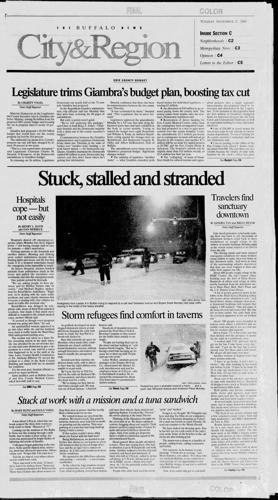
The front page of The Buffalo News' City and Region section on Nov. 21, 2000.