

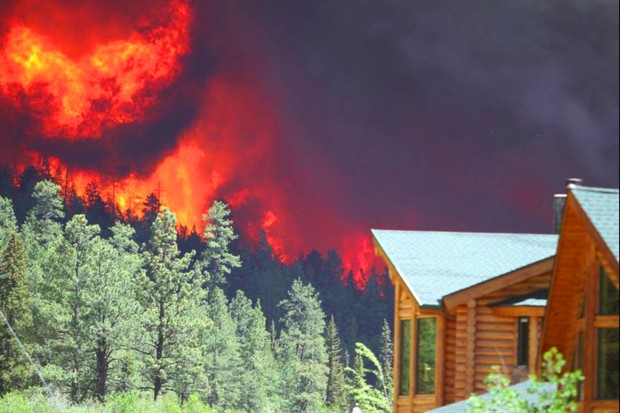
The thinned swaths of forest that stood between two Arizona towns and the advancing Wallow Fire did not stop the blaze.
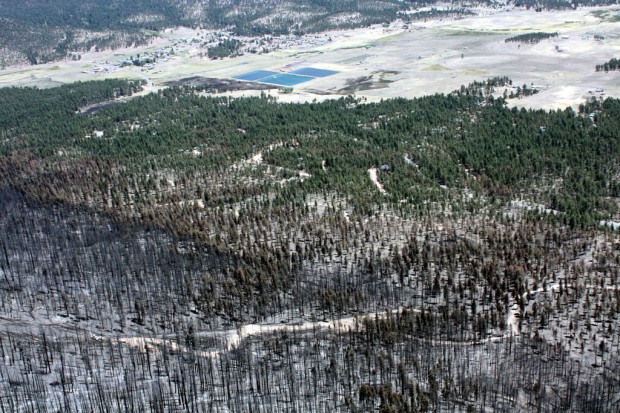
The selective logging and clearing did, however, change the behavior of an inferno that was leaping treetop-to-treetop as it approached the White Mountain towns of Alpine and Greer, dropping it to the ground and allowing firefighters to save most of the homes in its path.
That's the assessment of a team of Forest Service fire and fuels specialists who interviewed eyewitnesses and assembled photographic evidence of the effectiveness of the thinning projects done outside Greer and Alpine by the White Mountain Stewardship Project.
That's also the assessment of Jayson Coil, a branch director for the firefighting teams in both towns, who took some of the stunningly scary photographs used in the report.
People are also reading…
The fire charged toward Alpine on June 3, the sixth day it burned, making an eight-mile run in a single afternoon and spewing embers that ignited spot fires up to a mile and a half ahead of the main wall of "crown fire."
When it reached the ridge south of Alpine, it threw a storm of ash and embers ahead of it. "So it's dark and it's super smoky, and you're in a place you've never been before," Coil said.
Through the smoke, Coil watched the fire hit the half-mile-wide swath of forest that the Stewardship Project had begun thinning in 2004. It stopped leaping tree-to-tree and burned along the ground. Aerial photos show the progression from totally blackened stumps to singed trees to green ones.
As the night went on, crews of hotshots and engine companies would pull out as the main fire hit, then go back in to extinguish the burning areas. None of the 100 homes in south Alpine were lost that night.
In Greer, five days later, it was even scarier, Coil said.
"That was right up there with the worst of the worst," said Coil. "I was really nervous. Anyone who wasn't essential, we pulled out."
Coil positioned himself near the former Greer Lodge, which had burned in an unrelated structure fire the month before. He served as lookout for the single crew that stayed behind and also helped direct the helitankers dropping water on the advancing fire.
Again, fuel treatments at the south end of Greer caused the fire to drop to the ground, aided by those water drops. In places, crews used the thinned patches to set backburns into the fire.
Coil said engine crews were able to return and extinguish spot fires within 20 minutes of the fire hitting Greer.
No amount of thinning would have saved homes in Greer and Alpine without a concerted firefighting effort, said Tim Sexton, district ranger for the Superior National Forest in Cook, Minn., who helped prepare the assessment.
"You would need a denuded area half-a-mile to a mile wide to do that."
Sexton said some areas of Greer were not defensible, and 22 homes burned that afternoon.
Many of the homes in Alpine and Greer had "defensible space" around them and "firewise" construction, he said.
"Fuel treatments on wildlands are effective only when adjacent homeowners have well-maintained, fire-safe property and when there are sufficient suppression resources present to extinguish spot fires and surface-fire spread," Sexton said.
In addition to Alpine and Greer, the team also saw aerial evidence that thinning projects and logging of timber helped stop the fire on its eastern edge from entering the San Carlos and White Mountain Apache lands, said team member Pam Bostwick, a regional fuels specialist for the Forest Service, based in Albuquerque.
Although a more detailed analysis will follow, she said she doesn't expect the overall lesson to change. "The treatments worked. They helped the fire drop to the ground so that the firefighters could stay there and do their work to save homes."
Did you know?
The Wallow Fire, which began on May 29 and was not contained until July 8, is the largest recorded wildfire in Arizona at 538,049 acres.
Contact reporter Tom Beal at tbeal@azstarnet.com or 573-4158


