

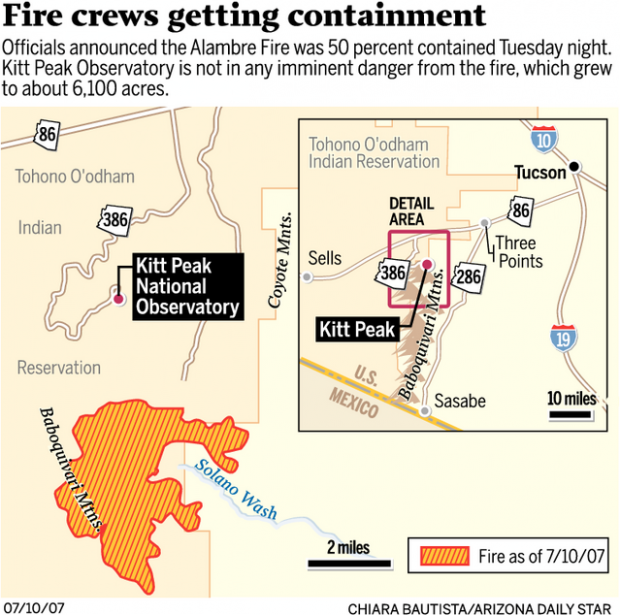
KITT PEAK — The threat to the Kitt Peak Observatory from the Alambre Fire has been greatly reduced as officials announced Tuesday night that the blaze is 50 percent contained.
The fire grew to 6,118 acres Tuesday with more expansion on the southwest. Without rain, officials say it could take firefighters until Saturday to achieve 100 percent containment.
The blaze hasn't damaged any property or caused any injuries and remains 4.5 miles from the sacred Baboquivari Peak, five miles from the nearest village and two miles from Kitt Peak. Firefighting crews have established a line of protection between the fire and the observatory, one of the world's largest and most diverse gatherings of telescopes for nighttime, optical and infrared viewing.
Crews completed a 2.4-mile hand-dug fire line. It connects to an existing road in the valley below Kitt Peak, creating a 4-mile stretch of cleared land that they say would prevent the fire from spreading north to the peak. The fire's northern perimeter — which is still smoldering but not in flames — is two miles from the peak. The most active section, west of the Quinlan Mountains, is about four miles from the peak.
People are also reading…
"We're seeing a lot of progress being made and that's good news for everyone up here," said Rich Fedele, a spokesman for the National Optical Astronomy Observatory, an institution that oversees the 26 telescopes at Kitt Peak.
"We're still cautious. Fires are very unpredictable and we are at the mercy of Mother Nature," Fedele said. "We're taking it day by day."
Kitt Peak is closed to the public through Sunday, he said.
The blaze remains the top-priority fire in Arizona and New Mexico because of the threat to the Kitt Peak Observatory, said Heidi Schewel, spokeswoman with the Eastern Arizona Incident Management Team.
If no rain falls, officials say it could take until Saturday to gain complete containment of the fire, Schewel said. It is on pace to burn about 16,000 acres. If enough rain falls to sink into the ground, the containment date would likely come sooner, she said.
It's not likely to happen anytime soon, according to a meteorologist from the Eastern Arizona Incident Management Team. There is a 20 percent chance of moisture today, he said. A storm would help, but only if it dumps substantial rain, Schewel said.
"A storm that blows through, drops a little rain and moves out isn't going to help much," Schewel said.
From Kitt Peak, the blaze appeared calm east of the Quinlan Mountains, with no flames or smoke. Red retardant lines and white patching of ashes were the only visible signs of the fire that ripped through there Sunday.
West of the Quinlan Mountains, the fire continued to burn, producing small clouds of smoke. Four small, single-engine planes and one large air tanker flew above the fire Tuesday, spraying fire retardant, while three helicopters dumped water. At Kitt Peak, crews continued cutting tree limbs and brush, cautionary measures in case the fire approaches the observatories.
"If the fire came here, it would do a lot of damage," said Mark Goklish, a crew boss with a 20-firefighter unit from the White Mountain Apache Tribe.
Although the Tohono O'odham Nation has said it was likely lighting that caused the fire, officials with the Eastern Arizona Incident Management Team — the agency coordinating the firefighting efforts of 333 people from Arizona and other states — say a definite conclusion has not been reached.


