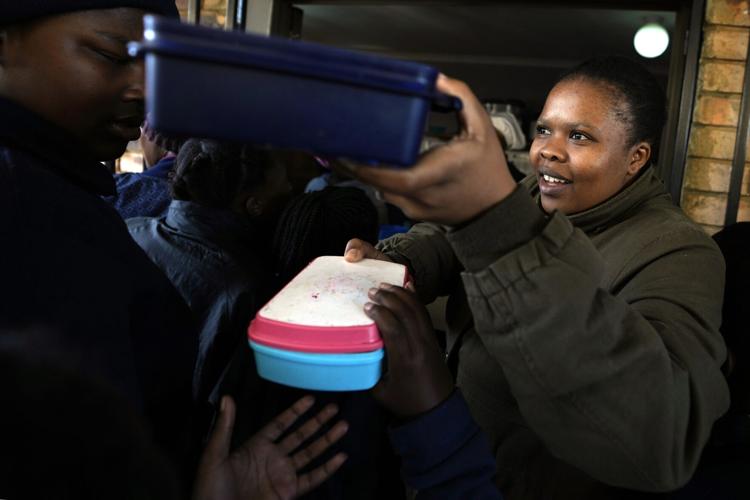
JOHANNESBURG — As Lebohang Mphuthi works amid the chaos of boisterous children during a lunch break at the Omar H.S. Ebrahim elementary school in South Africa — the kids are pushing, shoving and spilling food everywhere — she can't help but think how this is as far from her dream job as it can get.
Four years after graduating with a degree in analytical chemistry, the only work the 26-year-old has found is as a student assistant at a public school in Pretoria. Her responsibilities include handing out meals to the children and limiting the chaos as best she can.

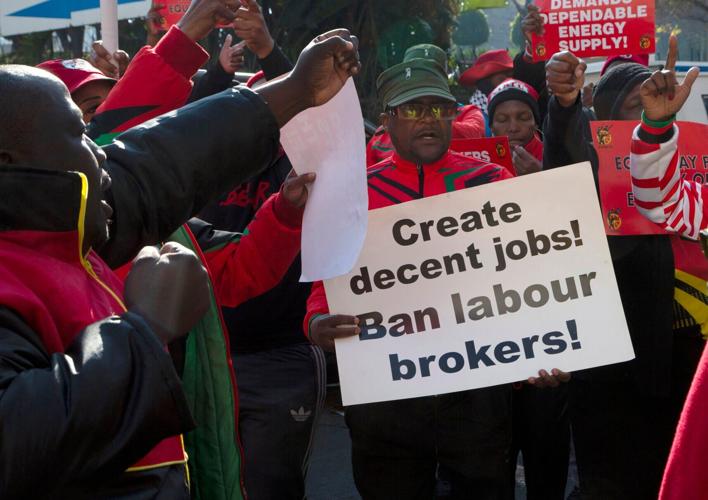
Members of the Congress of South Africa Trade Unions take part in an unemployment protest march July 6 in Johannesburg. South Africa's official unemployment rate of 33% is the highest in the world, and economists say it's even higher at 42% if you count those who have given up looking for work and have dropped off unemployment systems.
Mphuthi's story mirrors those of so many young South African graduates sitting at home jobless or trying to make ends meet doing fairly menial jobs in a country with a 33% official unemployment rate. It's a figure badly at odds with the status of a nation meant to embody the aspirations of Africa and the developing world.
People are also reading…
“It is demotivating and frustrating,” Mphuthi said of her battle to make progress. “You ask yourself, if we who studied are struggling to find jobs, then what about these ones who are still at school?”
In a South African context, Mphuthi might be considered lucky with the $215 she earns a month.
Analysts say the official unemployment number doesn't even count those who have given up on finding work and dropped off the grid and that a more accurate assessment would be that nearly 42% of South Africa's working-age population is unemployed.

Lebohang Mphuthi distributes meals to children during a lunch break July 25 at the Omar H.S. Ebrahim Primary School in Lotus Gardens, west of Pretoria, South Africa. “It is demotivating and frustrating,” Mphuthi said of her battle to make progress. “You ask yourself, if we who studied are struggling to find jobs, then what about these ones who are still at school?”
South Africa has the highest unemployment rate in the world, according to the World Bank, outstripping Gaza and the West Bank, Djibouti and Kosovo.
When it comes to youth unemployment, the rate is 61% of 15- to 24-year-olds, according to official statistics, and a staggering 71% if you again count those who are no longer trying.
Isobel Frye, executive director of the Social Policy Initiative in South Africa, which researches poverty and unemployment, said it equates to 24 million adults out of a population of 60 million who are either unemployed or not involved in any economic activity and barely surviving.

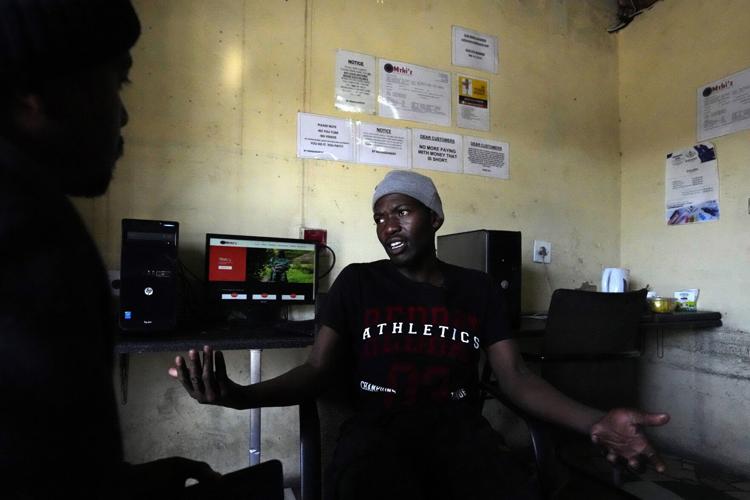
Unemployed resident Thato Sengoatsi speaks Aug. 2 in Soweto, west of Johannesburg, South Africa. “The generation that came before us protested ... so that we could have a better life. But we are not getting that life, and we cannot hide that fact,” Sengoatsi said.
A United Nations report on unemployment in South Africa that was delivered to Deputy President Paul Mashatile last month described the situation as a “ticking time bomb."
"We have to ask ourselves why this was allowed to happen," Frye said.
South Africa's GDP needs to grow by 6% a year to start creating enough jobs just for the 700,000 people who enter the workforce every year, according to Duma Gqubule, a financial analyst who has advised the South African government.
South Africa's growth hasn't approached that much-needed figure for more than a decade. Its economy — which grew by 2% last year — is expected to grow by less than 1% this year and between 1% and 2% for the next five years.
Gqubule and Frye believe there are policies that would ease unemployment but have expressed exasperation that the problem isn't a top priority for everyone from the government to private businesses and every South African given the country's massive problems, including poverty, inequality and an epidemic of violent crime.
“People just don’t want to talk about this crisis,” Gqubule said when he appeared on national television to reflect on the U.N. report.
The U.N. report didn't come as a surprise. Unemployment was high 30 years ago and has been trending up. The COVID-19 pandemic ripped jobs away from more than 2 million South Africans in a devastating blow, according to government statistics. However, there were warning signs long before that.
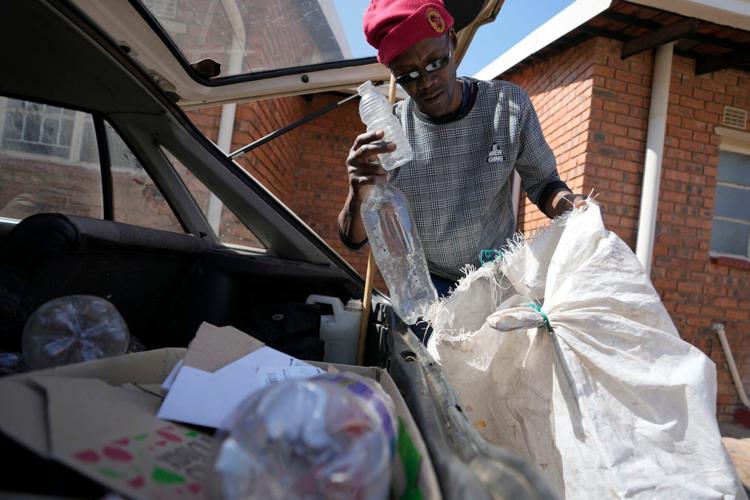
The pandemic didn't cause 46-year-old Themba Khumalo's problems. He lost his job as a machine operator in 2017 and now tries to support his wife and two children by collecting metal and plastic containers anywhere he can find them to sell in bulk for recycling.

Themba Khumalo collects empty metal and plastic containers Aug. 1 to sell in bulk for recycling and support his family in Daveyton township, east of Johannesburg, South Africa. “There are too many guys sitting at home without work," Khumalo said.
“There are too many guys sitting at home without work," Khumalo said as he crushed some metal cans with his worn-out work boots in the backyard of his home on the outskirts of Johannesburg.
Sengoatsi and school assistant Mphuthi are among South Africa's "Born Free" generation — born after the apartheid system of racial segregation ended in 1994 and who have only known a free South Africa. Their lives started in the dawn of democracy when Nelson Mandela was president and hope filled the air.
But unemployment has cast its shadow on the future of millions of South Africa’s Black majority in 2023. Sengoatsi didn't live through apartheid, but he knows bringing it down promised something.
“The generation that came before us protested … so that we could have a better life. But we are not getting that life, and we cannot hide that fact,” Sengoatsi said.
There's clear desperation. When the premier of the economic hub province of Gauteng announced last month that he was offering jobs for 6,000 unemployed young people, more than 40,000 waited in the winter cold to apply. More than 30,000 were set for rejection.
And there's anger.
Warning of how unemployment threatens the country's stability, the U.N. referred specifically to a week in 2021 when riots and looting left more than 350 people dead in South Africa, the worst violence since the last days of apartheid.
It's a “tinderbox,” Frye said of South Africa, waiting for any spark to set it off.
And there is concern over the future of young generations.
Mphuthi, still young herself, worries about what lies ahead for the children she cares for at the elementary school.
“We have a problem right now," Frye said, “but we'll have a massive problem in five, 10, 15 years' time where it's just unthinkable what that means for the structure of society.”
Popular videos from the past week you may have missed
Helicopter footage shows parts of Maui reduced to gray and black rubble after the wildfires, the fossil of a 310-million-year-old spider has been discovered in Germany, and more popular videos from the past week you may have missed.