CINCINNATI — Brynn Schulte nearly died twice when she was a baby, at one point needing emergency surgery for massive bleeding in her brain.
No one knew what was wrong until a test that looked at her full genetic blueprint found a rare bleeding disorder called factor XIII deficiency — an early diagnosis that saved her life.
“You have this hopeless feeling when you don’t really know what’s going on,” said her father, Mike Schulte. “Casting a wide net really made a world of difference figuring this out quickly and getting her the right care that she needed almost immediately.”
Brynn, now 4, got the genetic testing as part of a clinical trial, the results of which were published recently in the Journal of the American Medical Association.

Brynn Schulte rides on a toy unicorn Aug. 3 at her home in Cincinnati shortly before getting medication to treat her rare genetic bleeding disorder. Brynn was diagnosed thanks to whole genome testing, which was recently shown to be nearly twice as good at finding genetic disorders in sick babies as more targeted tests. Her parents and doctors credit early diagnosis with saving her life.
“Whole genome” tests are nearly twice as good as narrower tests at unearthing genetic abnormalities that can cause disease in infants — the study found 49% of abnormalities, compared to 27% with more commonly used tests targeting particular types of genetic diseases.
People are also reading…
Whole genome tests could solve the problem of doing several narrowly targeted tests on babies, which still might not find the disorder. Experts caution there are some issues, because labs vary in how they interpret results, and whole genome tests are costlier and less likely to be covered by insurance.

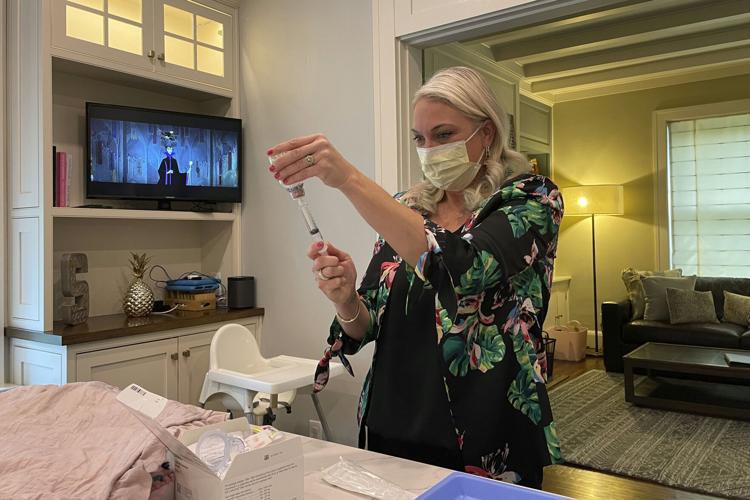
Lindsay Schulte prepares to administer medication Aug. 3 to her daughter Brynn, who has a rare genetic bleeding disorder diagnosed thanks to whole genome testing.
But researchers envision that whole genome tests eventually will be used for millions of hospitalized babies with confounding, sometimes life-threatening conditions. According to the U.S. National Human Genome Research Institute, around 350 million people worldwide live with rare disorders, and about 80% of the more than 7,000 conditions are genetic.
“I’ve been doing clinical trials of babies for over 40 years,” said study author Dr. Jon Davis, chief of newborn medicine at Tufts Medical Center in Boston. “It’s not often that you can do something that you feel is going to really change the world and change clinical practice for everyone.”
‘A memory I’ll never erase’
The night after Brynn was born, her mother Lindsay noticed her skin was gray, her breathing labored. Blood had pooled beneath Brynn's scalp, causing two bulges on her head.
Doctors transferred her to the neonatal intensive care unit at Cincinnati Children’s Hospital Medical Center, where she got blood transfusions and tests for different bleeding problems.
She improved and went home — only to wind up back in the hospital when she was about a month old for a massive brain bleed. A doctor warned she likely wouldn’t make it. A pastor prayed with the family.
After her surgery, Brynn stayed in the NICU for two months. At various points, doctors thought she might have a vascular problem or a mass in her liver.

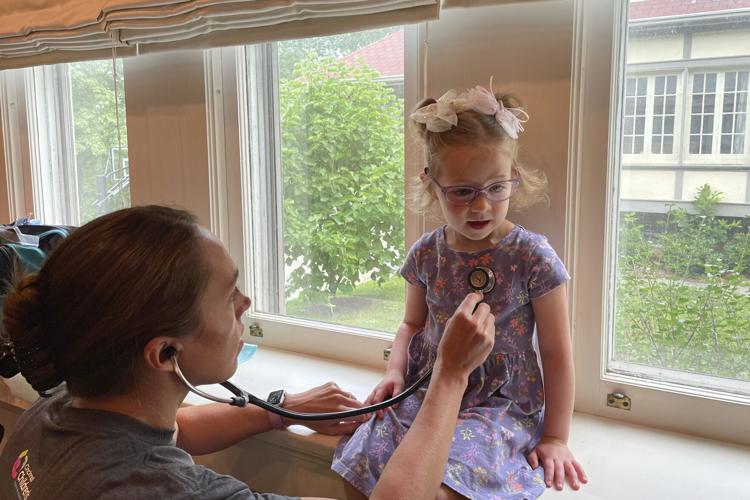
Courtney Chase, a nurse at Cincinnati Children's Hospital Medical Center, listens Aug. 3 to 4-year-old Brynn Schulte's heart before the girl gets an infusion of medication to treat a rare genetic bleeding disorder.
“Everybody was very unsettled because nobody knew what the heck was going on,” Lindsay Schulte recalled. “I don’t think we slept. I mean, watching your child nearly die in front of your eyes twice is a memory I’ll never erase.”
Then the Schultes learned about the clinical trial, which involved 400 hospitalized infants.
Brynn and both parents got the whole genome testing. The diagnosis came in less than a week: She had the rare bleeding disorder, which affects an estimated 1 in 2 million to 1 in 3 million live births, and another condition causing a severe reaction to certain anesthesia drugs.
Doctors said that diagnosis would likely have been delayed — or even missed — with multiple narrower tests.

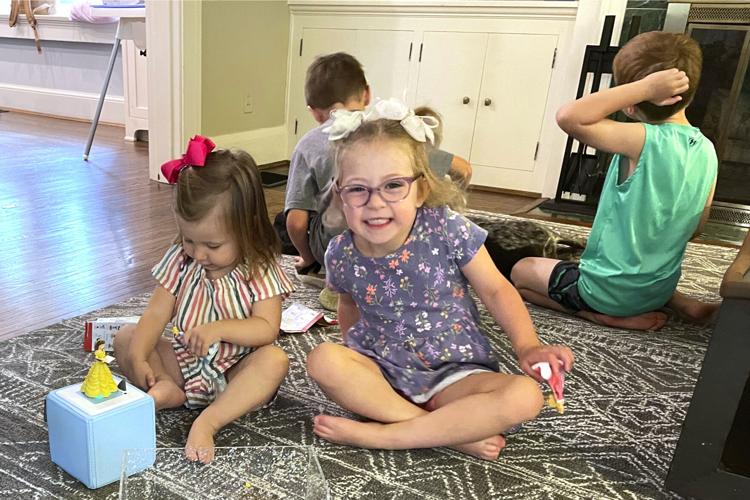
Brynn Schulte, 4, center, plays Aug. 3 with her nanny's daughter Gracie Grubbs before getting an infusion of medication, which she must get every day for her genetic bleeding disorder.
Many babies in the trial had genetic variants that narrower tests just couldn’t detect, said Dr. Jill Maron, a study author and chief of pediatrics at Women & Infants Hospital in Rhode Island.
That’s because targeted tests cover maybe 1,700 out of 20,000 genes, so whole genome testing simply “captures more things,” said Dr. Paul Kruszka of GeneDx, a company that provides whole genome testing but wasn’t involved in the study.
“I’ve been doing clinical trials of babies for over 40 years. It’s not often that you can do something that you feel is going to really change the world and change clinical practice for everyone.” — study author Dr. Jon Davis
Another child in the clinical trial, 2-year-old Cash Denaro of Oceanside, California, was found to have a genetic condition called Noonan syndrome, which involves heart defects, developmental delays and other problems.
His mom, Amanda Denaro, said that with the diagnosis, “we know what they think he may be delayed on, so we can work on these more — not just kind of push it under the rug.”
Whole genome testing made all the difference
Broader access to full genome tests is necessary if more kids are going to be helped, experts like Maron said. Full genome tests generally cost about three times more than narrower tests, she said, and aren't covered by Medicaid in most states.
Then there's the question of interpreting test results: More than 40% of the time in the study, labs found the same genetic variant, but one considered it the cause of disease while the other saw it as insignificant. Philip Brooks at the National Institutes of Health, which helped pay for the research, said it “remains a topic to be addressed.”
One reason for the differing interpretations is that science is moving so quickly linking genes to disorders and there isn't a comprehensive international system where doctors can check for the latest information, said Mara Aspinall, who teaches biomedical diagnostics at Arizona State University. She was not involved in the study.
Despite such hurdles, some kids are already benefitting from whole genome testing. It made all the difference in ensuring Brynn got the right treatment so she could thrive, said Dr. Cristina Tarango, her hematologist at Cincinnati Children’s.
Today, Brynn lives like any active preschooler except for regular infusions of factor XIII replacement.

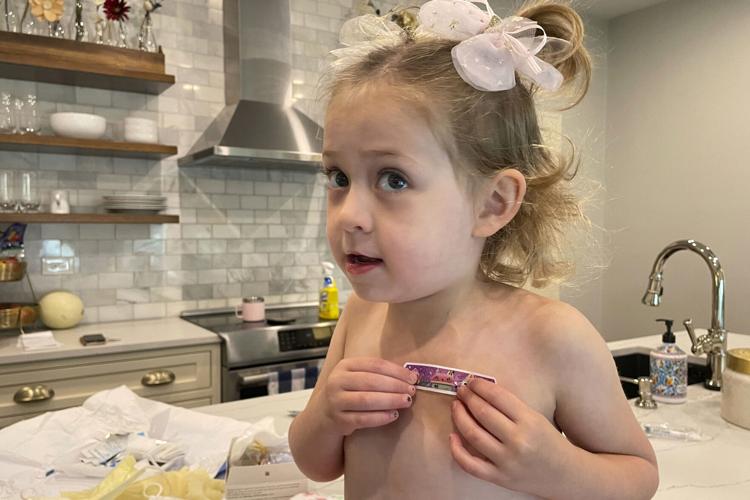
Brynn Schulte puts a bandage over her port after getting an infusion of medication to treat her rare genetic bleeding disorder.
On a recent morning, Lindsay Schulte put “Sleeping Beauty” on the television and laid Brynn on a blanket on the kitchen counter. A visiting nurse took blood from a port implanted in her chest and Schulte slowly administered the medication through a syringe.
Like usual, Brynn chose the bandage to put over her port — one featuring a cat from her favorite show.
“All done!” her mom chirped, and soon Brynn was running barefoot across a couch, gleefully chasing her older brother.
10 traits you may not know can be tied to genetics
10 traits you may not know can be tied to genetics

Although the longstanding debate between nature versus nurture is often framed as one being dominant over the other, scientists today know it’s not that simple: Nature and nurture interact in complex ways.
You probably already know that your parents and family history play a big role in determining your physical features, from the color of your hair to your height. But did you know that genetics also has an influence on some of your personality traits too? To create a list of traits that have some of their origins in genetics, Top10.com collected information from scientific journals such as Nature Genetics and the Proceedings of the National Academy of Sciences.
Today, more is often known about the genetic component of inheritable medical conditions such as hemophilia, a blood clotting disorder, and Huntington’s disease, a degenerative condition affecting the brain’s nerve cells. But according to a study published in Nature Genetics, more is being discovered about how traits like extraversion, creativity, and compassion, may also have correlations to specific genetic variants.
We’ve only scratched the surface of what genetics can tell us about who we are, but researchers are hopeful that with more study, we’ll unlock more about how psychological traits are impacted by genetics and environmental factors. Here are 10 physical and psychological traits that researchers have determined have some of their origins linked to genetics.

Facial expressions

A 2006 study conducted in Israel found facial expressions associated with concentration, sadness, and anger can be inherited. Researchers videotaped 21 people born blind and 30 of their relatives born sighted. Participants were asked to solve challenging puzzles, listen to a disgusting story, recount a sad or joyful personal experience, and respond to a silly question. Those who were blind had very similar facial expressions to their sighted relatives when concentrating or feeling angry or sad. Moreover, a computer program able to recognize similar facial expressions correctly matched blind participants with their relatives 80% of the time.
Deviated septum

The septum is the bone and cartilage in the nasal cavity that divides it into two nostrils. The septum can become deviated, or crooked, making it difficult to breathe. A deviated septum is most commonly the result of trauma, such as a blow to the face. However, it is also associated with conditions that affect connective tissue, such as Marfan syndrome and Ehlers-Danlos syndrome, both of which are genetic.
Children’s insomnia

A team led by researchers at the University of Basel in Switzerland found maternal symptoms of insomnia were associated with a child’s sleep pattern as objectively measured by in-home electroencephalography. Maternal insomnia was associated with less total sleep time, more stage 2 sleep, less slow-wave sleep, a later time to sleep onset, and a later wake time for their child. The insomnia symptoms of both parents influenced their perceptions of their children’s refusal to adhere to a designated bedtime, duration of sleep, sleep anxiety, incidents of waking up during the night, and/or daytime sleepiness.
Widow’s peak

A V-shaped frontal hairline, often called a widow’s peak, is a morphogenetic trait inherited by people from their parents. It has also been associated with a number of inherited genetic conditions. Reports also exist of a link between a widow’s peak and craniofacial clefts, or malformations of part of the face. However, the association between a widow’s peak and the severity of these conditions has not yet been defined.
Caffeine response

Every person responds differently to caffeine. Scientific evidence that these responses may be genetic is increasing. Genetic factors may directly influence individual responses by changing acute or chronic reactions to caffeine. These factors may also play an indirect role by altering the psychological or physiological processes related to the effects of caffeine, such as sensitivity to anxiety and the generally reinforcing effects of substance use. Genes can also affect the body’s response to long-term caffeine use.
Sensitivity to bitter food

About one-fourth of the population has a taste receptor gene, TAS2R38, that can make foods such as leafy greens and hoppy beers taste bitter. The perceived bitterness of these foods varies among individuals and depends on how strongly compounds in foods bind to the receptor. In a 2014 study of 93 Caucasian participants, TAS2R38 was associated with a bitter taste on the papillae of the tongue when it was swabbed with ethyl alcohol. The researchers concluded that genetic variations in the TAS2Rs gene may explain why alcoholic beverages taste bitter to some people but not to others.
Sneezing in the sun

Autosomal Dominant Compelling Helioopthalmic Outburst syndrome, appropriately known as ACHOO syndrome, is characterized by sneezing after sudden exposure to bright light, usually strong sunlight. The cause of ACHOO syndrome is not well understood. However, researchers do know it is inherited as an autosomal dominant trait, so if one parent is affected, a child has half a chance of inheriting ACHOO syndrome.
Optimism

The oxytocin receptor gene, also known as the OXTR gene, codes for the oxytocin receptor, to which the hormone oxytocin binds and exerts its effects throughout the body. Studies have linked part of the OXTR gene to psychological resources including optimism. The findings of a 2011 study suggest those who inherited a certain variation of the OXTR gene from both parents are more optimistic than those who inherited the variation from one parent or not at all.
Pain tolerance

In 2014, researchers presented a paper at the American Academy of Neurology’s annual meeting identifying four genes associated with pain perception: DRD1, DRD2, COMT, and OPRK1. The researchers enrolled almost 2,800 people who took opioids for chronic pain in their study. The DRD1 gene was 33% more prevalent among those with low pain perception than those with high pain perception. The COMT gene was 25% more common among those with moderate pain perception compared to those with high pain perception, and the OPRK1 gene was 19% more common. Among those with high pain perception, the DRD2 gene was 25% more prevalent compared to those with moderate pain perception.
Identifying these genes can help physicians better understand why some of their patients perceive pain differently than others, according to author Tobore Onojighofia, a member of the American Academy of Neurology and scientist with Proove Biosciences.
Life satisfaction

A study of twins published in 2012 by an international team of researchers found genetics explain about 33% of the variation in reported life satisfaction. Although at first the researchers found people with a certain variant of the 5-HTT serotonin transporter gene reported greater life satisfaction, they had difficulty replicating their results in an independent sample. The researchers said their findings suggest more work is necessary to better understand the relationship between the 5-HTT gene variant and life satisfaction.
This story originally appeared on Top10.com and was produced and distributed in partnership with Stacker Studio.