

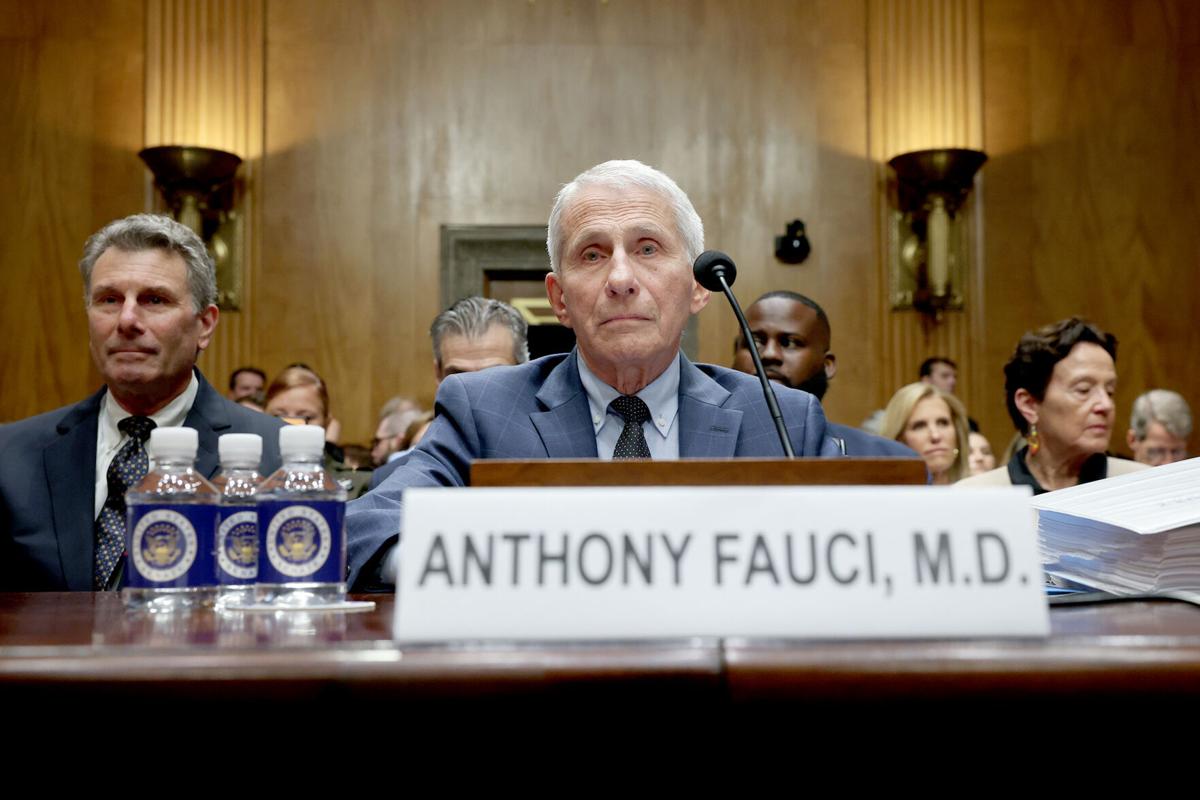
WASHINGTON — Sen. Rand Paul, R-Ky., said Thursday he will ask the Justice Department to prosecute Dr. Anthony Fauci for refusing to answer questions about the COVID-19 pandemic after a Senate committee voted to hold the former top infectious disease official in contempt of Congress.
The Homeland Security and Governmental Affairs Committee, which Paul chairs, approved a contempt resolution on a party-line vote with Republicans in favor and Democrats opposed. The resolution accuses Fauci of failing to obey a congressional subpoena.
The move followed a hearing last week where Fauci, who retired in 2022 as the head of the national infectious-disease agency and a presidential adviser, invoked his Fifth Amendment constitutional right against self-incrimination more than 100 times.
Paul sent the referral, a formal request to consider criminal charges, after the contempt finding. But the Kentucky senator, a longtime Fauci antagonist, bypassed a referral vote by the full Senate.
People are also reading…
He described that step as unnecessary and said his request would be hand delivered to the attorney general Thursday. Democrats said Paul was violating Senate rules by skipping the vote, which would likely fail to achieve the necessary 60-vote majority, and called the move dangerous and unprecedented.
A Justice Department spokesperson confirmed copies of the referral had been sent to the DOJ leadership and the U.S. Attorney's Office in Washington, D.C.
"We have received the document, we are reviewing it and will work with the Senate accordingly," the spokesperson said.
The development was the sharpest escalation yet in a broad Republican and Trump administration campaign to relitigate the pandemic and hold accountable the officials who ran the U.S. response.
Pandemic response
Fauci's attorney, David Schertler, said Thursday's vote was "a crude political stunt intended to punish Dr. Fauci for exercising his constitutional rights."
"Dr. Fauci has committed no crime — and Senator Paul knows it," Schertler said, describing the resolution as a continuation of a "personal vendetta."
Paul denied this, saying in his opening statement: "Seeking the truth is not a witch hunt." He said the committee seeks accountability to prevent "a repeat of the mistakes and the very real consequences of the past."
Fauci, who led the National Institute of Allergy and Infectious Diseases for 38 years, became the face of the U.S. COVID-19 pandemic response and a primary target of anger over measures taken against a virus that killed more than 1.1 million Americans.
Paul and other Republicans pursued a yearslong investigation, including hard-nosed tactics such as publishing Fauci's daily diary entries and obtaining the contents of his phone, in a bid to prove Republican claims that Fauci orchestrated a cover-up of the coronavirus' origins.
The senator claims Fauci's institute funded risky virus research in China that sparked the pandemic through a lab leak there. Fauci denies the accusation, and the National Institutes of Health has also rejected it, saying the viruses studied with U.S. funding differed from the one that caused COVID-19.
U.S. intelligence agencies and scientists remain divided over whether a lab leak or natural transmission from animals sparked the pandemic.
Presidential pardon
Fauci, before invoking the Fifth Amendment of the U.S. Constitution at the start of last week's hearing, said Paul summoned him only to force testimony backing the senator's repeated public pledges to see him imprisoned.
President Donald Trump and many conservatives criticized Fauci's handling of COVID-19 including his guidance on lockdowns, mask-wearing, social distancing and vaccines. While Fauci's recommendations were backed by then-current science, the issue became heavily politicized.
Recommendations were being made by numerous scientists and public health officials at the time, not any one individual, said Jennifer Kates, senior vice president and director of the Global and Public Health Policy Program at KFF, a health policy research group.
"When new information became available, recommendations changed, but not always fast enough or clearly enough," Kates said.
Former President Joe Biden preemptively pardoned Fauci in January 2025 to guard against "unjustified and politically motivated prosecutions" related to COVID or his role in the response. The pardon does not cover subsequent conduct.
Paul claimed Fauci had no valid Fifth Amendment claim because the pardon nullified it and because Fauci waived any remaining protection by testifying. The U.S. Attorney's Office in Washington, run by Trump ally Jeanine Pirro, could review any referral from Congress on Fauci and decide whether to seek a grand jury indictment.
Contempt of Congress, a federal misdemeanor, can be punished with a fine of up to $100,000 and up to 12 months in prison.
When asked if the DOJ should prosecute Fauci, Trump told reporters Thursday that former aides Peter Navarro and Steve Bannon faced similar action "over something that essentially was never prosecuted before, and there are sort of telltale signs of similarity."
A jury found Bannon, 68, guilty of two misdemeanor counts in 2022 for refusing to provide testimony or documents to the House of Representatives select committee as it scrutinized the Jan. 6, 2021, Capitol riot.
A 12-member jury convicted Navarro on two counts of contempt in 2023 after he also refused to testify or turn over documents to the Democratic-led House panel.
Members of Congress regularly refer matters to the Justice Department for potential prosecution, but such communications carry no special legal weight.
In contrast, the department is legally required to consider a referral for contempt of Congress that is approved by either the full Senate or the House of Representatives.
Stanley Brand, a lawyer specializing in congressional investigations, said if Paul seeks to bypass a full Senate vote, it would render his referral "null and void."
"There’s no authority for the Justice Department to take up a contempt of Congress prosecution without following the procedures specified in the statute," Brand said. "This won't pass muster."


