Shawna Jeanguenat was 5 months pregnant with her second child when she was detained in the LaSalle County Jail in Illinois on drug-related charges in 2019.
She was later transferred on a separate warrant to the Rock Island County Jail, where she said that she tried to alert staff during booking that she was prone to complications after her first pregnancy.

Shawna Jeanguenat, left and daughter Indie Baylis and son, Kashawn Davis
At one point in Rock Island, Jeanguenat, of Ottawa, Illinois, said she waited close to five hours in extreme pain and with significant bleeding before officers transported her to the emergency room. While in the hospital, she was informed that her placenta was dangerously close to her cervix, a problem she also experienced during her first pregnancy.
Although it was recommended that she see a specialist in Peoria, officers sent Jeanguenat to a midwife who recommended an additional mattress and blanket while she was in custody, according to a 2024 report on reproductive health care within jails from the Women's Justice Institute and the American Civil Liberties Union of Illinois.
People are also reading…
In addition to state licensure, a certified nurse-midwife must also undertake 1,000 clinical hours. However, Jeanguenat claimed her midwife was inexperienced in high-risk pregnancies,
"They said they only had to provide me with the most minimal level of care and they didn't have to go beyond," she said.
State statute provides greater protections for pregnant individuals than any other inmates, particularly when it comes to the use of restraints and access to educational materials. But a lack of enforcement of these policies can put more than one life at risk.

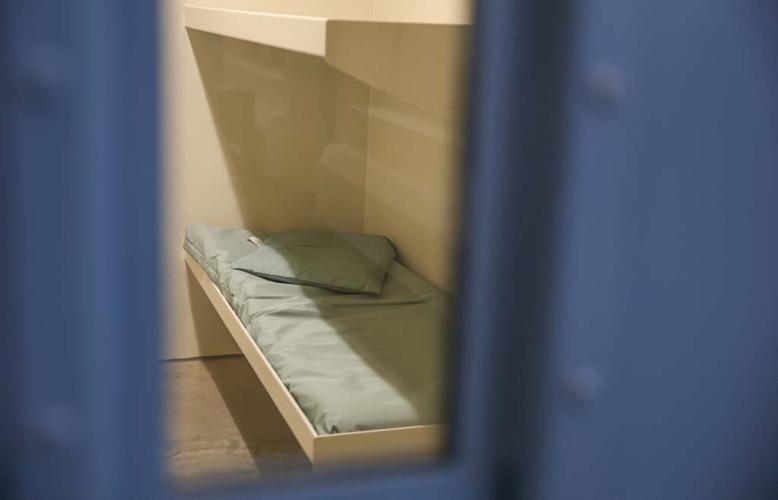
Bunk bed cells are shown in the McLean County Jail. The jail has a capacity of 455: 381 males and 74 females.
"It was serious enough to where it freaked me out," Jeanguenat said. "Thank God nothing happened but they definitely didn't try to prevent (complications) from happening."
Research on reproductive health care for detained individuals who are pregnant is scarce.
One of the most recent studies tracking pregnant individuals in custody was performed in 2017 by Carolyn Suffrin, a medical anthropologist and OB/GYN at Johns Hopkins University. According to this study, roughly 5% of women entering U.S. jails from 2016 to 2017 were pregnant based on a sample size of 5% of all female detainees.
The Women's Justice Institute's 2024 report, which acknowledged the need for a deeper evaluation of the conditions of Illinois' county jails for pregnant or postpartum detainees, chronicled the experiences of numerous women, including Jeanguenat, who were pregnant during their detainment in county jails across Illinois.
Common themes emerged through these interactions, including a lack of sufficient nourishment, dismissal of requests for assistance and frequent use of restraints.
"Unfortunately, without any ongoing monitoring of conditions for pregnant and postpartum people in custody in Illinois, it is impossible to truly know how pervasive these issues are," the report said.

Shawna Jeanguenat (center) sits with daughter Indie Baylis (left) and son Kashawn Davis (right) for a photo with Santa Claus.
Pregnancy guidelines
Although the Illinois Department of Corrections' Jail and Detention Standards Unit performs an annual inspection on each county jail in Illinois, reports don't specifically indicate whether pregnant detainees are sleeping more than 3 feet above the ground, whether these individuals are offered educational programming specific to prenatal care and whether any are being placed in administrative segregation. All of these protections are outlined in state statute.
As of 2024, IDOC inspections only have three questions related to pregnancy: whether the admitting officer questioned female detainees to determine if they are pregnant, whether the use of restraints on pregnant female detainees in jails outside of Cook County follows the County Jail Act and whether the use of restraints follows the Counties Code.
A former detainee of the Montgomery County Jail interviewed for the WJI report was 22 weeks pregnant when she was booked. Although she was prescribed and received prenatal vitamins once a day, she said her medical care was the same as everyone else in the jail.
When she experienced bleeding or various pains, she said staff would not answer her questions so she had no idea whether these symptoms were normal.
"You’re in jail but you’re still a human being and I had another human being inside of me that was not in trouble," the woman said.
But like all other medical care within jails, treatment can vary across county borders.
When a female detainee is booked in Woodford County, former jail superintendent Dennis Wertz said a nurse will perform a pregnancy test as soon as possible after admission. They will then follow up with the detainee's doctor and set outside appointments as necessary.
Because the jail does not own any special equipment related to prenatal care, Wertz said a pregnant detainee would have to be transported to a doctor's office or hospital. The McLean County Jail, meanwhile has its own Doppler machine to check fetal heart rates on site, according to jail administrator Diane Hughes.
Livingston County Jail Superintendent Lisa Draper said the jail tests any female that states they are or may be pregnant within 24 hours of booking as long as they are complying with the jail's codes of conduct. OBGYN appointments are then scheduled accordingly.
The provision of education materials about pregnancy, which is outlined in state statute, may also vary.

Rock Island County Sheriff Darren Hart
Rock Island County Sheriff Darren Hart said medical staff provide a variety of programs that provide information on elective abortion, family planning services prior to discharge, routine and high-risk care, management of chemical dependencies and other reproductive health care topics.
Wertz, meanwhile, said all pregnant detainees are given a packet of information produced by its health care provider, Advanced Correctional Healthcare, regarding a healthy pregnancy.
Draper said this education is given through medical appointments.
Although statute has since been amended to provide supplemental nutrition for pregnant detainees, several former inmates interviewed in the WJI report said they had to eat raw lunchmeat and received no additional nourishment aside from prenatal vitamins. According to the American Pregnancy Association, pregnant women are more susceptible to bacteria such as listeria that may be present in deli meats.
Emily Werth, senior staff attorney for ACLU of Illinois, said her understanding is that it's common for jails to have special nutrition policies for many types of health issues.
"We reviewed whether (jails) had any policies related to supplemental nutrition and many of them did have some sort of policy," Werth said. "Whether (jails) were following the policy and practice is not something that we were able to fully dive into in this report."
Several jail officials interviewed by the Lee Enterprises Public Service Journalism Team and the Pantagraph said they offered supplemental nutrition before it was required under state statute.
Wertz said the Woodford County Jail supplements the meals of pregnant detainees with extra milk and other items to support a healthy fetus as well as prenatal vitamins.
Draper said these individuals receive additional calories and calcium in addition to prenatal vitamins.
Use of restraint
In the past, when there was less pressure on jails to operate as mental health treatment centers or medical facilities, policies were shaped to be gender neutral. If policy mandated that male prisoners be restrained while receiving outside medical care, pregnant women were restrained as well, according to the WJI report.
"However, this blanket application of policies designed for cisgender men fails to consider the adverse consequences of restraining people during pregnancy and childbirth and the fact that these conditions may make someone less of a flight or security risk," the report said.
Under Illinois law, the use of handcuffs, shackles or other restraints were not to be used on a pregnant female detainee during her transport to a hospital to deliver a baby. Leg and waist shackles also cannot be used on any pregnant detainee who is in labor.
According to women interviewed in the WJI report, this isn't always the case.
A former detainee of the St. Clair County Jail interviewed for the WJI report said she was four months along when she was booked and this was the first of her nine pregnancies to have made it past the first trimester without miscarriage.
Although she had a high-risk pregnancy and was experiencing severe bleeding and abdominal pain, she said a month had passed before she was taken to the hospital. After receiving an ultrasound, she learned that her baby had a birth defect.
A few days after giving birth, she said she was handcuffed, even though she could barely walk, in order to see her son.
"The whole process forces detachment with you and your child," the woman had said. "It makes you want to give up."
Last year, the Illinois General Assembly amended the state's restraint policy last year so it aligns with the policies of the Cook County Jail, which offers further restrictions on the use of security restraints for pregnant detainees.
These new policies prevent security restraints from being used on detainees during their pregnancy or while they are in postpartum recovery at a medical facility barring "extraordinary circumstances."
Leg irons and waste shackles must never be used on a pregnant or postpartum person in jail, according to the new law.
Although some jails outside Cook County have internal policies about the use of restraints that align with the previous statute, others mirror the policies set forth for the Cook County Jail.
Rock Island and McClean counties said their internal policies align with state statute regarding the use of restraints on pregnant women in custody
Wertz said the Woodford County Jail does not use restraints on pregnant detainees per policy.

Several sets of handcuffs are hanging on a wall outside the operations room of the McLean County Jail.
New rules
Legislation passed last year also implemented new education requirements and annual reporting of all pregnant detainees.
However, several organizations have said that the provision and overall transparency of reproductive health care can go even further.
The National Commission of Correctional Health Care, a health care accreditation agency for jails and prisons, recommended in a position statement that intake procedures for detainees who may be pregnant should include histories on menstrual cycle, prior pregnancies, gynecologic problems, STI risk factors, HPV vaccine history, current and prior contraception use, current breastfeeding, and history of sexual and physical abuse.
Some counties already are contracted to provide this information.
In DeKalb County, a confirming urine test is conducted within 48 hours of the booking of any detainee who claims she is pregnant. A medical record should also be opened with a notation indicating pregnancy, according to the sheriff's office's custody manual.
If the detainee is under the influence of or withdrawing from alcohol or other substances, they are to be referred to a nurse. They are then interviewed by a qualified health care professional in order to document their last menstrual period, estimated date of conception, estimated due date, number of pregnancies, number of live births, miscarriages, prenatal care history, current medications, current adverse symptoms and high-risk factors.
The WJI report, meanwhile, recommended that the Jail and Detention Standards Unit have regulations and protocols in place to collect and assess information regarding compliance with state laws concerning reproductive health care and treatment of pregnant and postpartum individuals.
To aid in this, the commission also recommended the formation of a reproductive health task force of stakeholders, legislators, medical professionals, people with lived experience and other representatives to examine the care and treatment of people pregnant or postpartum in the custody of county jails.
Participating counties would be required to submit ongoing data to the task force regarding treatment and compliance with state law.
“Our main sort of takeaway from the report is that very few counties have a comprehensive set of policies to sort of deal with the full spectrum of possible needs that a person would need around reproductive health care and pregnancy and childbirth,” Werth said. “And it sort of varies, from county to county, how prepared they are to deal with these issues.”
Contact Drew Zimmerman at 309-820-3276. Follow Drew on Twitter: @DZimmermanLee