Since she escaped from Afghanistan to Wisconsin more than three years ago, Zahra Hakimi has experienced a brightness to her life that would have been stripped from her had she stayed in her native country.
She’s studying computer science at Arizona State University and has a job with the university’s web services department. She has snowboarded in Utah, ran marathons in New York and California, visited the Grand Canyon and showcased one of her paintings in an art exhibit.
But she also feels a pang of guilt about her new life in America.

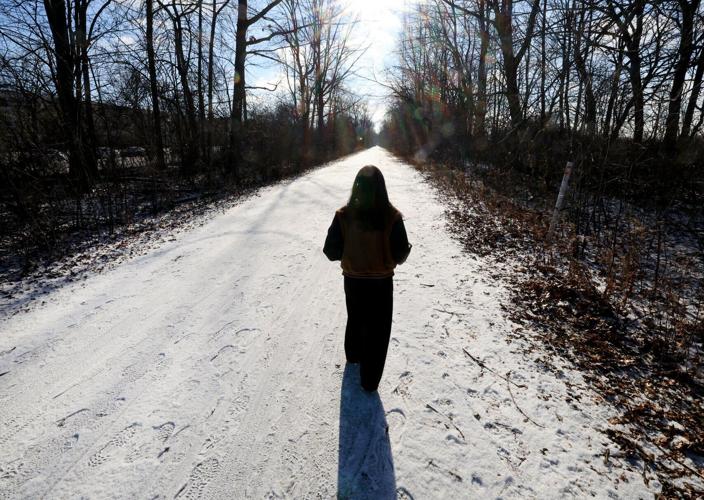
Zahra Hakimi escaped Afghanistan in August 2021 and found temporary refuge at Fort McCoy, a military base in western Wisconsin that housed 13,000 Afghan refugees. Now, Hakimi is studying computer science at Arizona State University.
“Who am I to deserve this?” Hakimi said. “Why doesn’t everybody get the same chance as I do?”
Under Taliban rule, the young women Hakimi grew up with in Afghanistan are in darkness, she said. They cannot go to school past the sixth grade, let alone college. They cannot work or travel without a husband or male guardian. They must cover their faces with hijabs or risk arrest. Recent Taliban laws bar women from singing or speaking loudly in public.
People are also reading…
“Women are just a hidden part of the society,” Hakimi said. “They’re not allowed to raise their voices. They’re not allowed to be out in the world and to actually have opinions.”
Like thousands of others who fled Afghanistan when the Taliban retook control of the country following the United States’ withdrawal in 2021, Hakimi’s American journey started at Fort McCoy in western Wisconsin. With nearly 13,000 evacuees, Fort McCoy was the second-largest Afghan refugee encampment in the U.S.
All have since been resettled, with the last Afghans leaving the fort three years ago, in January 2022. Now they’re adjusting to life in the U.S. and navigating the lengthy immigration process to become permanent residents here.
A decades-long debate over immigration has intensified as President Donald Trump attempts to make good on campaign promises of severely limiting the number of immigrants in the country. But for those who fled oppression, the issue is personal and painful.
Lee Enterprises recently caught up with five of the women who passed through Fort McCoy, now living in Arizona, Rhode Island, Virginia and Wisconsin. Like Hakimi, they struggle with feelings of gratitude for the opportunities they’ve been given in the U.S. and the heartbreak of being separated from family and friends facing oppression in Afghanistan.
Tens of thousands resettled
Fort McCoy was one of eight military bases in the U.S. that together housed about 73,000 Afghan evacuees after the U.S. pulled its troops out of Afghanistan, according to the Department of Defense.
In total, the U.S. government has resettled some 183,000 Afghan evacuees across the nation, a U.S. Department of Health and Human Services spokesperson said. Many of them stayed temporarily in other countries before coming to the U.S. to join their families or simply take the U.S. up on its offer to welcome allies who stood by the U.S. during the 20-year war in Afghanistan.
Lee Enterprises requested data from the U.S. Department of Health and Human Services showing where the evacuees have gone. A reporter received information on about 81,000 of those with “special immigrant visas” or who have been classified as refugees. Special immigrant visas offer a path to citizenship for those who have worked with the U.S. government abroad. Refugees can also gain permanent residency.
Resettlement data broken down by state was unavailable for other immigration statuses.
For additional data, the Department of Health and Human Services deferred to the Department of State and the Department of Homeland Security, neither of which provided answers to written questions about the data gaps.
The records show Afghans with special immigrant visas or refugee status have settled in every state except Wyoming and Hawaii, according to the U.S. Department of State’s Refugee Processing Center.
More than half of the 81,000 went to four states: California, Texas, Virginia and Washington. Wisconsin had a much smaller concentration of Afghan evacuees, with nearly 400 Afghan special immigrant visa and refugee arrivals over those three years.

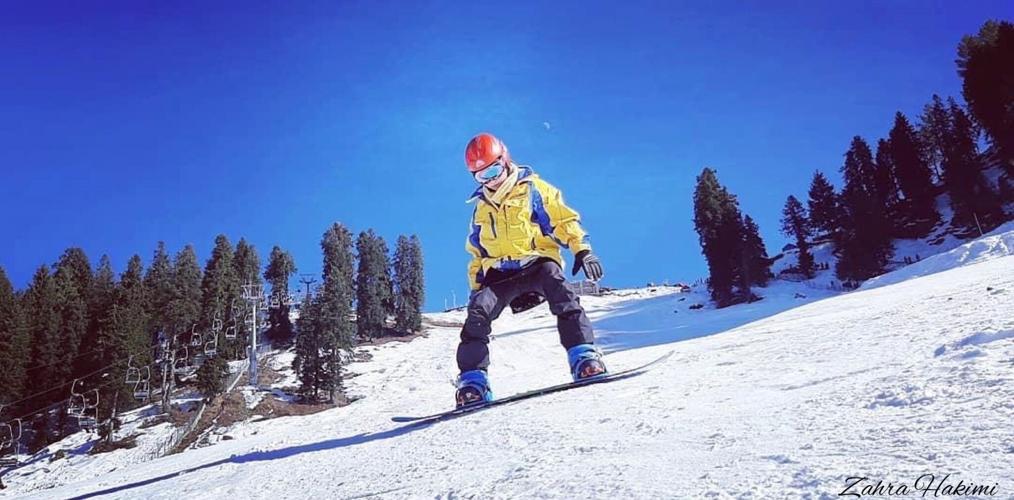
Zahra Hakimi snowboards during the Pakistan International Snowboarding Open Cup in January 2021 before she came to the U.S. After leaving Fort McCoy, she was able to snowboard briefly in Utah while a family hosted her there, but she left the state to focus on her college education.
After arrival, nonprofit resettlement agencies sponsored the Afghan evacuees for 30 to 90 days to help them find housing, employment and schooling, according to the Refugee Processing Center.
For long-term assistance, the Department of Health and Human Services’ Office of Refugee Resettlement provided programs for cultural orientation, job and housing searches, immigration legal help, English language education and mental health support.
The transition was tough for some Afghans, according to surveys of a few thousand Afghans conducted by the Office of Refugee Resettlement. Most respondents were male, so the results do not represent all Afghan evacuees.
Only 38% of those surveyed in June 2022 said they could afford their living expenses. By spring 2023, 66% of respondents could afford their expenses.
Despite problems making enough money, the vast majority were able to find housing. Most stayed at least briefly in temporary housing, but by June 2022, 91% of respondents had found a permanent place to live.
‘I was not counted as a person’
One of the women who resettled, who asked to have her identity shielded to protect her family members still in Afghanistan, is now studying public health at UW-Milwaukee while also working as a health coordinator for Hanan Refugees Relief group, a resettlement agency.
She was among a group of about 150 students from the Asian American University for Women who made a treacherous escape from Afghanistan on seven buses in August 2021. It took three tries over five days for the young women to get into the Kabul airport as guns and bombs went off around them. Hakimi and another former Fort McCoy resident, Arzo Yousofzai, were also part of the group.
“It’s something that I want to just erase completely from my life, but it’s there,” the 24-year-old said.
She said she has struggled to afford her books, rent, utilities and food in Milwaukee while also financially supporting her younger brother and sister, who are still in Afghanistan. Her brother is too young to work, and her sister never got to finish school. She recently moved to Iran, but women still face restrictions there.
The 24-year-old said her mother died in February after suffering multiple strokes, a heartbreaking thing to witness from afar. She wanted to visit her mother in the hospital in Afghanistan. But if she traveled back to her home country, she would have lost her asylum status here and her ability to reenter the U.S.
“My mom was so sick,” she said. “I was just so worried. I’m just like, ‘I’m going to go back. Whatever happens to me, I want to see my mom.’ But then you weigh it, and my whole life will be ruined if I go back.”
After finishing her undergraduate degree, she hopes to go to medical school, become a pediatrician and one day work for Doctors Without Borders.
“Being here taught me a lot,” she said. “Living independently, being free. ... In Afghanistan, no one would care or would ask my opinion or anything. So it’s just great that I can do anything I can do and also express myself as a person.
“I was not counted as a person in Afghanistan.”

A 24-year-old University of Wisconsin-Milwaukee student was among a group of about 150 students from the Asian American University for Women who made a treacherous escape from Afghanistan in August 2021. She says she wishes she could forget the sleepless nights she experienced while trying to get out through the Kabul airport, the sounds of the bombs and guns that went off around her, and the voices of the Taliban men who threatened her classmates, but "you always remember."
An overwhelming sadness
Arzo Yousofzai, who is in her late 20s, was a TV and radio journalist, a risky profession in Afghanistan.
The Taliban attacked and killed one of Yousofzai’s female coworkers, she said. Yousofzai’s own aunt physically attacked her for shaming the family by showing her face on TV.
Now, Yousofzai is studying journalism at Arizona State University. She said it’s a challenging major because English is not her first language, but she enjoys the subject and hopes to become a news anchor.
Despite her passion for school, Yousofzai has struggled to find happiness. For several months in 2023, she went through a severe depression. She would sit in the dark in her room and cry for hours.
“If I didn’t cry, I feel like I’m dying,” she said. “I was hopeless.”
She kept thinking about the Taliban member who questioned her on the Kabul streets at 2:30 a.m. when her bus had failed to make it into the airport. Thankfully he let her go, and her brother-in-law found her.
But what would that man have done if he had recognized her from TV?
Yousofzai’s biggest source of sadness was her continued separation from her husband. She hasn’t seen him for nearly a decade. He left Afghanistan in 2015 and obtained asylum in France while she has asylum here, she said. Neither of them has been able to get travel documents to see each other.
Erin Barbato, director of the Immigrant Justice Clinic at the University of Wisconsin’s Law School, said generally people cannot leave the U.S. while under asylum and waiting for approval to become lawful permanent residents. Asylees can apply for travel documents, but it typically takes at least 18 months and is “incredibly tedious” and “very complicated,” Barbato said.
Yousofzai saw a psychologist on campus, who gave her medication and helped her through her depression. She said she is doing a lot better and has friends who make her feel less alone.
She still hasn’t been able to see her husband in person, but he has supported her from afar. He told her she should push herself to keep studying so she can build a life.
“If I didn’t have a good past then I should make my future better,” Yousofzai said.
Separated families
An Afghan woman who was resettled in Rhode Island after leaving Fort McCoy also worries about her family still in Kabul. She asked to be anonymous to protect them.
She has been trying to get them out of Afghanistan, but so far her efforts have been unsuccessful. Her brother hasn’t been able to go to a university because of financial challenges. Her mother is sick and can’t leave the country for better treatment. And her sister can hardly do anything.
“My sister, she’s not able to go to school. She’s at home,” the woman said. “I’m really worried about her.”
Benjamin Harville, a staff attorney with Catholic Charities local resettlement office in Milwaukee, said the biggest challenge he currently sees while providing legal assistance to Afghan evacuees is the family reunification process.
There’s no longer a U.S. consulate in Afghanistan, so residents can’t get paperwork to come to the U.S. without traveling to another country first, Harville said. And the legal reunification process is only for spouses and minor unmarried children, so Harville can’t do anything to help the young women hoping to reunite with siblings or parents.
“We’re looking at many many years of being separated,” Harville said.
The young woman who is now in Rhode Island said her life looks very different from her younger sister. The woman graduated from Brown University in May 2024 with her master’s in public health. She is now looking for a full-time job in health care.

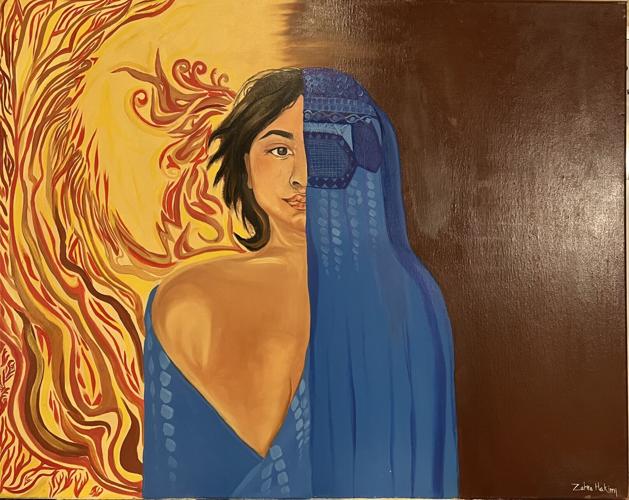
Zahra Hakimi painted this piece titled "Rise from Ashes," depicting one woman with two different life paths. On one side, the woman is surrounded by shadow, her face covered with a burqa. On the other side, "there's happiness, there's brightness and there's a Phoenix," Hakimi explains. Hakimi's art portfolio can be found online at go.madison.com/hakimi.
She said she wants to work in the field because she saw “so many people die” during the COVID pandemic.
“I thought if I … do something in public health, maybe I will be able to change people’s lives or at least be somehow helpful,” she said.
Her application for permanent residence in the U.S. is pending. She worries the process could slow now that Trump has taken office.
Will Trump’s agenda affect Afghans?
Trump campaigned on promises to crack down on border crossings, conduct mass deportations and limit immigration. His focus has largely been on the southern border, but his slew of anti-immigration executive orders, signed on his first day in office, have already impacted Afghan refugees who were still abroad and hoping to come to the U.S.
One of Trump’s executive orders suspends refugee admissions into the U.S. for at least 90 days. Since fiscal year 2022, this process has been used by 23,000 Afghans to legally enter the U.S., according to data from the U.S. Department of State’s Refugee Processing Center.
Trump’s decision to pause the process affects more than 1,600 Afghans who helped America’s war effort and had already been approved for entry to the U.S., the Associated Press reported. Now those Afghans had to cancel their travel plans.
Other immigration-related executive orders seek to end birthright citizenship, declare a national emergency at the U.S.-Mexico border, prohibit people arriving at the border from claiming asylum and require them to stay in Mexico, and eliminate a program that allowed Cubans, Nicaraguans, Venezuelans and Haitians to enter to the U.S. under humanitarian parole.
It’s unclear how many of the executive orders will hold up to court challenges. A federal judge has already temporarily blocked Trump’s attempt to end birthright citizenship, which conflicts with the guarantee in the Constitution’s 14th Amendment that all people born in the U.S. are citizens.
Harville said his office has been getting calls from worried Afghans in Wisconsin. He has assured them that Trump’s order will not cause their children who were recently born here to get their U.S. citizenship taken away.
Other Afghans feared they would not be able to reunite with their families, but Harville said that process should continue. Although refugee admissions have been suspended, family reunification is a different legal process that doesn’t appear to be affected by any of Trump’s orders, Harville said.
Harville also thinks it’s unlikely Afghan evacuees will be targeted in any mass deportations since they have legal status.
Potential future orders, like travel bans or requirements for more extensive background checks, could disrupt family reunification or slow the green card process for Afghans. But Harville is hopeful that Afghan evacuees will continue to be successful in gaining lawful permanent residency.
“Most of the folks we work with were allies of the United States. Many of them risked their lives on behalf of the United States,” Harville said. “We’re not talking about people who entered the United States illegally. We’re not talking about people who have criminal convictions. So I’m hopeful that this process will not be affected much by the new administration.”
Hakimi said the U.S. government has already done a lot for her and the other women who escaped Afghanistan, and she chooses to continue believing in the government, regardless of which administration is in charge.

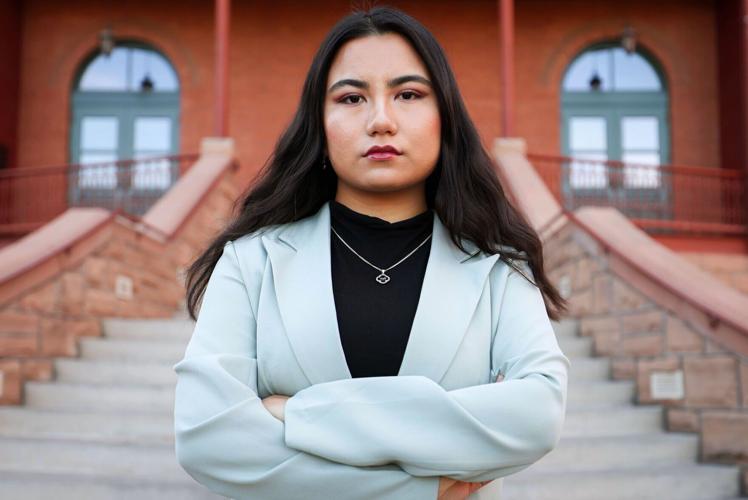
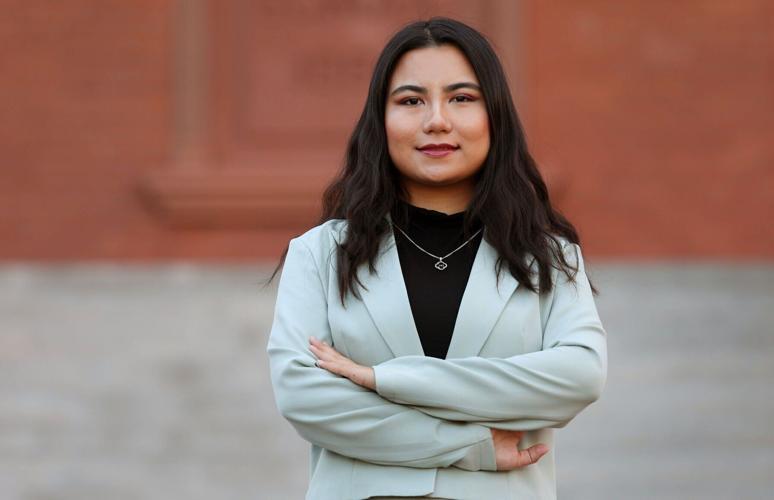
Zahra Hakimi escaped Afghanistan in August 2021 and stayed temporarily at Wisconsin's Fort McCoy military base before resettling to Arizona. She is a snowboarder, runner, painter, human rights advocate and now a student at Arizona State University. She is pictured here on campus outside of Old Main, 1151 South Forest Avenue, Tempe, Ariz., Dec. 14, 2024.
“We love the United States government (and) the way they helped us to get out and have opportunity to study in the U.S.,” Hakimi said. “It’s a great opportunity.
“Knowing that all these other women do not have the same opportunity back in my home country or some other countries, it’s disappointing, and it’s hurting me.”
Fighting for human rights
The women who left Afghanistan hope to help not only their own families, but all people in Afghanistan.

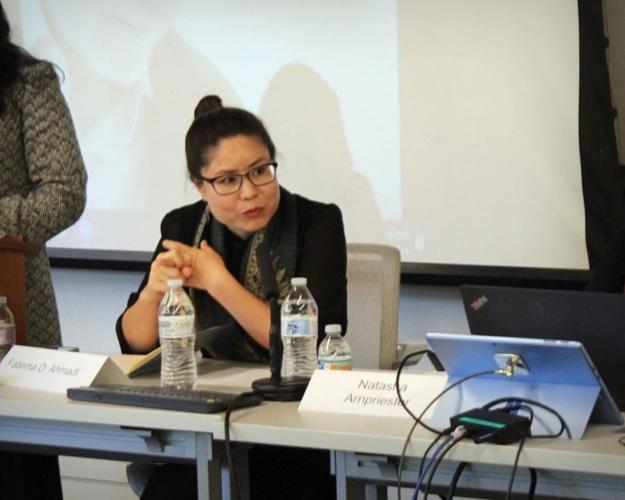
Fatema D. Ahmadi answers questions during a panel discussion about the status of women's rights in Afghanistan at American University Washington College of Law in Washington D.C., in October.
Fatema D. Ahmadi, a longtime human rights advocate who worked for the United States Institute of Peace in Kabul, continues to fight for women’s rights.
After Fort McCoy, Ahmadi moved to Arlington, Virginia, where she got her master’s in public affairs at the American University’s School of Public Affairs.
Ahmadi now works for Rawadari, an organization that provides on-the-ground reports from inside Afghanistan.
“Since August 2021, every day we’re hearing a new limitation, we’re hearing a new violation of human rights, human dignity,” Ahmadi said.
Ahmadi then works with other exiled Afghans to share those reports publicly and push government officials to find solutions.
Rawadari is currently advocating for countries or the U.N. to force the Taliban to lift its new laws that bar girls and women from working, getting educations and going out in public alone. Ahmadi said the Taliban needs to be held accountable.
“It’s about all women around the world,” Ahmadi said. “When one country thinks that the rulers can do any change to people’s lives, specifically to women’s rights and women’s lives, then why should others feel safe about their own women in their own country?”

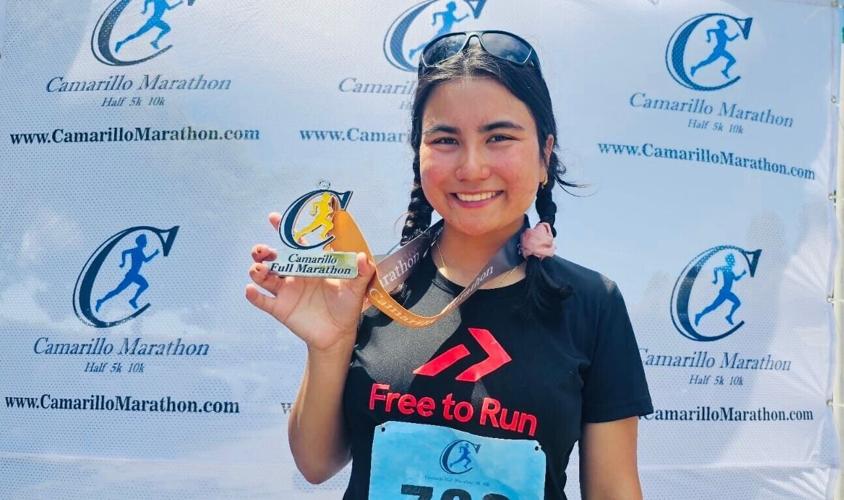
Zahra Hakimi holds up a medal for a marathon she ran to support Free to Run in Camarillo, California in 2024. She has also run marathons for Free to Run in Arizona and New York.
Hakimi has also continued to fight for women’s rights. She is an ambassador for Free to Run, a nonprofit that seeks to empower women through running in conflict-affected areas including Iraq, Afghanistan and the West Bank.
Hakimi knows first hand how empowering sports can be. She said she was the first woman in Afghanistan to snowboard. She has run three marathons so far to support Free to Run, and is raising money for the organization again this year.
She said it’s important to bring more awareness to women’s continued oppression in her home country.
Hakimi wants to prove that she and other women can change society for the better. She hopes to use her degree to work in security systems so she can use technology to keep people safe.
“Women are not only for small things,” she said. “They can be ambitious. They can actually do so much in this world and accomplish so much.”
Emily Hamer's favorite stories of 2021 include coverage of Afghan refugees, criminal justice
Criminal justice and county government reporter Emily Hamer is most proud of her coverage of the arrival of roughly 13,000 Afghan refugees at a military base in Wisconsin.
Earlier this year, she also exposed concerning conditions within the state prison system during COVID-19 outbreaks last fall, including that some prisoners were put in the same cells as those who were exposed to the virus. She also explored the lasting mark the pandemic has left on the criminal justice system.

Young Afghan women in Wisconsin share hopes and fears after a treacherous escape from Afghanistan, where they would have had "no rights, no ed…

Guards and inmates tell of frustrations with how Kettle Moraine prison handled a COVID-19 outbreak that exploded to more than 870 cases.

"There are many people who don’t have anything to wear, anything to eat," one Afghan woman said of the conditions at Fort McCoy in September.

The COVID-19 pandemic upended the entire criminal justice system, leading to system-wide reform. But are the changes sustainable?

"Two of them have a big hole," Baber Shah Dorani said of his teeth. But the young Afghan man couldn't see the dentist for weeks in October.
Fort McCoy was one of eight military bases in the U.S. that together housed about 73,000 Afghan evacuees after the U.S. pulled its troops out of Afghanistan.