ATLANTA — The apology letters that Donald Trump-allied lawyers Sidney Powell and Kenneth Chesebro were required to write as a condition of their plea deals in the Georgia election interference case are just one sentence long.
The letters, obtained Thursday by The Atlanta Journal-Constitution through an open records request, were hand-written and terse. Neither letter acknowledges the legitimacy of Democrat Joe Biden’s win in Georgia’s 2020 election nor denounces the baseless conspiracy theories they pushed to claim Trump was cheated out of victory through fraud.
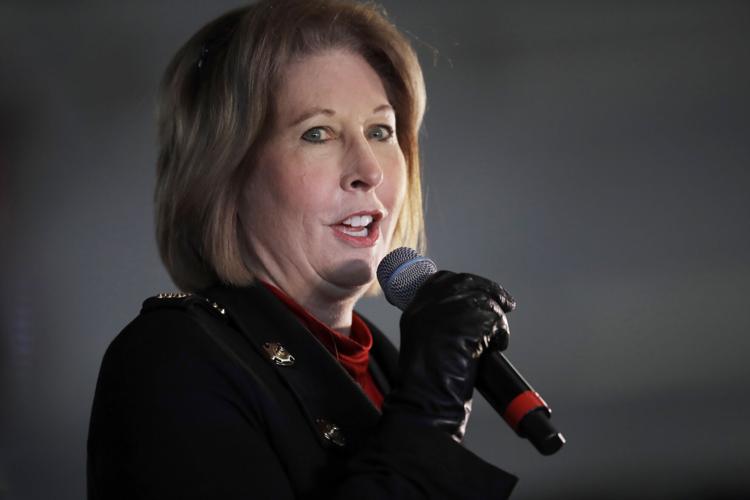
“I apologize for my actions in connection with the events in Coffee County,” Powell wrote in a letter dated Oct. 19, the same day she pleaded guilty to six misdemeanors accusing her of conspiring to intentionally interfere with the performance of election duties.

Attorney Sidney Powell, an attorney for Donald Trump, speaks Dec. 2, 2020, in Alpharetta, Ga. Powell pleaded guilty as part of deal with prosecutors over efforts to overturn Trump’s loss in Georgia.
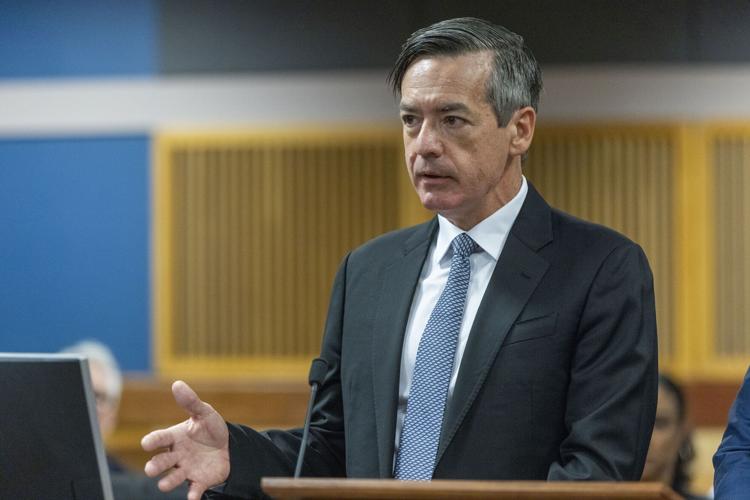
“I apologize to the citizens of the state of Georgia and of Fulton County for my involvement in Count 15 of the indictment,” Chesebro wrote in a letter dated Oct. 20, when he appeared in court to plead guilty to one felony charge of conspiracy to commit filing false documents.
People are also reading…
A spokesperson for Fulton County District Attorney Fani Willis, who brought the election interference case, declined Thursday to comment on the contents of the letters.
Powell and Chesebro were among four defendants to plead guilty in the case after reaching agreements with prosecutors. They were indicted alongside Trump and others in August and charged with participating in a wide-ranging scheme to illegally keep the Republican in power. The remaining 15 defendants — including Trump, lawyer Rudy Giuliani and former White House chief of staff Mark Meadows — have all pleaded not guilty.

Kenneth Chesebro speaks Oct. 20 in Atlanta to Fulton County Superior Court Judge Scott McAfee during a hearing where Chesebro accepted a plea deal.
Each of the four who reached a deal with prosecutors received a sentence that included probation but no jail time. They were also allowed to plead guilty under Georgia’s first offender law, meaning that if they complete their probation without violating the terms or committing another crime, their records will be wiped clean.
The letters written by the other two defendants to plead guilty — Trump lawyer Jenna Ellis and bail bondsman Scott Hall — were longer and more specific. Ellis read her letter in open court on Oct. 24, tearfully telling the judge that she looked back on her involvement in challenging the election results with “deep remorse.”
“What I did not do but should have done, Your Honor, was to make sure that the facts the other lawyers alleged to be true were in fact true,” she said. “In the frenetic pace of attempting to raise challenges to the election in several states, including Georgia, I failed to do my due diligence.”
Hall, who pleaded guilty Sept. 29, wrote in his five-paragraph letter to the citizens of Georgia, “I owe you an apology.”
“I wish I had never involved myself in the post-election activities that brought me before the court,” he wrote, explaining that he got involved after observing what he thought were some irregularities.
Powell was initially charged with felony racketeering and six other felony counts.
Prosecutors allege that she conspired with Hall and others to access election equipment without authorization and hired computer forensics firm SullivanStrickler to send a team to Coffee County, in south Georgia, to copy software and data from voting machines and computers there. The indictment says a person who is not named sent an email to a top SullivanStrickler executive and instructed him to send all data copied from Dominion Voting Systems equipment in Coffee County to an unidentified lawyer associated with Powell and the Trump campaign.
Chesebro was initially charged with felony racketeering and six other felony counts.
Prosecutors allege that he unlawfully conspired with Trump and lawyers associated with his campaign to have the group of Georgia Republicans sign the false elector certificate and to submit it to various federal authorities. He also communicated with Trump campaign lawyers and Republican leaders in other swing states won by Biden to get those states to submit false slates of electors as well, prosecutors alleged.
Ellis pleaded guilty to one felony count of aiding and abetting false statements and writings. She had been charged with violating the state’s anti-racketeering law and soliciting the violation of oath by a public officer, both felonies.
The indictment in the sweeping case details a number of accusations against Ellis, including that she helped author plans on how to disrupt and delay congressional certification of the 2020 election’s results on Jan. 6, 2021, the day a mob of Trump supporters eventually overran the U.S. Capitol. And she’s accused of urging state legislators to back false, pro-Trump electors in multiple states.
Hall pleaded guilty to five misdemeanor counts for his role in accessing Coffee County elections equipment.
A look at the 19 people charged in the Georgia indictment connected to Trump's election scheme
Key people in the Georgia election fraud case

Four of the 18 people charged alongside former President Donald Trump with participating in an illegal scheme to overturn the results of the 2020 presidential election in Georgia have now negotiated deals with prosecutors, pleading guilty to reduced charges in exchange for their truthful testimony in future trials.
Lawyer Jenna Ellis on Tuesday became the latest to turn against Trump, pleading guilty to a single felony charge in exchange for a sentence of probation rather than prison time. Fellow attorneys Sidney Powell and Kenneth Chesebro reached similar deals last week, just as their trial in the case was supposed to start because they had invoked their rights to a speedy trial. Bail bondsman Scott Graham Hall last month was the first to plead guilty.
Trump and the others charged in the case have pleaded not guilty.
The sweeping indictment, brought by Fulton County District Attorney Fani Willis, pictured, in August, capped an investigation that had lasted more than two years and marked the fourth criminal case brought against the former president. Its 41 counts include racketeering, violating the oath of a public officer, forgery, false statements and other offenses.
Here’s a look at the 19 people charged:
Donald Trump

Then-President Trump fixated on Georgia after the 2020 general election, refusing to accept his narrow loss in the state and making unfounded assertions of widespread election fraud there. He also called top state officials, including Gov. Brian Kemp, to urge them to find a way to reverse his loss in the state. In a Jan. 2, 2021, phone call with Georgia Secretary of State Brad Raffensperger, Trump suggested the state’s top elections official could help “find” the votes needed for him to win the state. Willis opened the investigation into possible illegal attempts to influence the election shortly after a recording of that call was made public.
Rudy Giuliani

During several legislative hearings at the Georgia Capitol in December 2020, the former New York mayor and Trump attorney promoted unsupported allegations of widespread election fraud in Georgia. Prosecutors have said Giuliani was also involved in a plan to have 16 Georgia Republicans serve as fake electors, falsely swearing that Trump had won the 2020 presidential election and declaring themselves the state’s “duly elected and qualified” electors.
John Eastman

Eastman, one of Trump’s lawyers and a former dean of Chapman University's law school in Southern California, was deeply involved in some of his efforts to remain in power after the 2020 election. He wrote a memo arguing that Trump could remain in power if then-Vice President Mike Pence overturned the results of the electoral certification during a joint session of Congress. That plan included putting in place a slate of “alternate” electors in seven battleground states, including Georgia, who would falsely certify that Trump had won their states.
Mark Meadows

Trump’s chief of staff visited Cobb County, in the Atlanta suburbs, while state investigators were conducting an audit of the signatures on absentee ballot envelopes in December 2020. Meadows obtained the phone number of the chief investigator for the secretary of state’s office, Frances Watson, and passed it along to Trump, who called her. He also participated in the Jan. 2, 2021, phone call between Trump and Georgia Secretary of State Brad Raffensperger.
Sidney Powell

A lawyer and staunch Trump ally, Powell was present for a now-infamous December 2020 meeting at the White House where participants hatched far-fetched schemes. She also was part of a group that met at the South Carolina home of conservative attorney Lin Wood in November 2020 “for the purpose of exploring options to influence the results of the November 2020 elections in Georgia and elsewhere,” prosecutors said. Additionally, prosecutors alleged Powell was involved in arranging for a computer forensics team to travel to rural Coffee County, about 200 miles southeast of Atlanta, to copy data and software from elections equipment there in January 2021.
Kenneth Chesebro
Prosecutors have said Chesebro, an attorney, worked with Republicans in numerous swing states Trump lost, including Georgia, in the weeks after the November 2020 election at the direction of Trump’s campaign. Chesebro worked on the coordination and execution of a plan to have 16 Georgia Republicans sign a certificate declaring falsely that Trump won and declaring themselves the state’s “duly elected and qualified” electors.
Jeffrey Clark

A U.S. Justice Department official who championed Trump’s false claims of election fraud, Clark presented colleagues with a draft letter pushing Georgia officials to convene a special legislative session on the election results, according to testimony before the U.S. House committee that investigated the Jan. 6, 2021, Capitol riot. Clark wanted the letter sent, but Justice Department superiors refused.
Jenna Ellis

The lawyer appeared with Giuliani at a Dec. 3, 2020, hearing hosted by state Republican lawmakers at the Georgia Capitol during which false allegations of election fraud were made. Ellis also wrote at least two legal memos to Trump and his attorneys advising that Pence should “disregard certified electoral college votes from Georgia and other purportedly ‘contested’ states” when Congress met to certify the election results on Jan. 6, 2021, prosecutors said.
Ray Smith
A Georgia-based lawyer, Smith was involved in multiple lawsuits challenging the results of the 2020 election in Georgia. He also gathered witnesses to provide testimony before Georgia legislative subcommittee hearings held in December 2020 on alleged issues with the state’s election.
Robert Cheeley
A Georgia lawyer, Cheeley presented video clips to legislators of election workers at the State Farm Arena in Atlanta and alleged the workers were counting votes twice or sometimes three times. He spoke to the lawmakers after Giuliani.
Michael Roman
A former White House aide who served as the director of Trump’s election day operations, Roman was involved in efforts to put forth a set of fake electors after the 2020 election.
David Shafer

The chairman of the Georgia GOP, Shafer was one of 16 state Republicans who met at the state Capitol on Dec. 14, 2020, to sign a certificate declaring falsely that Trump had won and also declaring themselves the state’s “duly elected and qualified” electors. He also joined Trump in a lawsuit challenging the certification of the 2020 election in Georgia.
Shawn Still
He was one of 16 Georgia Republicans who signed a certificate falsely stating that Trump had won the state and declaring themselves the state’s “duly elected and qualified” electors. Still was the finance chairman for the state GOP in 2020 and served as a Georgia delegate to the Republican National Convention that year. He was elected to the Georgia state Senate in November 2022 and represents a district in Atlanta’s suburbs.
Stephen Cliffgard Lee
Prosecutors say Cliffgard Lee, a pastor, worked with others to try to pressure Georgia election worker Ruby Freeman and her daughter after Trump and his allies falsely accused them of pulling fraudulent ballots from a suitcase during the vote count. Lee allegedly knocked on Freeman’s door, frightening her and causing her to call 911 three times, prosecutors said in a court filing last year.
Harrison William Prescott Floyd
Also known as Willie Lewis Floyd III, he served as director of Black Voices for Trump, and is accused of recruiting Lee to arrange a meeting with Freeman and Chicago-based publicist Trevian Kutti.
Trevian C. Kutti
Prosecutors allege Kutti, a publicist, claimed to have high-level law enforcement connections. They say Freeman met with Kutti at a police precinct, where she brought Floyd into the conversation on a speakerphone. Prosecutors say Kutti presented herself as someone who could help Freeman but then pressured her to falsely confess to election fraud.
Cathy Latham

Latham was one of 16 Georgia Republicans who signed a certificate falsely stating that Trump had won the state and declaring themselves the state’s “duly elected and qualified” electors. She was also chair of the Coffee County Republican Party. She was at the county elections office for much of the day on Jan. 7, 2021, and welcomed a computer forensics team that arrived to copy software and data from the county’s election equipment in what the secretary of state’s office has said was “unauthorized access” to the machines.
Scott Graham Hall
An Atlanta-area bail bondsman, Hall was allegedly involved in commandeering voting information that was the property of Dominion Voting Systems from Coffee County, a small south Georgia jurisdiction. Also charged in the scheme were Powell, Latham and former county elections supervisor Misty Hampton.
Misty Hampton
She was the elections director in Coffee County. Hampton was present in the county elections office on Jan. 7, 2021, when a computer forensics team copied software and data from the county’s election equipment. She also allowed two other men who had been active in efforts to question the 2020 election results to access the elections office later that month and to spend hours inside with the equipment.