LANSING, Mich. — When former President Donald Trump visits Detroit next week, he'll be looking to blunt criticisms from a United Auto Workers union leadership that has said a second term for him would be a "disaster" for workers.
Trump will bypass the second Republican presidential debate on Sept. 27 to instead visit striking autoworkers in Michigan, where he has looked to position himself as an ally of blue-collar workers by promising to raise wages and protect jobs if elected to a second term.

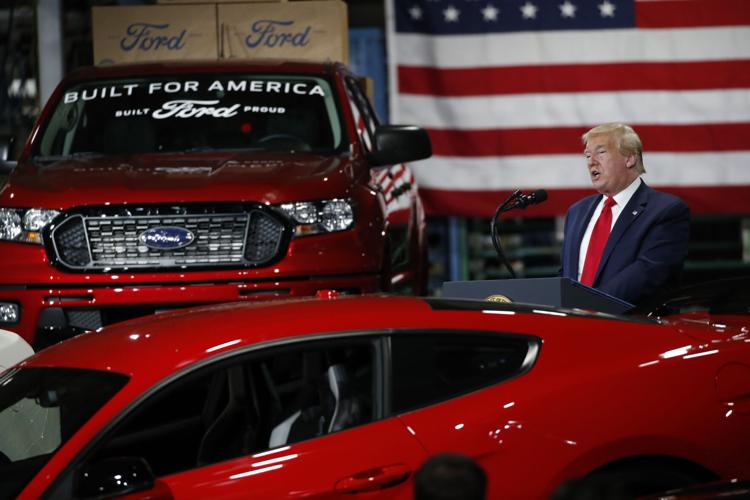
FILE - President Donald Trump speaks at Ford's Rawsonville Components Plant that has been converted to making personal protection and medical equipment, Thursday, May 21, 2020, in Ypsilanti, Mich. Former President Donald Trump will skip the second GOP presidential debate next week to travel to Detroit as the auto worker strike enters its second week. (AP Photo/Alex Brandon, File)
But union leaders say Trump's record in the White House speaks for itself. Union leaders have said his first term was far from worker-friendly, citing unfavorable rulings from the nation's top labor board and the U.S. Supreme Court, as well as unfulfilled promises of automotive jobs. While the United Auto Workers union has withheld an endorsement in the 2024 presidential race, its leadership has repeatedly rebuffed Trump.
People are also reading…
Nevertheless, Trump plans to speak directly to a room of former and current union members. A Trump campaign radio ad released Tuesday in Detroit and Toledo, Ohio, praised auto workers and said the former president has "always had their back."
Not everyone thinks so. Despite Trump's history of success in courting blue-collar workers in previous elections, union leaders say their members would do well to believe their own eyes.
"Just look who Trump put in the courts," said Dave Green, the UAW regional director for Ohio and Indiana. "Look at his record with the labor relations board. He did nothing to support organized labor except lip service."

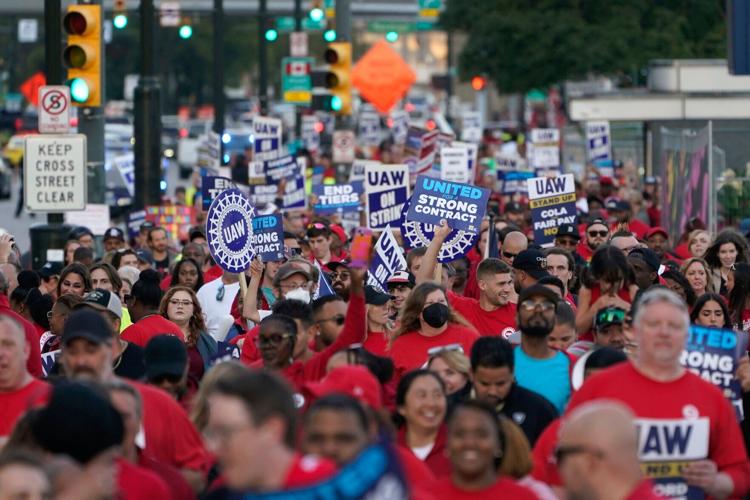
FILE - United Auto Workers members march through downtown Detroit, Friday, Sept. 15, 2023. The UAW is conducting a strike against Ford, Stellantis and General Motors. Former President Donald Trump will skip the second GOP presidential debate next week to travel to Detroit as the auto worker strike enters its second week. (AP Photo/Paul Sancya, File)
The National Labor Relations Board, which enforces the country's labor laws and oversees union elections, came under Republican control during the Trump administration for the first time since 2007. The board reversed several key Obama-era rulings that made it easier for small unions to organize, strengthened the bargaining rights of franchise workers and provided protection against anti-union measures for employees.
In 2017, the Trump-era board reversed a decision holding employers responsible for labor violations by subcontractors or franchisees. In 2019, the board gave a boost to companies that use contract labor, such as Lyft and Uber, by emphasizing "entrepreneurial opportunity" in determining a worker's employment status, making organizing harder.
Mark McManus, president of the plumbers and pipefitters union, said in a statement Tuesday that Trump "tried to gut" the labor relations board under his administration "to undo the safeguards that protect working families." Michigan AFL-CIO President Ron Bieber told The Associated Press in an emailed statement that the board was stacked with "anti-worker appointees who trampled on collective bargaining rights."

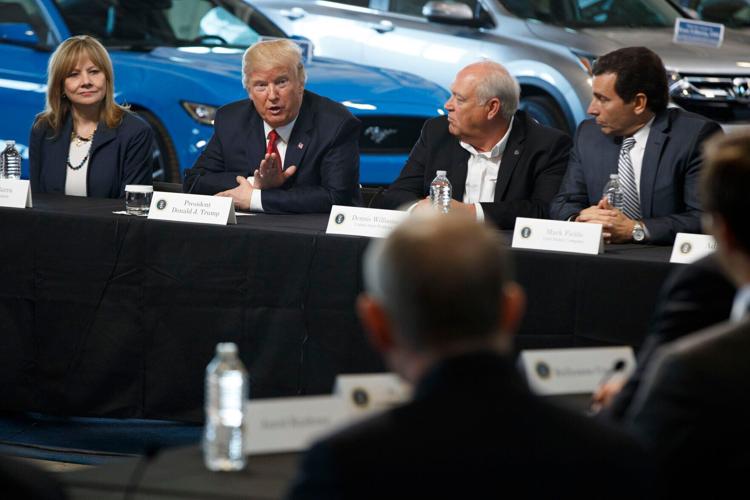
FILE - President Donald Trump speaks during a roundtable discussion at the American Center of Mobility, Wednesday, March 15, 2017, in Ypsilanti Township, Mich. From left are, GM CEO Mary Barra, the president, UAW President Dennis Williams and Ford CEO Mark Fields. Former President Donald Trump will skip the second GOP presidential debate next week to travel to Detroit as the auto worker strike enters its second week. (AP Photo/Evan Vucci, File)
The union leaders also point to unfavorable U.S. Supreme Court rulings under a conservative majority that grew during Trump's term. The nation's high court has dealt a number of blows to unions, most recently ruling against unionized drivers who walked off the job with their trucks full of wet cement, allowing a civil suit against them to go forward.
In 2018, the court's conservative majority overturned a decades-old pro-union decision involving fees paid by government workers. The justices in 2021 rejected a California regulation giving unions access to farm property so they could organize workers.
"If you're appointing conservatives to the court, you're often appointing people who relate to the preference for business or property owners or shareholders, more than the preference of stakeholders like workers," said Peter Berg, a professor of labor relations at Michigan State University.
The Trump campaign vigorously defended his record as pro-worker.
"President Trump has always been on the side of American workers," his campaign spokesman Steven Cheung said in a statement.
Cheung responded to the criticisms from labor leaders with a long list of economic gains and policies from Trump's time as president, ranging from the surging stock market to low unemployment. He cited Trump's broad push to remove regulations and abandon or renegotiate trade deals as beneficial to American workers across a range of industries.
Republicans have long tried to position themselves as being anti-union while remaining pro-worker. The party has branded itself as being for "the working class" while attacking organized labor, which has supported the Democratic Party for decades.

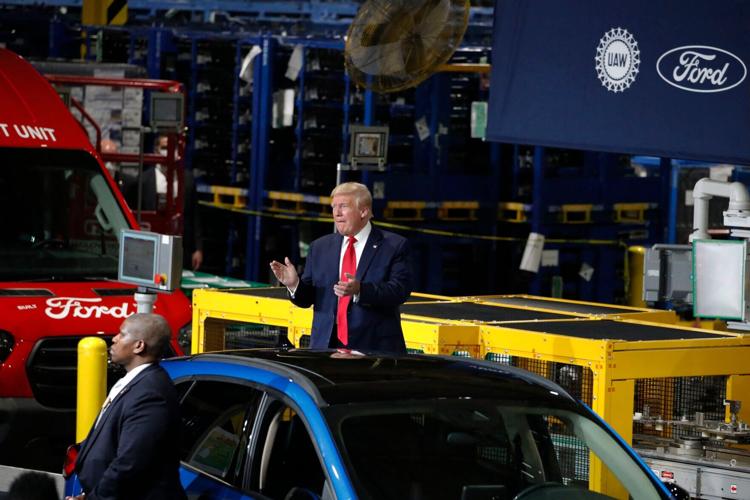
FILE - President Donald Trump claps as he walks to the podium to speak at Ford's Rawsonville Components Plant that has been converted to making personal protection and medical equipment, Thursday, May 21, 2020, in Ypsilanti, Mich. Former President Donald Trump will skip the second GOP presidential debate next week to travel to Detroit as the auto worker strike enters its second week. Trump is planning to speak with union members and will look to blunt criticisms from a United Auto Workers union leadership that has said a second Trump term would be a “disaster.” (AP Photo/Alex Brandon, File)
Trump has used a similar tactic in an effort to separate workers from a UAW leadership that endorsed Democrat Joe Biden in 2020 and that has attacked Trump since. In a recent campaign video addressed to autoworkers, Trump encouraged them not to pay union dues and claimed union leaders have "got some deals going for themselves." Trump also claimed he would raise their wages and protect their jobs.
Job growth figures in the auto industry during Trump's presidency contradict his claim that the industry thrived under his watch. The total number of auto manufacturing jobs in Michigan, which holds the most automotive jobs in the U.S., stayed even during Trump's presidency.
In Ohio, the number of auto manufacturing jobs grew by fewer than 2,000 jobs during Trump's four years in the White House. But Green, the UAW director, said some communities that had backed Trump in 2016 were abandoned by him. He pointed to Lordstown, Ohio, an area that Trump won by a significant margin in 2016 and where Green previously served as the local UAW president.
In 2017, during a visit to the region, Trump pledged that jobs there were "all coming back" and implored residents to stay put. A year later, General Motors announced the closure of its Lordstown plant, one of the largest employers in the area.
"The guy came to my community and flat out lied to everybody," Green said last week. "Banks were closing, schools were shutting down. I wrote the guy two letters, and he didn't even reply."
Trump hopes in 2024 to win back the support of union-friendly states such as Michigan, which became the first in nearly 60 years to repeal a union-restricting law known as "right-to-work." It's one of three Rust Belt states along with Pennsylvania and Wisconsin that broke for Democrats but where Trump narrowly won in 2016, carrying him into the White House. He lost those states to Biden in the 2020 election.
States With the Highest Union Participation Rates
States With the Highest Union Participation Rates

Photo Credit: Ground Picture / Shutterstock
The U.S. economy today in some ways offers the most favorable conditions workers have had in many years. The unemployment rate is as low as it has been in two decades, having bounced back from a COVID-induced spike in 2020. Simultaneously, the wave of quits and job switches now known as the Great Resignation shows that workers are on the hunt for better jobs. To recruit and retain employees in a tight labor market, employers are raising wages and offering better benefits and flexible working arrangements.
Amid these labor-friendly conditions, another historic source of worker power may be making a comeback: unions. Recent union drives at major U.S. employers like Starbucks and Amazon have grabbed headlines, and Congress is currently considering the PRO Act, a major piece of legislation to strengthen unions. But support for unions is more widespread than that. A majority of Americans believe that declines in union membership have been bad for the country, and according to the National Labor Relations Board, petitions for union elections nationwide rose by 57% from 2021 to 2022.
While labor organizing appears to be on the rise again, unions have a ways to go to reverse the long-running decline in unionization of recent decades. Forty years ago, one in five U.S. workers (20.1%) was a union member, but today, that figure is approximately one in ten (10.3%).
Union membership in the US has experienced a steady decline

Experts point to a number of factors for the decline of unions in the U.S. The rise of right-to-work laws and other beginning in the middle of the 20th century allowed more employers to hire non-union workers. The economic downturn of the late 1970s and early 1980s led to major layoffs for many heavily unionized employers and industries. Globalization has made it easier for employers to find less expensive labor outside of the U.S., while technological advancements have allowed certain professions to be more automated.
The impact of these factors has been experienced differently across sectors of the economy. Industries like transportation and warehousing, manufacturing, construction, and trade have seen the sharpest declines in union membership rate over the last two decades. These are industries that have been reshaped by the major economic and social trends that have contributed to decreases in union participation. In contrast, fields like education and health care have experienced more measured declines.
Union membership declined least in education and health care

Unionization’s steady decline has been costly for workers in many industries. Across all wage and salary workers, union members receive $194 more per week than non-union members in median weekly earnings. In some cases the difference can be even greater: for example, union construction workers earn $422 more per week than their non-union categories.
Union members typically earn more than their non union counterparts

As organized labor potentially regrows its role in the U.S. economy, some parts of the country will offer more favorable terrain than others. Among the 27 states with right-to-work laws, union membership rates average 6.1%, compared to 13.8% in the states without. Rates are even lower in some parts of the country, including Southern states which have historically had more limitations on union activity. In contrast, the top states for union participation are largely found in the Northeast and in the West.
Union membership is lower in right to work states

The data used in this analysis is from the U.S. Bureau of Labor Statistics 2021 Current Population Survey. To determine the states with the highest union participation rates, researchers at HireAHelper calculated the percentage of workers who are union members. In the event of a tie, the state with the greater percentage of workers who are represented by unions was ranked higher.
Here are the states with the highest union participation rates.
15. Maine

Photo Credit: Sean Pavone / Shutterstock
- Percentage of workers who are union members: 12.4%
- Percentage of workers who are represented by unions: 14.7%
- Total workers who are union members: 70,000
- Total workers who are represented by unions: 83,000
14. Massachusetts

Photo Credit: Sean Pavone / Shutterstock
- Percentage of workers who are union members: 12.6%
- Percentage of workers who are represented by unions: 13.6%
- Total workers who are union members: 402,000
- Total workers who are represented by unions: 433,000
13. Pennsylvania

Photo Credit: Sean Pavone / Shutterstock
- Percentage of workers who are union members: 12.9%
- Percentage of workers who are represented by unions: 13.6%
- Total workers who are union members: 693,000
- Total workers who are represented by unions: 732,000
12. Michigan

Photo Credit: Sean Pavone / Shutterstock
- Percentage of workers who are union members: 13.3%
- Percentage of workers who are represented by unions: 15.3%
- Total workers who are union members: 540,000
- Total workers who are represented by unions: 620,000
11. Illinois

Photo Credit: Sean Pavone / Shutterstock
- Percentage of workers who are union members: 13.9%
- Percentage of workers who are represented by unions: 15.2%
- Total workers who are union members: 752,000
- Total workers who are represented by unions: 818,000
10. Connecticut

Photo Credit: Sean Pavone / Shutterstock
- Percentage of workers who are union members: 14.6%
- Percentage of workers who are represented by unions: 16.3%
- Total workers who are union members: 223,000
- Total workers who are represented by unions: 248,000
9. Rhode Island

Photo Credit: Sean Pavone / Shutterstock
- Percentage of workers who are union members: 15.7%
- Percentage of workers who are represented by unions: 17.4%
- Total workers who are union members: 75,000
- Total workers who are represented by unions: 83,000
8. Alaska

Photo Credit: Marcus Biastock / Shutterstock
- Percentage of workers who are union members: 15.8%
- Percentage of workers who are represented by unions: 17.2%
- Total workers who are union members: 46,000
- Total workers who are represented by unions: 50,000
7. California

Photo Credit: Sean Pavone / Shutterstock
- Percentage of workers who are union members: 15.9%
- Percentage of workers who are represented by unions: 17.8%
- Total workers who are union members: 2,468,000
- Total workers who are represented by unions: 2,757,000
6. Minnesota

Photo Credit: Checubus / Shutterstock
- Percentage of workers who are union members: 16.0%
- Percentage of workers who are represented by unions: 17.1%
- Total workers who are union members: 416,000
- Total workers who are represented by unions: 446,000
5. New Jersey

Photo Credit: Sean Pavone / Shutterstock
- Percentage of workers who are union members: 16.2%
- Percentage of workers who are represented by unions: 17.9%
- Total workers who are union members: 608,000
- Total workers who are represented by unions: 672,000
4. Oregon

Photo Credit: Sean Pavone / Shutterstock
- Percentage of workers who are union members: 17.8%
- Percentage of workers who are represented by unions: 18.8%
- Total workers who are union members: 318,000
- Total workers who are represented by unions: 336,000
3. Washington

Photo Credit: f11photo / Shutterstock
- Percentage of workers who are union members: 19.0%
- Percentage of workers who are represented by unions: 20.0%
- Total workers who are union members: 629,000
- Total workers who are represented by unions: 661,000
2. New York

Photo Credit: Andrew Zarivny / Shutterstock
- Percentage of workers who are union members: 22.2%
- Percentage of workers who are represented by unions: 24.1%
- Total workers who are union members: 1,729,000
- Total workers who are represented by unions: 1,869,000
1. Hawaii

Photo Credit: Dave H. Fine / Shutterstock
- Percentage of workers who are union members: 22.4%
- Percentage of workers who are represented by unions: 24.1%
- Total workers who are union members: 121,000
- Total workers who are represented by unions: 131,000