When Cody Heller hears former President Donald Trump denigrate immigrants and promise mass deportation, it infuriates him.
His Heller Farms, a fourth-generation family dairy in Jackson County, Wisconsin, relies on immigrant labor. Thirty-two of the farm’s 46 employees are from Mexico.
He's hardly alone. A 2023 University of Wisconsin-Madison survey of Wisconsin dairy farmers found that nearly 40% of farms have at least one foreign employee; other studies have estimated that immigrants account for up to 90% of the labor force in the dairy industry.
“Mass deportation would have a dynamic, negative economic impact, to the point where it would destroy the food cycle in our country and literally change our food prices overnight” Heller said. A 2015 Texas A&M poll found that eliminating immigrant labor nationwide would increase retail milk prices by more than 90%.
People are also reading…
Still, Heller, who said he does not identify with either political party, voted for Trump in 2016 and 2020 and said he will again this year.
In that, he's also far from alone — the UW-Madison survey found 59% of dairy farmers identified as conservative, while only 4% identified as liberal. The remaining 38% identified as moderate, progressive or libertarian. Yet, just 15% of respondents opposed creating a pathway to citizenship for undocumented farm workers.
With his vote for Trump this year, Heller is betting that Trump's deportation promises are nothing more than "white noise" intended to appeal to his white working-class base.

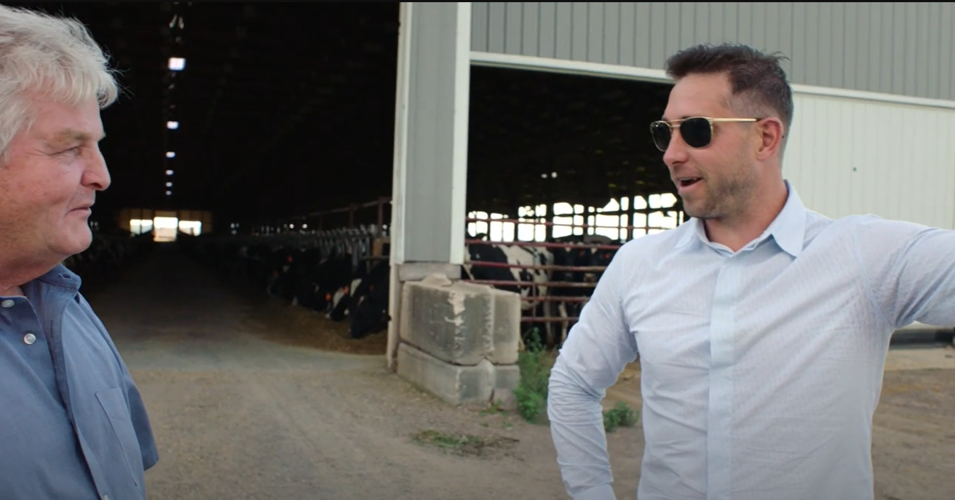
Cody Heller, right, with his father, Blake, on their family's farm in Alma Center. A supporter of former President Donald Trump, Heller's livelihood depends on immigrant labor, he said. He's counting on the former president not following through with his mass deportation promises.
“He believes that immigrant labor is directly competing for labor with his base, and that is what they like to hear,” Heller said. But that isn’t true in the dairy industry, he noted, where farm jobs are often turned down by domestic workers.
“He can’t do it, nor would he ever do it,” he said of a mass deportation.
It's a sentiment echoed by several farmers who spoke to the Wisconsin State Journal for this story, none of whom had confidence that Trump could actually enact sweeping deportations.
Those who support Trump said they believed his economic plans outweighed the risks of his proposed immigration policies. Others, like John Rosenow, who owns Rosenholm Dairy in Buffalo County and employs 13 Mexican immigrants, said Trump’s candidacy poses a serious threat to America’s Dairyland.
“Last time he said the same thing,” said Rosenow, a lifelong Democrat who says he’s voting for Vice President Kamala Harris and who has become an outspoken advocate for immigrant farm workers. “He said he was going to deport everybody day one, and what happened was there was a huge concern amongst the immigrant population on dairy farms, and people started going home.”
For Hans Breitenmoser Jr., owner of Breitenmoser Family Farms in Lincoln County, Trump's rhetoric is dangerous even if he is bluffing about deportations.
“We’ve seen what happens in other places around the world and in this country when we demonize a population and when we have high-ranking political officials give permission to our worst instincts,” he said.
'The industry needs employees'
Breitenmoser’s parents were immigrants. In 1968, they moved to the United States from Switzerland and started their family farm, then a family-operated 25-cow dairy. Now, the farm has nearly 500 cows and employs a dozen people, 10 of whom are immigrants from Mexico.
“For any farm that is milking more than 100 or 200 cows, without immigrant labor, it simply doesn’t work,” Breitenmoser said. “The dairy industry stops existing in a big way.”
The ballooning need for immigrant labor was born out of a changing dairy industry with increasing workforce needs, several farmers said.
“When I was a kid, we had 13 dairy farms on my road,” Breitienmoser said. “Every one was a family farm. Everyone had their kids milking their cows.”
But over the last two decades, the number of dairy farms in Wisconsin has decreased by about 30%. As the number of dairies has dropped, they have grown in size, leading to fewer farms with larger herds and larger, non-family workforces.
“Anytime that a farmer needs more money, the solution is to get more cows,” said Tina Hinchley, who owns Hinchley’s Dairy, a 240 cow farm in Cambridge.
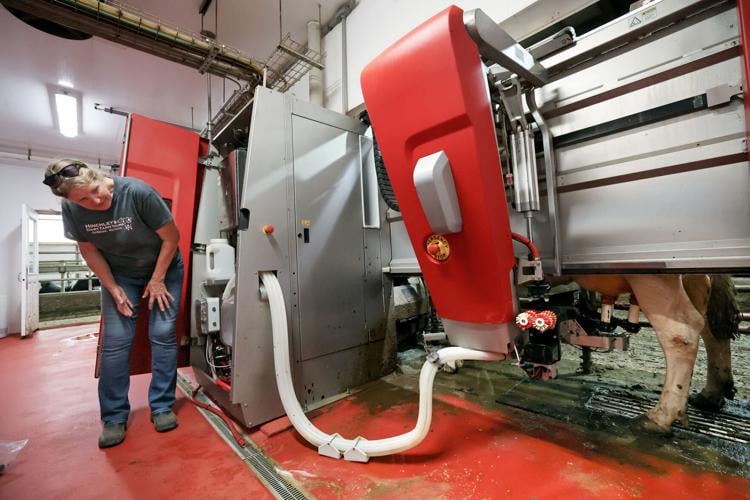
More cows means more output, however. With the dearth of domestic workers, she said, larger dairies have no choice but to rely on immigrants or robots. At her farm, all the miking is done by four Lely Milking Robots, which operate 24/7 to milk cows three times a day.

With so few domestic workers willing to take agricultural jobs, farmers face the choice of automation or hiring immigrant workers, said Tina Hinchley, who owns Hinchley’s Dairy, a 240-cow farm in Cambridge. “We’ve got robots, so we don’t have to have immigrants,” she said.
“Wisconsin’s agricultural workforce looks a lot different than it did 20 years ago,” said Tyler Wenzlaff, director of government relations at the Wisconsin Farm Bureau Federation. “It’s no longer the neighboring kid helping out on the farm, because most likely the farm that was next door closed down.” Earlier this month, the Farm Bureau endorsed U.S. Sen. Tammy Baldwin in her reelection bid against Eric Hovde, its first time in over two decades supporting a statewide Democrat.
In a state with the eighth-lowest unemployment rate in the nation according to the Bureau of Labor Statistics, virtually no domestic employees are interested in farm work, farmers said. The fact that farm jobs are not particularly lucrative or highly regarded in American society further complicates things for agricultural employers, Rosenow said.
Most larger dairy farmers began hiring immigrant labor in the '90s, when domestic labor became impossible to find. Breitenmoser recalled posting job advertisements and getting no responses. Rosenow said he used to go door-knocking to find local employees, often offering them higher salaries than they were making. But he had no takers.
“We’ve been driven to a place where, as an industry, we need labor. We’re no longer just relying on our children,” Breitenmoser said. “The industry needs employees, and the only place to source them, really, is from outside our borders.”
Farmers: Rules haven't kept up
In addition to the shortage of domestic workers, the dairy industry is competing with an increasing number of factory jobs for immigrant employees, Heller said.
The problem is exacerbated by the fact that initiatives designed to provide farmers with cheap foreign labor — like the H-2A program, which grants temporary visas to foreign employees working seasonal agriculture jobs — do not extend to the dairy industry, which requires year-round work.
A path to citizenship for immigrant workers would help, Heller said.
“Those people need a path,” he said. “I sit next to them at ball games at school. I know they’re undocumented, and they need a path.”
Another "missing cog," he said, is a permit program granting dairy workers the ability to cross back and forth over the border to legally visit family members in their home country.
For Paul Lippert, who employs seven immigrants at his family’s farm in Pittsville, the most crucial next step involves making lives easier for immigrants who are already here. He said that begins with ensuring they have access to basic rights like health care and driver’s licenses. A law banning undocumented immigrants from obtaining driver’s licenses has long been controversial in the industry.
“Immigrants have, since the beginning of this country, played an important role in our workforce and will continue to do so,” Lippert said. “So we need to have a system that works for us and also for them.”
José Martinez, CEO and president of migrant workers agency UMOS, said he wants to see the agriculture industry pay more attention to ensuring fair wages and safe working conditions for immigrant farm workers.
Rhetoric brings real costs
Cris Peterson, whose Grantsburg dairy farm employs eight Mexican immigrants, spoke in support of Trump at the 2020 Republican National Convention. While her own experiences with her immigrant employees have been positive, she said, she still supports the former president's tough-on-immigration, adding that she she believed unvetted migrants are “trying to destabilize our country.”
Like Heller, Peterson believes a deportation plan would cripple the dairy industry, but she said she is still going to vote for Trump. “There’s no way he’s going to deport all of them, but he will try real hard to get rid of the bad ones,” she said.
Heller agreed that border security is important. But he said he “vehemently disagrees” with Trump's focus on that to the exclusion of other issues he sees as more pressing.
“Since Trump came around in 2016, the narrative around immigration changed,” Heller said. While it was once about addressing the needs of immigrants already in the country, “because of Trump’s narrative and rhetoric, everything now is about the wall and border security.”

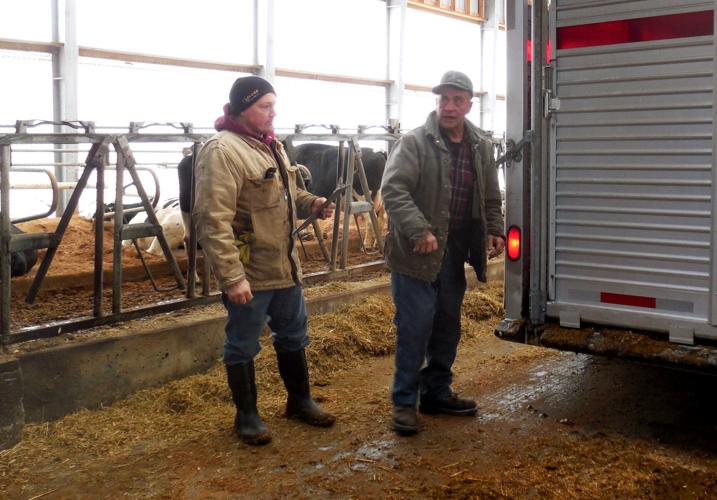
Breitenmoser Family Farm owner Hans Breitenmoser Jr. loads cattle with his neighbor Charles Rheinhardt. A child of immigrants, Breitenmoser employs 10 immigrants on his farm. Without immigrant labor, he said, farming "simply doesn't work."
Breitenmoser, a lifelong Democrat, said he struggles to understand why many of his colleagues in the dairy industry have embraced Trump and said his anti-immigrant rhetoric.
During the first part of Trump's presidency, Rosenow said, labor shortages on Wisconsin dairies worsened after workers moved back to their home countries out of fear of deportation. Once it became clear that no mass-deportation plan would actually be enacted, Rosenow said, workers slowly started coming back. He’s not sure the industry will recover so quickly from another Trump victory.
Other policies
Like any other demographic, farmers the State Journal interviewed are divided over the candidates' positions on other issues.
Breitenmoser said he is "baffled" by claims that Trump’s platform would be better for rural economies.
He said he could not think of an instance where Trump’s deregulation policies, which are often touted by his supporters in the agriculture industry, would have made a difference in his life. He praised the Biden-Harris administration’s focus on antitrust legislation and the Inflation Reduction Act, which he said has “flooded” rural areas with money.
“Last time he was president, he put on tariffs, and immediately our price of milk dropped $4 a hundredweight,” Rosenow said.
Trump later offered sizable payouts to farmers, which Rosenow said eased initial the impact of the tariffs. But he's nervous about Trump's promises to impose even steeper tariffs in a second term.
“He has tariffs he wants to put in that are literally going to decimate our crops and our exports,” said Hinchley, who has appeared in a Harris campaign ad in which she talked about her experience struggling with health insurance while suffering from a brain tumor. “The last time, he came in and he sabotaged our relationship with Canada and Mexico. We are still in recovery from that.”
Heller said he's not a big fan of either candidate, but he thinks Trump’s defense and economic policies are the “lesser of two evils.” He specifically praised Trump’s promises of lower inheritance and capital gains taxes and to end taxes on overtime pay.
“Most of us are family farms, and if you hurt our ability to maintain our land base, our ability to transfer our assets to future generations, that’s hard,” Heller said.
Both Rosenholm and Breitenmoser said they think farmers who support Trump do so because of social policies — like abortion restriction and gun rights — rather than a deep consideration of how his immigration policies will affect their businesses.
Rosenow said he thinks there is a “tradition” of conservatism among his community that can be difficult to change.
“There’s also a lot of apathy involved,” he said. “If you don’t care, you don’t want to see another political ad, you don’t want to talk politics, then when you go to vote, you just think, ‘well I’ve always voted Republican, so I might as well vote Republican again.’”