Plenty of spacecraft have orbited and even landed on the surface of Mars. But the red planet's twin moons have remained untouched — until now.
A mission led by Japan's space agency aims to become the first to return a piece of a Martian moon. And now, the spacecraft tasked with pulling off the feat has officially launched on its journey toward Mars's largely unexplored moons — Phobos and Deimos.
If all goes to plan, the uncrewed vehicle will reach the moons of Earth's planetary neighbor next year, and even land on one before returning within five years.
The mission, which will rely on scientific instruments from NASA, the European Space Agency and others, aims to collect not only detailed observations of the moon, but physical samples from Phobos. The results, scientists hope, might reveal not just the origin of the moons, but Mars itself at a time when NASA is working toward the first astronaut-led ventures to the planet.
People are also reading…
Here's what to know about Japan's mission:

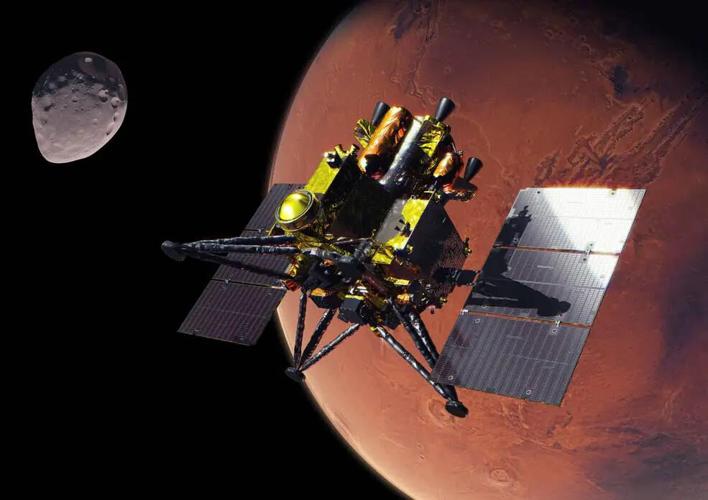
An artist’s concept of JAXA’s (Japan Aerospace Exploration Agency) Martian Moons eXploration (MMX) spacecraft at Mars.
Japan launches mission
The Japan Aerospace Exploration Agency (JAXA) launched an uncrewed spacecraft to Mars from the country's main spaceport, the Tanegashima Space Center, in southwestern Japan. The launch took place early Tuesday.
The country's officials declared the launch a success after the Martian Moons eXploration (MMX) spacecraft separated from an H3 rocket's upper stage to continue on its journey to Phobos and Deimos.
What is Japan's Martian Moons eXploration mission?
While Mars' rovers have snapped images of the planet's moons from afar, the mission marks the first time that Phobos and Deimos will be examined up close.
The MMX spacecraft is expected to arrive in Mars's neighborhood by August 2027. The vehicle won't just orbit near the moons, but will also land on Phobos — the larger and closer of the two — in December 2028 and collect a sample that could be returned to Earth by 2031, according to NASA.
Scientists suspect that the smaller asteroid-sized moons could either be the remnants of something that crashed into Mars, or themselves could be asteroids captured in the planet's gravity. The objective of the mission is to survey the two moons — including studying the elemental composition of Phobos’s surface — to determine their origin and evolution, according to NASA.

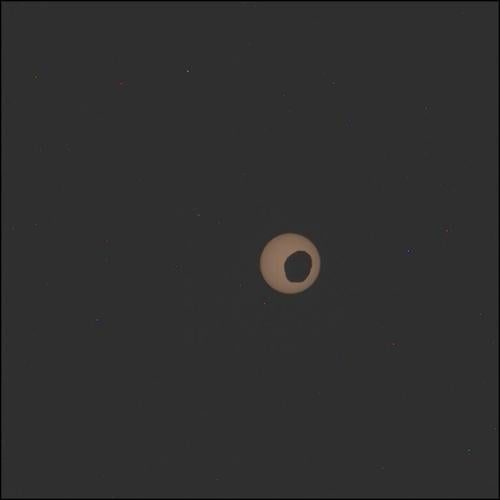
NASA’s Perseverance Mars rover used its Mastcam-Z camera to capture the silhouette of Phobos, one of the two Martian moons, as it crossed in front of the sun Aug. 13. Perseverance has captured several Phobos transits since its landing at Jezero Crater in February 2021.
What to know about Phobos and Deimos
Translated as "fear" in Greek, Phobos is much closer to Mars than its brother Deimos, according to NASA. Orbiting Mars three times a day, Phobos is also the larger of the two moons.
Unlike Deimos ("dread," in Greek), which is drifting ever outward and will eventually leave Mars' orbit, Phobos is on a collision course with the red planet. Because Mars's strong gravity is drawing Phobos about 6 feet closer to it every century, the moon is expected within the next 50 million years to either crash into Mars or break up into a planetary ring like Saturn's.
What was NASA's contribution to Mars mission?
NASA is among the five space agencies that helped devise and launch the mission, which also relied on assistance from private companies like Blue Origin.
Specifically, NASA helped develop an instrument on the MMX spacecraft known as the MEGANE gamma-ray and neutron spectrometer, which will assist in sample collection on Phobos's surface.
NASA also funded scientists from the U.S. participating on the MMX science team, and will provide communications and navigation support from the agency’s array of giant radio network antennas on Earth known as the Deep Space Network.

Contributing: Reuters