WASHINGTON — Stumpy lives on!
After this year's National Cherry Blossom Festival, the stunted and gnarled cherry tree that became an unlikely social media celebrity was cut down along with more than 100 other trees to make way for a massive repair project on the crumbling seawall protecting the Tidal Basin.
But thanks to the efforts of the National Arboretum, little Stumplings took root and could be returned to their parent's home in the next couple of years.
Earlier this year, workers collected multiple clippings and samples from Stumpy, transporting them to the arboretum in a protective cooler.
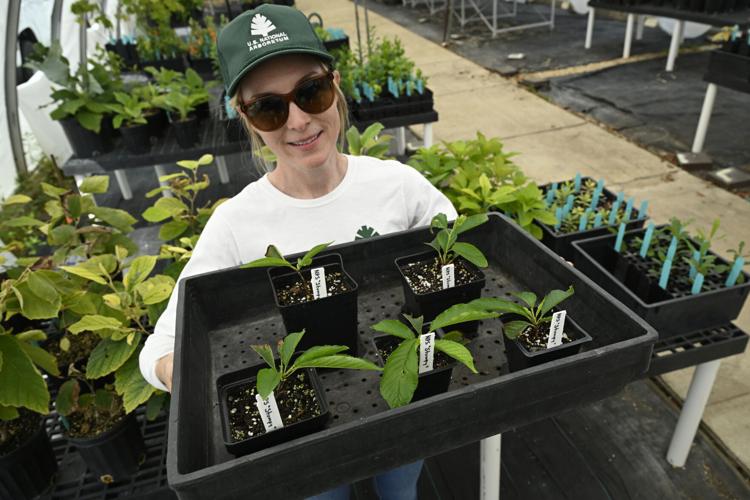
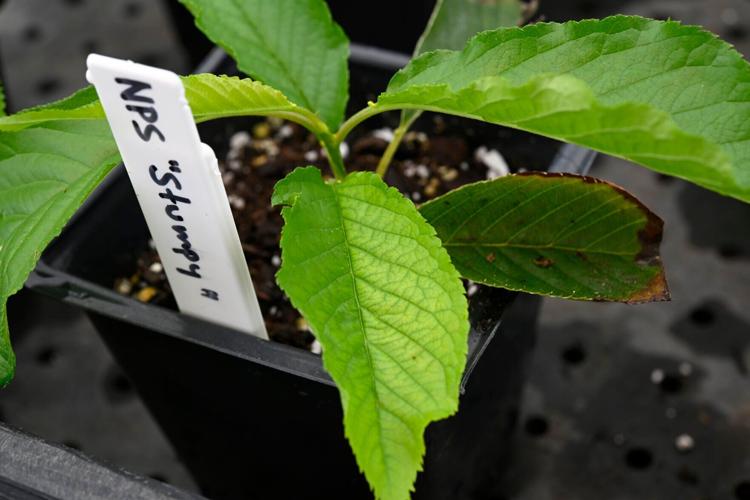
In a tree-mendous story of survival, those clippings were planted and nurtured to the point where the arboretum now has five small self-sustaining plants in its care.
People are also reading…

Horticulturist Piper Zettel of the National Arboretum holds a tray Aug. 15 containing some of the successfully planted clippings from Stumpy the cherry blossom tree in Washington.
The process was complicated and delicate, with no guarantees that it would actually work, said Piper Zettel, a horticulturist at the arboretum.
"Rooting the cuttings of woody plants is not a guaranteed success," Zettel said. "Timing and the condition of the cutting material are probably the most critical elements, but many variables could have influenced the results of this process."
In horticultural terms, the original Stumpy is referred to as the "parent plant." However, the five young seedlings in the arboretum's care are closer to being Stumpy's clones than its children, since they are genetically identical to the original.
The rooted cuttings are still vulnerable and will require years of patient nurturing before any of them are ready for their public debut.

A plant grows from a clipping from Stumpy on Thursday in Washington.
The National Park Service, which oversees the Tidal Basin in front of the Jefferson Memorial, is targeting spring 2026 for the completion of the seawall repair project — anticipating a larger-than-usual flood of tourists that summer for the 250th anniversary of the Declaration of Independence.
However there's no guarantee that a Stumpy 2.0 will be ready for replanting by that deadline.
"The new trees have a long way to go, but we are doing all we can to ensure NPS receives strong, healthy and vigorous trees," Zettel said. "The process takes a long time as trees grow very slowly. We need to be patient."
Stumpy became a social media star during the COVID-19 pandemic. Its legacy spawned T-shirts, a calendar and a fanbase. News that 2024 was Stumpy's final spring prompted people to leave flowers and bourbon; one Reddit user threatened to chain themselves to the trunk to save the tree.

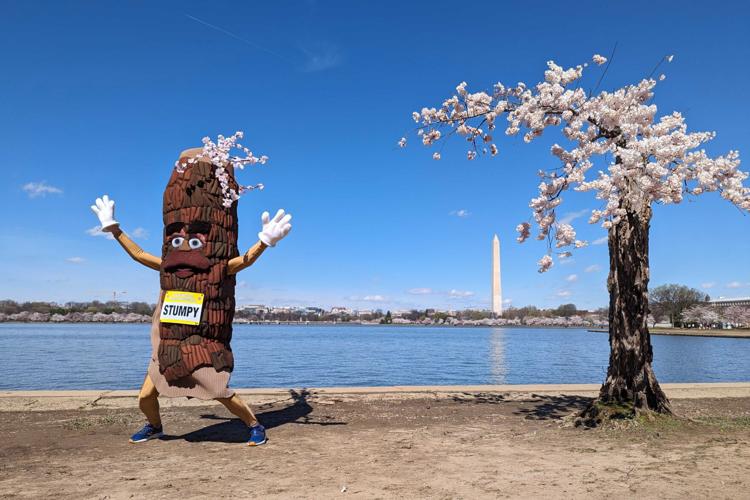
Stumpy the mascot dances March 19 near Stumpy the cherry tree at the Tidal Basin in Washington.
The $133 million seawall repair project kicked off in earnest Thursday, with the official launch of construction.
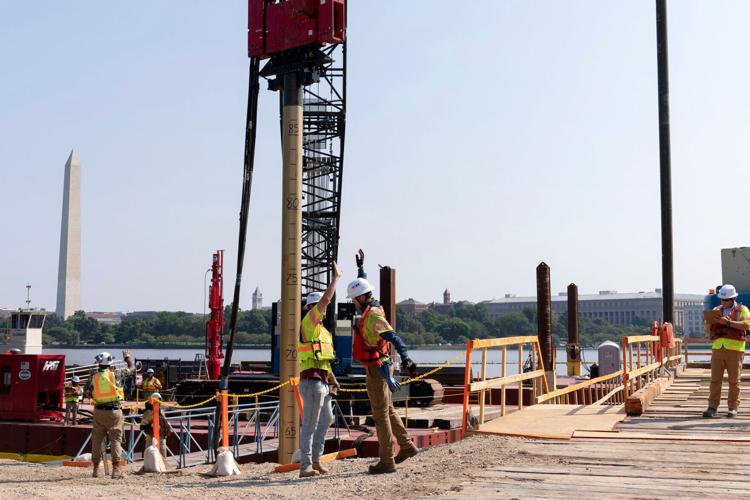
Rather than use a golden shovel or cut a ribbon with oversized scissors, National Park Service officials chose to paint one of the 90-foot-tall metal piles gold. Observers applauded as a giant construction crane inserted the golden metal cylinder — one of about 700 that will be used — into the ground.
"This has been a long time coming," said Catherine Townsend, president of the Trust for the National Mall, which uses private donations to support the publicly funded NPS projects. "It's hard to see all these construction fences and cranes, but it has to happen."

With the Washington Monument in the background, construction workers high-five Thursday after installing the first pile for repair of the Tidal Basin and Potomac River seawalls at the National Mall in Washington.
In addition to the seawall's deterioration due to age and weather, the water level rose by about 13 inches since the seawall was constructed in the 1940s. As a result, the Tidal Basin waters overflow the wall twice a day at high tide, blocking pedestrian pathways and soaking the cherry blossom tree roots with destructive brackish sea water.
"It was a sad moment for us to have to cut down so many cherry blossom trees," National Park Service Director Chuck Sams said. "Stumpy is a real symbol of resilience, simply for having survived in those conditions."
While NPS aims to have everything completed by spring 2026, the construction work inevitably will affect the cherry blossom season next spring.
"We just ask that people be patient," Sams said, "because on the other side of this is going to be improved facilities and an improved visitor experience."
Photos: Cherry blossoms in nation's capital in spring 2023

The Washington Monument is see from the Tidal Basin as cherry blossoms enter their peak bloom Wednesday, March 22, 2023, in Washington. (AP Photo/Alex Brandon)

People walk along the Tidal Basin as cherry blossoms enter their peak bloom Wednesday, March 22, 2023, in Washington. (AP Photo/Alex Brandon)

Desiree Moreno-Gutierrez holds her daughter Isabella Moreno-Gutierrez as photographer Danielle Miller takes their picture along the Tidal Basin as cherry blossoms enter their peak bloom Wednesday, March 22, 2023, in Washington. (AP Photo/Alex Brandon)

The Jefferson Memorial can be see along the Tidal Basin as cherry blossoms enter their peak bloom Wednesday, March 22, 2023, in Washington. (AP Photo/Alex Brandon)

Cherry blossoms bloom along the Tidal Basin as they enter their peak bloom Wednesday, March 22, 2023, in Washington. (AP Photo/Alex Brandon)

People walk along the Tidal Basin as cherry blossoms enter their peak bloom Wednesday, March 22, 2023, in Washington. (AP Photo/Alex Brandon)

Two people embrace under the cherry blossoms along the Tidal Basin, as the blossoms enter their peak bloom Wednesday, March 22, 2023, in Washington. (AP Photo/Alex Brandon)

People walk along the Tidal Basin as cherry blossoms enter their peak bloom Wednesday, March 22, 2023, in Washington. (AP Photo/Alex Brandon)

People walk along the Tidal Basin as cherry blossoms enter their peak bloom Wednesday, March 22, 2023, in Washington. (AP Photo/Pablo Martinez Monsivais)

People stop to take their pictures along the Tidal Basin as cherry blossoms enter their peak bloom Wednesday, March 22, 2023, in Washington. (AP Photo/Pablo Martinez Monsivais)

People take their picture along the Tidal Basin as cherry blossoms enter their peak bloom Wednesday, March 22, 2023, in Washington. (AP Photo/Pablo Martinez Monsivais)

Sunsets along the Tidal Basin as cherry blossoms enter their peak bloom Wednesday, March 22, 2023, in Washington. (AP Photo/Pablo Martinez Monsivais)

A person holds up their phone to take pictures at sunset along the Tidal Basin as cherry blossoms enter their peak bloom Wednesday, March 22, 2023, in Washington. (AP Photo/Pablo Martinez Monsivais)

People walk along the Tidal Basin during sunset as cherry blossoms enter their peak bloom Wednesday, March 22, 2023, in Washington. (AP Photo/Pablo Martinez Monsivais)

People stop to take their pictures along the Tidal Basin as cherry blossoms enter their peak bloom Wednesday, March 22, 2023, in Washington. (AP Photo/Pablo Martinez Monsivais)

A person stops to take pictures at sunset along the Tidal Basin as cherry blossoms enter their peak bloom Wednesday, March 22, 2023, in Washington. (AP Photo/Pablo Martinez Monsivais)

The Jefferson Monument is seen at sunset along the Tidal Basin as cherry blossoms enter their peak bloom Wednesday, March 22, 2023, in Washington. (AP Photo/Pablo Martinez Monsivais)

A Yoshino cherry tree blossom is seen in the afternoon sun Thursday, March 23, 2023, on Capitol Hill in Washington. (AP Photo/Carolyn Kaster)

Blooming Yoshino cherry trees are seen in the afternoon sun Thursday, March 23, 2023, on Capitol Hill in Washington. (AP Photo/Carolyn Kaster)

With the U.S. Capitol in the background, blooming Yoshino cherry trees are seen in the afternoon sun Thursday, March 23, 2023, on Capitol Hill in Washington. (AP Photo/Carolyn Kaster)