HIALEAH, Florida — A few days after selling all she had to flee Cuba with her three children on a crowded boat, Daneilis Tamayo raised her hand in praise and sang the rousing opening hymn at Sunday worship in this Miami suburb.
"The only thing that gave me strength is the Lord. I'm not going to lose my faith, whatever I might go through," she said. The family has been sleeping in Iglesia Rescate's improvised shelter since the promises of help made by her contact in the United States turned out to be "all lies."

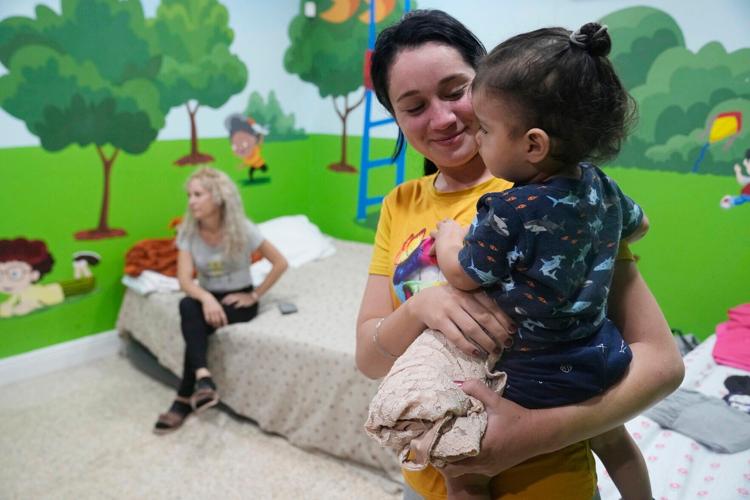
Isabel Bembow Tamayo holds Liam Centeno, 1, on Feb. 21 in the Iglesia Rescate school classroom that is converted into a bedroom for her family in Hialeah, Fla.
In the past 18 months, an estimated 250,000 migrants and asylum-seekers like Tamayo have arrived in the Miami area after being granted only precarious legal status that often doesn't include permission to work, which is essential to building new lives in the U.S.
This influx is maxing out the migrant social safety net in Miami's faith communities, long accustomed to integrating those escaping political persecution, a lack of freedoms and a dearth of basic necessities.
People are also reading…
Cubans were the first to arrive during the island's communist revolution 60 years ago, and they're still fleeing here alongside Haitians, Nicaraguans and Venezuelans.
"The Lord says to welcome the stranger. It's the saddest thing, the quantity of people who come and we can't help them," said the Rev. David Monduy, Iglesia Rescate's pastor.

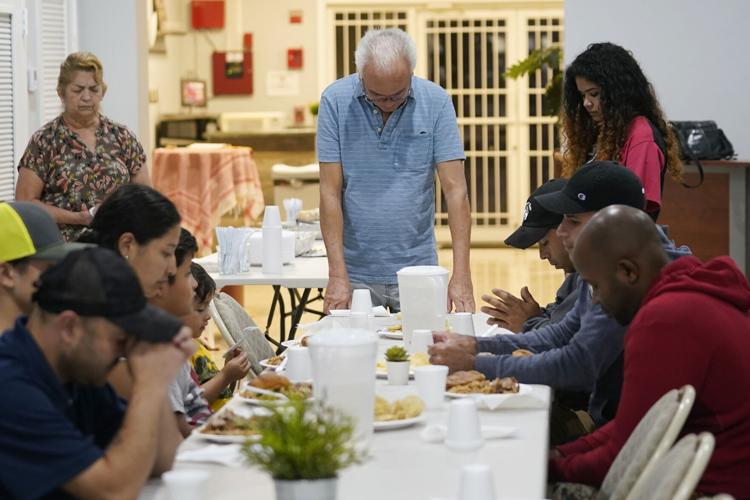
Daniel Monduy leads a group of newly arrived migrants in prayer Feb. 21 before dinner at the Iglesia Rescate in Hialeah, Fla.
Miami's faith leaders and their congregations remain steadfast in their mission to help settle new migrants, but they're sounding the alarm that the need is growing unmanageable.
"We can get a call on a Saturday that 30 migrants were dropped off, and two hours later all have been picked up," said Peter Routsis-Arroyo, the CEO of Catholic Charities in Miami. "But the challenge is at what point you reach saturation."
The number of arrivals, by sea directly to Florida and from those heading here from the U.S.-Mexico border, surged this winter. For most newcomers, the best hope to settle in the U.S. is to win asylum, but immigration courts are so backlogged migrants can be in limbo for years, ineligible to legally get a job.
Advocates say that makes them vulnerable to criminals, puts an impossible financial burden on existing migrant communities that try to help, and slows down integration into U.S. society.
"It's completely irrational that they're not giving out work permits," said Miami Archbishop Thomas Wenski, whose Catholic archdiocese has long helped welcome migrants. "Because of that, the government can make a situation that's not too bad yet, become worse."
Many migrants are already homeless due to soaring rent and motel rates.
"Every day, people knock on the doors of our parishes, saying they have no place to sleep," said the Rev. Marcos Somarriba, rector at St. Agatha Catholic Church on Miami's outskirts.
In addition to providing food, clothes and some housing relief, churches are helping educate migrants about their legal options.
St. Michael the Archangel Catholic Church put together a migration forum with Catholic Legal Services in mid-February about a new humanitarian parole program that allows 30,000 Cubans, Haitians, Nicaraguans and Venezuelans into the U.S. each month if they have a sponsor who assumes financial responsibility for them for two years.
Miami's established diaspora communities know all too well the hardships that migrating entails, and that motivates many to help. But there also is mistrust among some old timers who remain active in opposition to autocratic regimes like Cuba's and view some new arrivals' politics with suspicion, said Jorge Duany, director of the Cuban Research Institute at Florida International University.

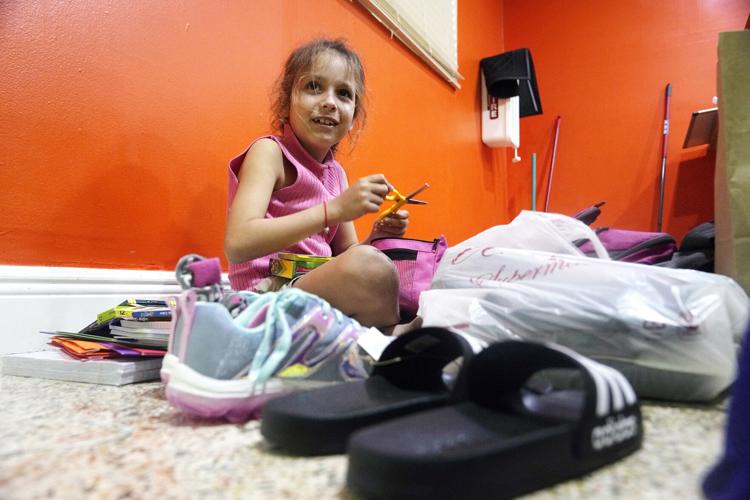
Delmis Benbow Tamayo, 8, finds a pair of children's scissors in some school supplies donated to her family Feb. 21 in Hialeah, Fla.
That underscores the potentially crucial role for faith leaders — to preach forgiveness and build a sense of shared experience.
"That's it — to unite," said the Rev. Elvis González, pastor at St. Michael the Archangel, a historically Cuban church that welcomes faithful from across Central America. "They have seen the church as the only institution that can give some hope."
A few miles south on the seashore stands La Ermita, a shrine dedicated to Our Lady of Charity that's long been a beacon for Cuban exiles.
Migrants from all over Latin America come to bring sunflowers to the Virgin, to cry in gratitude for having made it and to ask for help with food and clothing, said Sister Consuelo Gómez.

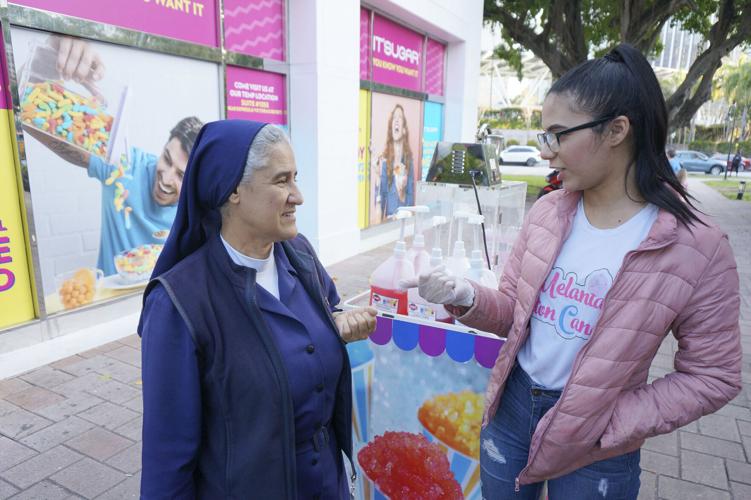
Sister Consuelo Gómez, left, talks with Daniela Valletero, a Venezuelan migrant that Gomez helped settle in her new U.S. life, Feb. 20 in Miami.
"Jesus also was a migrant," said Gómez, who helps many newcomers find jobs and decent housing, often with the aid of diaspora members. "We try to help so that they can get ahead on their own."
Outside the Ermita shrine, a couple stood under the palms, their homeland of Cuba some 200 miles across the sea. Roberto Sardiñas came seven years ago, and in December managed to get his wife, Dadiana Figueroa, to immigrate legally through family reunification.
Asked about the influx of new arrivals, Sardiñas said it would be selfish to argue anything but that "all who can come, let them come."
"The ideal would be that freedom existed in Cuba," Figueroa added.
Cities with the largest immigrant populations
Cities With the Largest Immigrant Populations

Photo Credit: spyarm / Shutterstock
With a foreign-born population of more than 44 million, the U.S. has the largest number of immigrants in the world. In fact, research from the Pew Research Center shows that the U.S. immigrant population accounts for one-fifth of the world’s migrants. While U.S. immigrants come from almost every country in the world, Mexico is the most common country of origin for the foreign-born population.
From the period of 1850 to 2020, when the most recent data is available, the foreign-born population share hit a high of 14.8% in 1900. From 1920 to 1980, the share of immigrants fell, dropping to a low of 4.7% in 1980. Until recently, the immigrant share of the population had been climbing and was at a near historic high in 2019 before the pandemic. The share of immigrants dropped slightly in 2020 to 13.5%, down from the 13.7% it had stood at for the last several years.
The US foreign born population share was at a near historic high before the pandemic

Accounting for 24.8% of the foreign-born population, Mexico claims the largest number of U.S. immigrants. The Chinese and Indian immigrant populations are also large, making up a collective 12.2% of the foreign-born population. Pew Research Center analysis of Census Bureau data shows that about one million immigrants arrive in the U.S. each year, and the most common region for new immigrants is now Asia, which recently surpassed Hispanic countries.
Mexican immigrants account for nearly 25 percent of the foreign born population

While immigrants live in every U.S. state, some parts of the country have larger foreign-born populations than others. Over one-fourth of California’s population is foreign-born—mostly coming from Mexico—making California the top state for immigrants. New Jersey and New York also have large immigrant populations, with 22.7% and 22.4% of their populations being immigrants, respectively. Alternatively, Montana and West Virginia have very small immigrant populations, accounting for just 2.2% and 1.6% of their populations, respectively.
More than a quarter of the California population is foreign born

To determine the U.S. metropolitan areas with the largest immigrant populations, researchers at BackgroundChecks.org analyzed the latest data from the U.S. Census Bureau. The researchers ranked metros according to the foreign-born population share. Researchers also calculated the most common country of origin, the total foreign-born population, and the total population.
To improve relevance, only metropolitan areas with at least 100,000 people were included in the analysis. Additionally, metro areas were grouped into the following cohorts based on population size:
- Small metros: 100,000–349,999
- Midsize metros: 350,000–999,999
- Large metros: more than 1,000,000
Here are the metros with the largest immigrant populations.
Small and midsize metros with the most immigrants

15. Sacramento-Roseville-Folsom, CA

Photo Credit: Andriy Blokhin / Shutterstock
- Foreign-born population share: 18.5%
- Most common country of origin: Mexico
- Total foreign-born population: 432,837
- Total population: 2,338,866
14. Dallas-Fort Worth-Arlington, TX

Photo Credit: f11photo / Shutterstock
- Foreign-born population share: 18.5%
- Most common country of origin: Mexico
- Total foreign-born population: 1,376,117
- Total population: 7,451,858
13. Orlando-Kissimmee-Sanford, FL

Photo Credit: Songquan Deng / Shutterstock
- Foreign-born population share: 18.8%
- Most common country of origin: Colombia
- Total foreign-born population: 481,158
- Total population: 2,560,260
12. Boston-Cambridge-Newton, MA-NH

Photo Credit: Travellaggio / Shutterstock
- Foreign-born population share: 18.9%
- Most common country of origin: China
- Total foreign-born population: 918,197
- Total population: 4,854,808
11. Seattle-Tacoma-Bellevue, WA

Photo Credit: mahaloshine / Shutterstock
- Foreign-born population share: 19.2%
- Most common country of origin: Mexico
- Total foreign-born population: 754,455
- Total population: 3,928,498
10. Riverside-San Bernardino-Ontario, CA

Photo Credit: Jon Bilous / Shutterstock
- Foreign-born population share: 21.1%
- Most common country of origin: Mexico
- Total foreign-born population: 970,476
- Total population: 4,600,396
9. Las Vegas-Henderson-Paradise, NV

Photo Credit: Virrage Images / Shutterstock
- Foreign-born population share: 22.1%
- Most common country of origin: Mexico
- Total foreign-born population: 492,617
- Total population: 2,228,866
8. Washington-Arlington-Alexandria, DC-VA-MD-WV

Photo Credit: ESB Professional / Shutterstock
- Foreign-born population share: 22.8%
- Most common country of origin: El Salvador
- Total foreign-born population: 1,425,904
- Total population: 6,250,309
7. San Diego-Chula Vista-Carlsbad, CA

Photo Credit: Sean Pavone / Shutterstock
- Foreign-born population share: 22.9%
- Most common country of origin: Mexico
- Total foreign-born population: 762,260
- Total population: 3,323,970
6. Houston-The Woodlands-Sugar Land, TX

Photo Credit: Tomas Simkus / Shutterstock
- Foreign-born population share: 23.3%
- Most common country of origin: Mexico
- Total foreign-born population: 1,623,239
- Total population: 6,979,613
5. New York-Newark-Jersey City, NY-NJ-PA

Photo Credit: Lukas Uher / Shutterstock
- Foreign-born population share: 29.3%
- Most common country of origin: Dominican Republic
- Total foreign-born population: 5,652,129
- Total population: 19,261,570
4. San Francisco-Oakland-Berkeley, CA

Photo Credit: yhelfman / Shutterstock
- Foreign-born population share: 30.7%
- Most common country of origin: China
- Total foreign-born population: 1,443,907
- Total population: 4,709,220
3. Los Angeles-Long Beach-Anaheim, CA

Photo Credit: Sean Pavone / Shutterstock
- Foreign-born population share: 32.7%
- Most common country of origin: Mexico
- Total foreign-born population: 4,325,660
- Total population: 13,211,027
2. San Jose-Sunnyvale-Santa Clara, CA

Photo Credit: thetahoeguy / Shutterstock
- Foreign-born population share: 39.1%
- Most common country of origin: China
- Total foreign-born population: 775,944
- Total population: 1,985,926
1. Miami-Fort Lauderdale-Pompano Beach, FL

Photo Credit: Just dance / Shutterstock
- Foreign-born population share: 40.9%
- Most common country of origin: Cuba
- Total foreign-born population: 2,504,666
- Total population: 6,129,858
Associated Press religion coverage receives support through the AP's collaboration with The Conversation US, with funding from Lilly Endowment Inc. The AP is solely responsible for this content.