

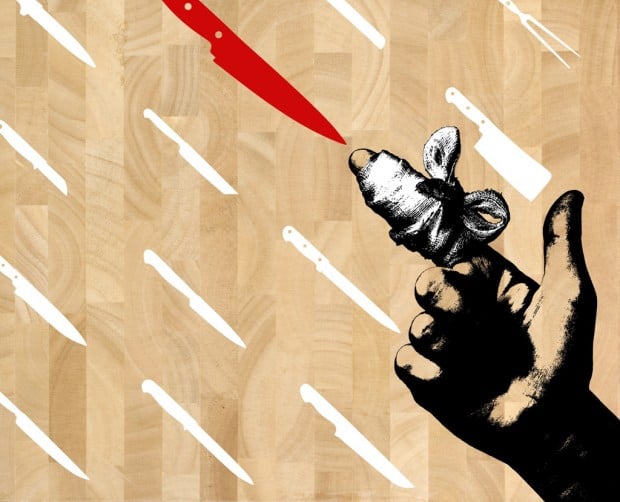
It happened so fast. I was frantically chopping and measuring last fall, testing a recipe for tamales for the Post's Food section, when I set my knife - my new, ultrasharp chef's knife - on the edge of a cutting board, which itself was perched at the edge of my kitchen counter. When I reached for some ingredient or another, I knocked the knife by the handle and it began to spin, and then to fall - off the board and off the counter.
I didn't try to catch it, I swear. I know the old kitchen-safety saying: "A falling knife has no handle." But I couldn't move out of the way fast enough. And before I knew it, I was clutching my right pinkie finger, pressing on a throbbing wound and holding my hand above my head to try to get the bleeding to stop. It wouldn't. The wound was deep, the pain was intense and the situation was clear. I needed to get to the ER, fast.
The kitchen is considered the most dangerous room in the house for good reason, and not just because of those knives. Ask any passionate cook to roll up her sleeves, and you're likely to see burn scars on arms that touched 400-degree oven racks, palms that grabbed sizzling pots without the protection of mitts, or fingers that were splattered by hot oil.
People are also reading…
Here are some ways to avoid cutting and burning yourself in the kitchen, and how to treat the injury if you do:
• Take a knife-skills class, offered by some cooking stores and schools, to get personalized training in the best way to hold a knife and to use it properly.
• Cut on a cutting board, not in your hand or on your lap or anywhere else. If the cutting board slides, put a wet dish towel under it to stabilize it.
• Cut away from, not toward, your body.
• When cutting food, first create a flat surface. That means carefully cutting an orange or an onion in half, then placing the flat side down on the cutting board before proceeding.
• Learn "the claw," a way of curling back the fingers of the hand that is holding the food as you cut it with the other.
• If a knife falls, do not try to catch it, and step away as quickly as you can.
• Don't use your knife to open a package; use scissors instead.
• Let frozen food thaw before trying to separate it with a knife. Freeze items individually so they're easier to separate in the future.
• Keep your knives sharp. Dull knives not only require more work, leading to more accidents, but wounds made with sharp knives heal better.
• If you cut yourself, use water, not alcohol or peroxide, to thoroughly clean the wound and prevent infection. Apply direct pressure to the cut, raise your hand above your heart to help stop the bleeding, and apply a sterile bandage. (Antibiotic ointments may help prevent infection but may also cause an allergic reaction.)
• Seek medical attention if the wound is gaping, won't stop bleeding or is particularly deep. If you think you need stitches, get to the hospital quickly, because time is of the essence to close the wound before it gets infected.
• To prevent burns, always use oven mitts, not makeshift items such as folded napkins, to handle hot pans.
• Use mitts when opening pots of boiling or steaming water, and open the lid away from you to let steam escape safely.
• Turn the handles of pots and pans toward the center of the stove - but not over a burner - so you can't accidentally touch them.
• If you burn yourself, cool the wound under cold water, but don't use ice, which can cause skin damage.
• Seek medical attention for any burns to the face and for other burns if they blister or if the pain cannot be controlled with over-the-counter medication.


