

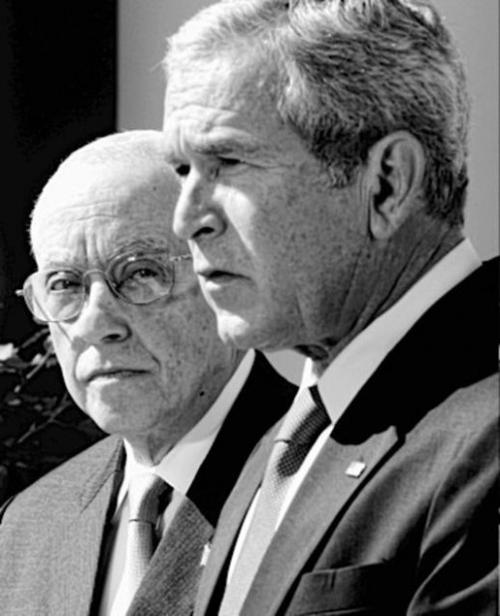
WASHINGTON — Three weeks ago, President Bush had never met former federal Judge Michael Mukasey, a sometimes-brusque New Yorker who had scolded his administration's Justice Department at least once.
On Monday, Bush made Mukasey his attorney general, turning to an outsider to lead the beleaguered department away from criticism that it has been too close to White House politics.
By nearly all accounts, Mukasey is a tough-on-terrorism jurist with an independent streak. If he's confirmed, he would replace Alberto Gonzales, Bush's longtime friend and fellow Texan who quit after months of senators' demands for his resignation and investigations that called his credibility into doubt.
The nomination was greeted Monday by congressional Democrats as a goodwill gesture with the potential to thaw some standoffs with the White House over executive privilege.
People are also reading…
Senate Judiciary Committee Chairman Patrick Leahy, D-Vt., had said earlier that he would not hold confirmation hearings until he received documents on prisoner interrogations and eavesdropping from the White House. But on Monday, Leahy reported that White House Counsel Fred Fielding had phoned with a new willingness to provide the information Leahy had demanded.
"They aren't going to agree to everything I've asked for but want to work out some (matters) where we can," Leahy said.
Sen. Chuck Schumer, D-N.Y., the White House's most vocal Senate critic, suddenly began speaking of optimism and hopefulness for the Justice Department.
"All of us want to look forward to straightening up things in the Justice Department and restoring rule of law in that very important department, rather than look back," he said.
Bush introduced Mukasey on Monday as "a tough but fair judge" and asked the Senate to confirm him quickly.
Mukasey, the former chief U.S. district judge in the Manhattan courthouse, was appointed to the bench in 1987 by President Ronald Reagan. Mukasey also worked for four years as a trial prosecutor in the U.S. Attorney's Office in New York's Southern District.
"The department faces challenges vastly different from those it faced when I was an assistant U.S. attorney 35 years ago," Mukasey, 66, said as he stood next to Bush on Monday. "But the principles that guide the department remain the same: to pursue justice by enforcing the law with unswerving fidelity to the Constitution."
Mukasey said that, if confirmed, he hopes to give Justice employees "the support and the leadership they deserve."
"I think that he'll not only provide the president with first-rate legal counsel, but this nomination will go through Congress without much, if any, partisan politicking," said Sen. Joseph Lieberman, I-Conn., who knew Mukasey at Yale Law School in the mid-1960s.
Mukasey oversaw some of the nation's most significant terror trials in the years before and after the attacks of Sept. 11, 2001.
He sentenced so-called "blind Sheik" Omar Abdel Rahman to life in prison for a plot to blow up New York City landmarks, and in 2002 he signed the material witness warrant that let the FBI arrest U.S. citizen Jose Padilla, who was convicted last month on terrorism-related charges.


